Control of Mustards in Wheat – Timely Treatment is Important
Mustard plants such as field pennycress, bushy wallflower (treacle mustard), flixweed, tansy mustard, and blue mustard in wheat fields are often not noticed until the mustards bloom in the spring (Figure 1). As a result, farmers may not think about control until that time. Although it is possible to get some control with spring herbicide applications, mustard control is much more effective before plants have flowered. Earlier applications are also more effective in preventing wheat yield loss due to mustard interference (Figure 2).
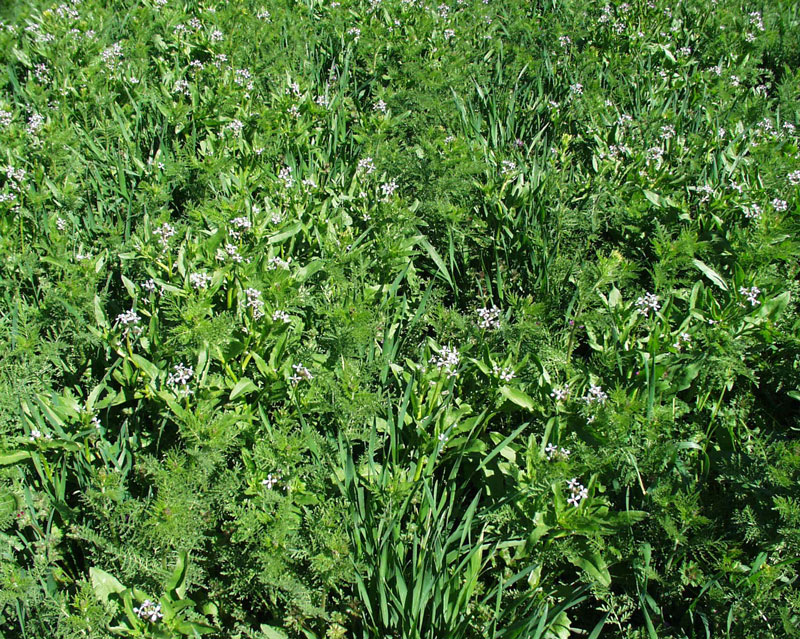
Figure 1. Flixweed and blue mustard growing in wheat. Photo by Patrick Geier, K-State Research and Extension.
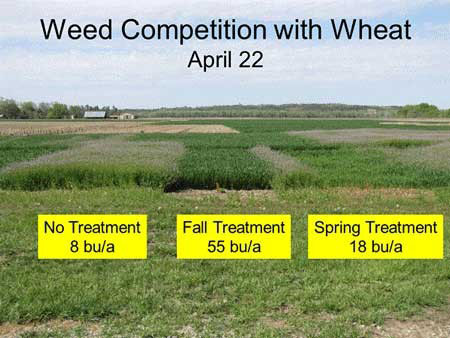
Figure 2. Effect of herbicide application timing on blue mustard control in wheat. Photos by Dallas Peterson, K-State Research and Extension.
Herbicide Options
- Group 2 herbicides: If mustards are present in the fall, they can be controlled by various active ingredients. Look for products containing Group 2 (ALS-inhibiting) herbicides such as chlorsulfuron (Glean, others), metsulfuron (Ally, others), triasulfuron (Amber, others), propoxycarbazone (Olympus, others), or pyroxsulam (PowerFlex, others), and premixes of thifensulfuron plus tribenuron (Affinity, others). Most ALS-inhibiting herbicides control winter annual mustards very well. However, there are populations of bushy wall flower and flixweed in Kansas that are ALS-resistant and cannot be controlled by these products. Alternative herbicides will be needed to control these populations. Also, be aware that some Group 2 herbicides have long rotation intervals for other crops.
- Group 27 herbicides: Group 27 (HPPD-inhibiting) herbicides like Huskie (pyrasulfotole) or Talinor (bicyclopyrone) can control ALS-resistant mustards. Both of these herbicides also contain bromoxynil to enhance the activity of the Group 27 herbicide.
- Group 4 herbicides: Other options to control ALS-resistant mustards are Group 4 (auxin-mimic) herbicides like 2,4-D and MCPA. Dicamba and fluroxypyr (Starane, others) are not very effective for mustard control. Quelex (halauxifen plus florasulam) and Tarzec (halauxifen plus pyroxsulam) are also labeled for control of some mustard species.
Note: The Group 27 and Group 4 herbicides listed above have little to no residual activity; thus, they will only control emerged weeds that are actively growing. Applying them with fertilizer in January or February when weeds are dormant will not provide good mustard control. In addition, special care should be taken to ensure wheat is fully tillered when 2,4-D is applied to avoid reducing tillering.
Application Timing for Troublesome Species
- Blue mustard is perhaps the most difficult of the winter annual broadleaf weeds to control in the late winter or early spring, because it bolts very early. To be effective on blue mustard, herbicides typically need to be applied by late February or early March. Blue mustard is more difficult to control than tansy mustard with 2,4-D because blue mustard has often already bolted by the time 2,4-D can be safely applied to wheat. Thus, 2,4-D is often applied too late to be effective on blue mustard.
- Flixweed and tansy mustard should be treated when they are no larger than 2 to 3 inches across and 2 to 3 inches tall. As these plants become larger, control decreases dramatically. Ester formulations of 2,4-D and MCPA are more effective on tansy mustard and flixweed than amine formulations.
- Field pennycress is easier to control than tansy mustard or flixweed. Herbicide applications made before the pennycress bolts are usually effective.
Non-Chemical Methods
Crop rotation with corn, grain sorghum, soybeans, cotton, or sunflowers is an effective way to manage mustards, provided they are controlled in the spring before they produce seed. Crop rotation will usually result in a gradual reduction in mustard populations over time as the soil seed bank decreases.
Prevention is also a helpful strategy for the long-term management of mustards. Managing mustards in roadsides and field borders can prevent movement into cultivated fields. Also, cleaning equipment when moving from infested to non-infested fields reduces mustard dispersal.
For additional information about the herbicides mentioned in this article, see the “2026 Chemical Weed Control for Field Crops, Pastures, and Noncropland” guide, K-State publication SRP-1194, or check with your local K-State Research and Extension office for a paper copy.
The use of trade names is for clarity to readers and does not imply endorsement of a particular product, nor does exclusion imply non-approval. Always consult the herbicide label for the most current use requirements.
Sarah Ganske, Weed Management Specialist
slancaster@ksu.edu
Jeremie Kouame, Weed Scientist, Agricultural Research Center – Hays
jkouame@ksu.edu
Patrick Geier, Weed Scientist – Southwest Research & Extension Center, Garden City
pgeier@ksu.edu