Fall Soil Testing of Hayfields and Pastures
Soil testing is the foundation of a sound fertility program for pastures and hayfields. Soil testing can be done in either spring or fall on hayfields and pastures; however, fall is generally preferred for a couple of reasons. Sampling in the fall allows time for lime applications to react before the next growing season and gives producers more flexibility in planning fertilizer applications.
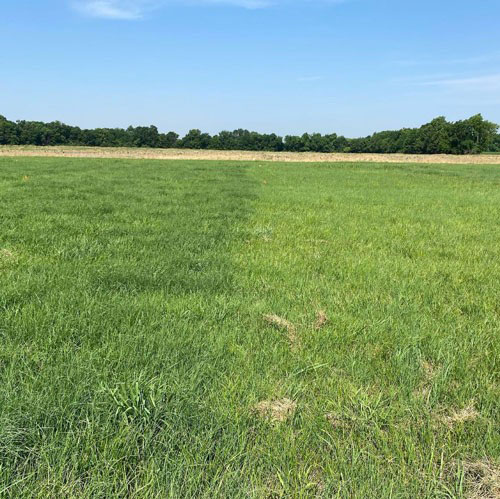
Figure 1. Fertility management effect in bermudagrass pastures. The left side of the pasture received an application of nitrogen fertilizer, while the right side did not. Photo credit: K-State Research and Extension.
Soil sampling is typically recommended at least every 3-4 years. More frequent sampling (every two years) can prevent over-application of fertilizer or manure and increase yields by revealing exactly which soil nutrients are too low for optimum productivity. This is especially valuable when fertilizer prices are high.
Collecting a representative soil sample
- Use a soil probe if possible (many county Extension or NRCS offices have probes available). A shovel or spade may also be used, but avoid “pointed” samples that over-represent the surface layer.
- Combine 15–20 cores into one composite sample for each uniform area (≤40 acres, or ≤10 acres in variable fields). Keep separate samples for areas with different crops, forages, or soil types. The goal is to capture variability within the fields.
- Avoid contamination by using clean equipment and containers.
Sampling depths
- pH evaluation: 3-4 inches
- mobile nutrients (nitrogen and sulfur): 24 inches
- Immobile nutrients (phosphorus and potassium): 6 inches
Why soil pH matters
Soil pH is one key soil property for forage production, especially with legumes. The optimal pH level is 6 to 7, depending on the forage species.
- Nutrient uptake can be reduced if the soil pH is too low or too high.
- Smooth brome grass and tall fescue perform best in the pH range of 6.0 – 7.5, but can handle pH down to 5.
- Legumes, especially alfalfa, require a near-neutral pH (~pH 7). A low soil pH reduces nodulation and nitrogen fixation in legumes, such as alfalfa and clover.
- Aluminum toxicity can occur at low soil pH.
If liming a new pasture, it is important to apply the lime 6 to 12 months before planting. Finer lime materials with a high effective calcium carbonate (ECC) value will react more quickly. Fields being prepared for alfalfa should also be evaluated for phosphorus and potassium, with any corrections made before planting. Sulfur and boron can also limit legume production, particularly in eastern Kansas.
Additional Resources
For more information on soil sampling and submitting samples to the K-State Soil Testing Laboratory, visit the K-State Soil Testing Laboratory at https://www.agronomy.k-state.edu/outreach-and-services/soil-testing-lab/.
You can also find practical soil sampling tips in these two recent eUpdate articles:
“Fall soil sampling: Sample collection and submission to the K-State Soil Testing Lab” https://www.agronomy.k-state.edu/eupdates/2026/issue-1123-october-1/fall-soil-sampling-and-submission-to-kstate-lab.html
“The challenge of collecting a representative soil sample” https://www.agronomy.k-state.edu/eupdates/2026/issue-1123-october-1/collecting-a-representative-soil-sample.html
A companion article in this eUpdate has more information on fall fertilization of smooth brome and tall fescue.
Dorivar Ruiz Diaz, Nutrient Management Specialist
ruizdiaz@ksu.edu
Cristie Preston, Sustainable Cropping Systems Agronomist – Parsons
clpreston@ksu.edu