The Challenge of Collecting a Representative Soil Sample
Collecting soil samples may seem straightforward, but variability within a field can make it difficult to obtain results that truly represent field conditions. Soil properties often differ due to natural soil formation, past management practices, or fertilizer applications. Because of this, a representative composite sample is essential for accurate test results and reliable fertilizer recommendations.
Preparing to sample
Before heading into the field to take the sample, be sure your objective is clearly in mind. Sampling protocols differ depending on the nutrient of interest (mobile N, S, Cl, or immobile P, K, Zn) and the scale of your sampling (whole field, zone, or grid). For instance, if all you want to learn is the average fertility level of a field to make a uniform maintenance application of phosphorus (P) or potassium (K), then the sampling approach would be different than grid sampling to develop a variable rate P application map.
In some cases, sampling procedures are predetermined and simply must be followed. For example:
- Soil tests may be required for compliance with nutrient management plans or for environmental regulations associated with confined animal feeding operations. Sampling procedures for regulatory compliance are set by the regulatory agency, and their sampling instructions must be followed exactly.
- Collecting grid samples for use with a spatial statistics package to produce nutrient maps may require sampling procedures specific to that program.
Regardless of the sampling objectives or requirements, some sampling practices should be followed.
Collecting soil samples
- Always take a composite sample of multiple cores:
- Collect 12–15 cores at a minimum (Figure 1). A single core is not an acceptable sample.
- For greater accuracy, take 20–30 cores from a relatively small area (2 – 4 acres).
- Increase the number of cores for larger fields, but not strictly in proportion to acreage.
- Keep sampling depth consistent:
- 6 inches for routine tests (pH, organic matter, P, K, Zn). See Figure 2.
- 24 inches for mobile nutrients (N, S, Cl).
- Split sample (0 to 3 inches and 3 to 6 inches) to assess pH and nutrient stratification in permanent sod or long-term no-till.
- Use a zigzag pattern when sampling across the field to avoid bias from tillage or fertilizer application patterns. With GPS, core locations can be recorded for consistent re-sampling.
- For grid sampling, collect cores within a 5–10 foot radius around each grid point.
- Avoid unusual areas such as old fencerows, low spots, or visibly different soil types. If information from these areas is needed, take a separate sample.
- Banded fertilizer application introduces more variability in soil test results. Sampling practices should be adjusted based on the spacing between bands and on whether the band locations are known or unknown.
- If the location of bands is KNOWN, then cores should be pulled from within the bands in proportion to the area of the field that bands occupy. The number of cores pulled from between bands is often calculated as: 8 x (Band spacing in inches/12)
- If the location of bands is UNKNOWN, then cores should be collected in pairs from random points across the field or zone. The distance between cores in each pair should be one-half the width of the band spacing.
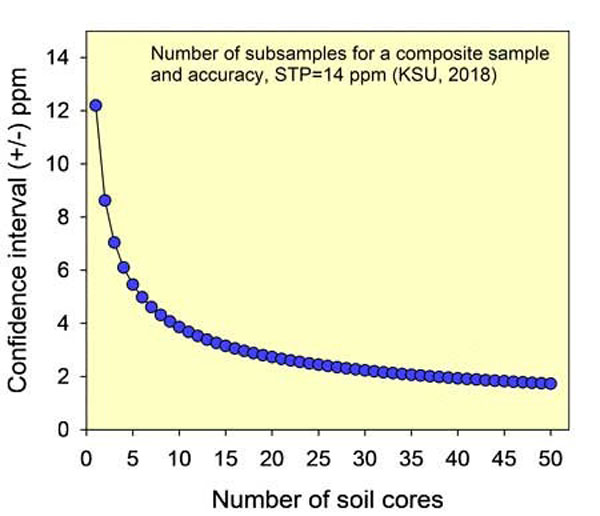
Figure 1. The level of accuracy of the results of a soil test will depend, in part, on how many subsamples were taken to create the composite sample. In general, a composite sample should consist of 15 or more subsamples. For better accuracy, 20-30 cores, or subsamples, should be taken and combined into a representative sample. Graph by Dorivar Ruiz Diaz, K-State Research and Extension.
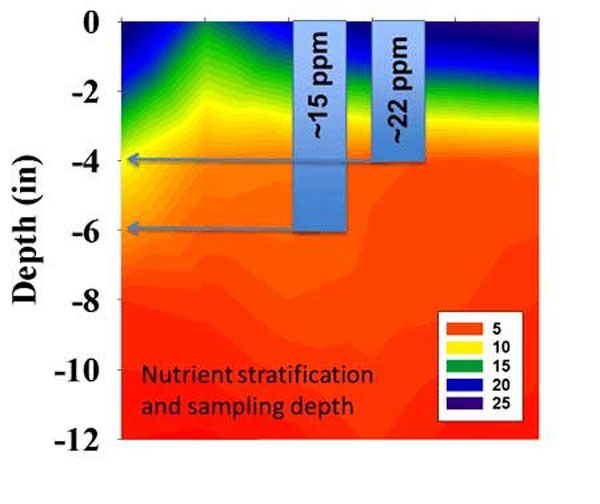
Figure 2. Consistency in sampling depth is particularly important for immobile nutrients like P. Stratification of nutrients and pH can be accentuated under reduced tillage. Image from Dorivar Ruiz Diaz, K-State Research and Extension.
Additional considerations
Soil test results for organic matter, pH, and non-mobile nutrients (P, K, and Zn) change relatively slowly over time, making it possible to monitor changes if soil samples are collected from the same field following the same sampling procedures. However, there can be seasonal variability and effects from previous crops. Therefore, soil samples should be collected at the same time of year and after the same crop.
After harvest in the fall is a good time to collect soil samples for the most limiting crop nutrients in Kansas.
Accurate soil tests are dependent on more than proper sampling techniques. Care should be taken regarding the handling/storage of soil samples before submission to a testing facility.
For instructions on submitting soil samples to the K-State Soil Testing Lab, please see the accompanying article “Fall soil sampling: Sample collection and submission to K-State Soil Testing Lab” found in this eUpdate issue.
Dorivar Ruiz Diaz, Nutrient Management Specialist
ruizdiaz@ksu.edu
Bryan Rutter, Soil Testing Lab Manager
rutter@ksu.edu
Peter Tomlinson, Environmental Quality Extension Specialist
ptomlin@ksu.edu