World of Weeds – Goosegrass
Goosegrass (Elusine indica), also called silver crabgrass, is commonly seen in late summer. As the alternative name implies, the seedhead of mature goosegrass could be confused with crabgrass species.
Ecology
Goosegrass is a summer annual grass native to South or East Asia that has spread worldwide. It is found throughout the United States, but is more common in the southeastern U.S. Goosegrass grows in fields, pastures, gardens, lawns, turfgrass, roadsides, and other areas. It tolerates short mowing heights, compaction, and drought, and thrives in over-fertilized areas. Goosegrass has been reported to produce cyanide, which would make the plants toxic to grazing animals
Identification
Goosegrass emerges with seedling leaves that open parallel to the ground, are about 3 to 5 times longer than they are wide. The leaf sheath is folded and has a white margin, distinguishing the plant from crabgrass species (Figure 1). Goosegrass has a short, toothed, membranous ligule and does not have auricles.
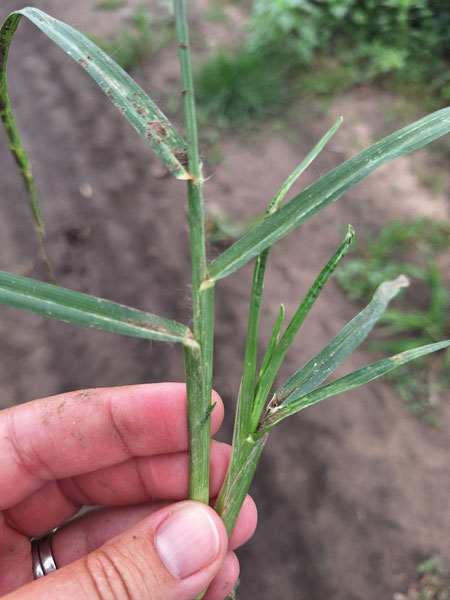
Figure 1. Goosegrass has flattened or folded leaf sheaths. Photo by Sarah Ganske, K-State Extension.
On mature plants, leaf blades are typically smooth on the top and the bottom, but may have a few long hairs near the base of the leaf (Figure 2). They have distinct veins and a distinct white midvein. Leaves grow up to about 14 inches long and 1/3 inch wide. The flattened leaf sheath retains the white margins and develops a white base.
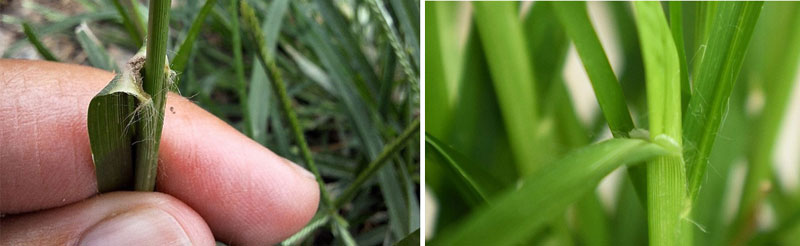
Figure 2. Goosegrass has a short, fringed membranous ligule and may have long hairs at the base of the leaf (left). The goosegrass ligule has a notch in the center (right). Photos by Sarah Ganske, K-State Extension.
Goosegrass typically grows in mats close to the ground, up to 3 feet wide. The white coloring at the base of the leaf sheath forms a white circle in the center of the mat (Figure 3). One way goosegrass can be distinguished from crabgrass species is that goosegrass does not root at the nodes. Like all grasses, it has a fibrous root system
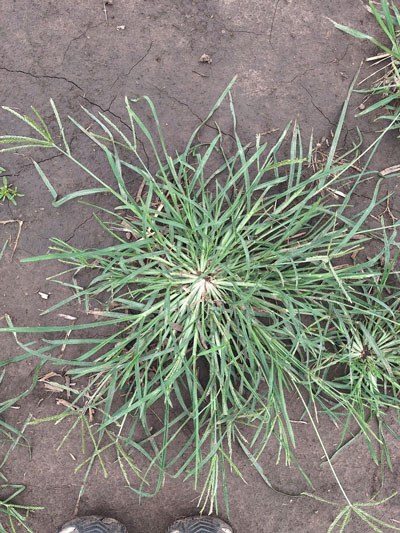
Figure 3. Goosegrass typically forms a mat with a center. Photo by Sarah Ganske, K-State Extension.
The seedhead has 2 to 13 spikes in a cluster at the top of the stem. Most spikes will come from a single point of attachment at the top of the plant, with one spike lower than the others (Figure 4). Each spike is about 1.5 to 6 inches long and contains two rows of flattened spikelets, attached to a central stalk (rachis) that is flat with white margins. Each spikelet has 3 to 6 seeds, with a single plant producing up to 140,000 seeds. Seeds are reddish brown to black and about 1.5 mm long.
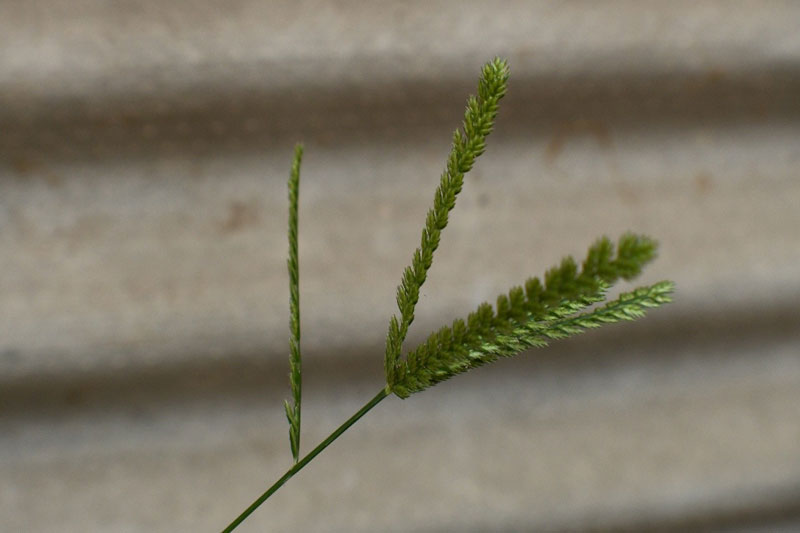
Figure 4. Goosegrass seed heads are comprised of multiple spikes attached at the end of the stem, plus a single spike attached below. Photo by Sarah Ganske, K-State Extension.
Management
Goosegrass management is generally more troublesome in turfgrass than in agronomic crops, although the first cases of resistance were reported in cotton from South Carolina. Goosegrass populations in the U.S. have developed resistance to herbicides in groups 1, 3, 5, and 14, as well as glyphosate and paraquat. Other countries have also reported resistance to group 2 herbicides and glufosinate.
Herbicides commonly used to manage goosegrass in agronomic crops include postemergence applications of glyphosate and Group 1 (ACCase-inhibiting) herbicides such as clethodim (Select, others) and quizalofop (Assure, others). In turfgrass, topramazone (Pylex) can also provide postemergence control. Preemergent applications of pendimethalin (Prowl, others) were historically used for goosegrass control, but sulfentrazone (Spartan, others), and Group 15 (VLCFA-inhibiting) herbicides like S-metolachlor (Dual, others), acetochlor (Harness, others), dimethenamid (Outlook), and pyroxasulfone (Zidua, others). In turfgrass, dithiopyr (Dimension, others), oxadiazon (Ronstar, others), or indaziflam (Specticle, others; warm-season grasses only) are also used.
As with all weeds, integrated weed management practices are recommended for excellent goosegrass control. Goosegrass seeds are relatively short-lived (less than 3 years) in the soil and only germinate from the surface, so deep tillage to bury seeds can be a management option. But shallow tillage increases germination, which could be used to deplete the soil seedbank. In addition, rotation to a winter cereal crop will suppress goosegrass.
The use of trade names is for clarity to readers and does not imply endorsement of a particular product, nor does exclusion imply non-approval. Always consult the herbicide label for the most current use requirements.
Sarah Ganske, Extension Weed Management Specialist
slancaster@ksu.edu