Management Considerations for No-Till Wheat Following a Summer Row Crop
With fall harvest progressing at earlier-than-normal rates and many row-crop acres chopped for silage, producers may consider planting wheat back into freshly harvested summer crop residue, especially if they receive some essential precipitation. While the current drought conditions offer significant challenges, there are additional considerations when seeding wheat immediately after the harvest of a summer crop. This article discusses several key management considerations to remember; a more detailed discussion on these can be found in the K-State publication MF-2641, Managing No-Till Wheat Following a Summer Crop in Eastern Kansas.
Variety Selection: If planting wheat after corn, adapted varieties with the best ratings for Fusarium head blight (scab) should be used. Due to moisture use by the previous summer crop, varieties with high levels of drought tolerance should be used. As wheat is generally planted later after a summer crop, varieties with good ratings for winter hardiness and late fall tillering should be selected. These ratings are available in the K-State publication MF991, Kansas Wheat Variety Guide 2026.
Planting Date: Wheat should be planted as soon as possible after harvest. Later planting dates shorten the window for forming fall tillers, which are more productive than spring-initiated tillers.
Seeding Rate: Seeding rates should be increased with delayed planting (Figure 1) or in challenging high-residue environments where adequate stand establishment may be difficult. As previously mentioned, delayed planting reduces the opportunity to initiate fall tillers, and increasing seeding rates can overcome some of that reduction.
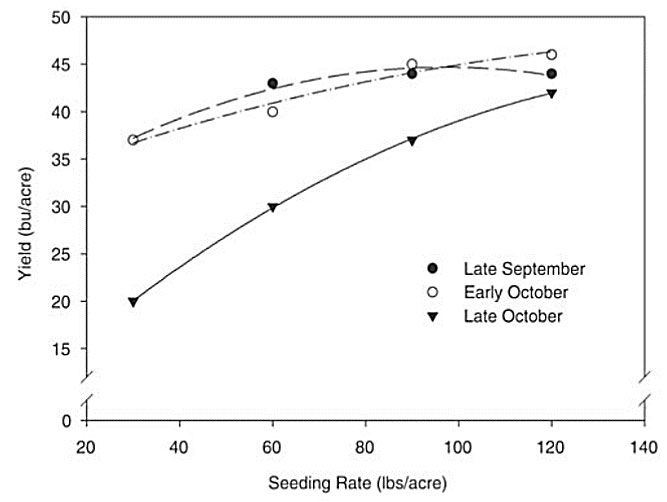
Figure 1. Wheat yield response to seeding rates as planting is delayed at the K-State North Central Experiment Field at Belleville. Source: K-State publication MF-2641, Managing No-Till Wheat Following a Summer Crop in Eastern Kansas.
Harvest Considerations: Evenly spreading crop residue at harvest is a key action that can positively affect the productivity of the subsequent wheat crop. Uneven distribution of the summer crop residue can make it difficult to maintain adequate depth of seed placement. It can also result in uneven nutrient availability, as areas with higher crop residue are likely to immobilize more nitrogen.
Seeding Equipment and Seeding Depth: Seeding to adequate depth in high-residue conditions is necessary to ensure healthy crown development, maintain access to sufficient soil moisture in drying conditions, and reduce the potential for winter injury. Producers should ensure their drill is set to achieve adequate depth in the thickest crop residue layers. Drills and air-seeders often require additional ballast (weight) to maintain adequate downforce to cut through residue and place seed at the target depth. Producers should use ground speeds that maximize seeding performance. Often, increasing ground speed aids in the flow of residue through the seeding tool. However, increasing speed also increases the ballast and downforce requirements necessary to achieve the target seeding depth.
Nutrient Management: Generally, higher rates of fall-applied nitrogen are necessary for wheat when planted after corn or sorghum. This is especially true after sorghum, which generally has residue with lower nitrogen content, making it more likely to immobilize available nitrogen. An additional 30 lb/ac of Nitrogen should be applied to wheat following grain sorghum or sunflowers, compared with other crops. Wheat planted after soybeans should not have its nitrogen application lowered relative to continuous wheat, as the organic nitrogen release from the soybean crop is likely to occur too late to benefit the wheat crop significantly.
Herbicide History: Producers should check the label of all products used in the preceding crop and their plant back restriction to wheat. Precipitation received since application can play a large role in the potential injury to the wheat crop from any residual herbicide.
Allelopathy: The potential effect of allelopathy of sorghum residue on wheat stand establishment and yield is often difficult to separate from nutrient availability and other potential yield-limiting factors. Concerns over allelopathy should not discourage producers from no-till planting wheat after grain sorghum when the aforementioned production concerns are addressed.
Grain sorghum termination and desiccation with glyphosate
While drought has or will accelerate maturity in most of the state, some producers interested in facilitating a timely sorghum harvest may consider applying glyphosate as a desiccant. Will this affect the standability or yield of the sorghum crop?
The answer to the question about standability is “yes”: applying glyphosate as a desiccant to sorghum can affect stalk quality and standability in some cases. Unlike corn, grain sorghum is a perennial plant and remains alive until a hard freeze kills it. Killing the plants before a freeze can affect the integrity of the stalks. Therefore, inspect the sorghum field for existing stalk issues before applying the glyphosate. If stalk rots are present, applying glyphosate may increase the risk of plant lodging if the crop is not harvested promptly.
The answer to the second question about the effect of a desiccant on sorghum yields is not as straightforward. It depends on the timing of the desiccant application.
Most glyphosate labels require that applications be made to the sorghum crop when grain moisture is at 30% or less to minimize any possible yield reductions. In addition, there is a seven-day period between application and harvest.
Sorghum response to pre-harvest glyphosate treatments
If glyphosate is applied at the correct time, K-State research in 2011 and 2012 by former Agronomy graduate student Josh Jennings found that using a desiccant did not affect sorghum yields.
From 2011 to 2013, he established six field trials to test the effect of pre-harvest glyphosate treatments on sorghum. Field trials were conducted at Belleville, Manhattan, and Ottawa from 2011 to 2012. From 2012 to 2013, field trials were conducted in Belleville, Manhattan, and Hutchinson (yield data were not collected in 2012).
Table 1 summarizes the effect of the pre-harvest treatments on grain sorghum. The response was similar in all harvested experiments, so the data below is averaged across the five field trials over the two years.
Table 1. Effect of pre-harvest glyphosate applications on grain sorghum (averaged across five sites in 2011 and 2012).
|
Observed Effect |
Glyphosate |
No glyphosate |
|
Yield (bu/acre) |
98 |
99 |
|
Grain moisture (%) |
12.1 |
12.3 |
|
Test weight (lbs/bu) |
60.4 |
60.2 |
|
Seed size (300 seeds, grams)* |
5.81 |
5.90 |
|
* 2011 only |
||
Glyphosate was applied to the sorghum crop when grain moisture was approximately 18-22%. Grain harvest occurred 8-11 days following the application. The average yield reduction in the sorghum crop when sprayed with glyphosate was about 1 bushel, or roughly 1%, less than in the untreated crop.
A potential question is whether the presence of aphids, headworms, or other insect pests in the head should affect the decision to use desiccants. There is no research on this, but by the time a desiccant is applied, grain filling is complete, and yield-reducing insect damage is unlikely. The presence of insects at this late stage of development should not influence the decision to use a desiccant.
Wheat response to pre-harvest glyphosate treatments to sorghum
In addition to getting the sorghum crop ready for harvest earlier than normal, desiccants can be helpful in cropping systems where wheat is planted directly after sorghum harvest. Killing the sorghum plants early can help save soil moisture for the wheat crop.
The research mentioned above also tested the effect of using a sorghum desiccant on the yield of wheat planted directly after sorghum harvest. Wheat yield responses varied across field trials over both years, so the data in Table 2 includes wheat yields within each field trial over both years of the experiment.
Table 2. Mean winter wheat yields following treated and untreated sorghum.
|
Location-Years |
|||
|
Sorghum pre-harvest treatment |
Belleville (2011-2012) |
Manhattan (2011-2012) |
Ottawa (2011-2012) |
|
Yield (bu/acre) |
|||
|
Glyphosate |
40 |
45 |
54 |
|
No glyphosate |
38 |
36 |
51 |
|
|
|||
|
|
Belleville (2012-2013) |
Manhattan (2012-2013) |
Hutchinson (2012-2013) |
|
Glyphosate |
39 |
51 |
34 |
|
No glyphosate |
38 |
49 |
35 |
Averaged over all three locations in 2011-2012, when glyphosate was applied to the sorghum pre-harvest, wheat yielded 12-13% more on average than wheat following untreated sorghum. This is equivalent to an average increase of about 5-6 bushels/acre. Averaged over all three locations in 2012-2013, wheat yields following grain sorghum treated with pre-harvest glyphosate were increased by only 1% or less than a bushel.
In 2011, glyphosate was applied, on average, 22 days earlier than glyphosate treatments in 2012. The first freeze date was also 12 days later in 2011 than in 2012. As a result, pre-harvest glyphosate applications were made, on average, 38 days before the first freeze in 2011 and only 6 days before the first freeze in 2012. A hard freeze soon after a pre-harvest glyphosate application to sorghum essentially negated its effect.
Summary
Using glyphosate as a preharvest desiccant on grain sorghum will reduce grain sorghum moisture and may allow producers to harvest the crop earlier than normal. However, care must be taken to ensure the crop is harvested promptly. If not, the desiccant could increase the potential for lodging. If applied at the proper time (after physiological maturity - formation of the black layer at the bottom of the sorghum grains), a desiccant will probably have little or no effect on sorghum yields.
Applying glyphosate to grain sorghum before fall harvest can also improve the performance of the following wheat crop when applied early in late summer/early fall. Wheat yields following glyphosate-treated grain sorghum, on average, were 6% greater in 2011-2012 compared to 2012-2013 when glyphosate treatments were made at least 38 days before the first freeze date. When pre-harvest glyphosate is applied to the grain sorghum crop, the response in wheat yields following treated sorghum may be minimal.
Lucas Haag, Agronomist at Tribune
lhaag@ksu.edu
Logan Simon, Southwest Area Agronomist
lsimon@ksu.edu