Options for Late Season Sericea Control
Sericea lespedeza (Lespedeza cuneata) is an invasive, perennial legume species distributed across central and eastern Kansas. At this point in the growing season, sericea plants are likely flowering or beginning to set seed (Figure 1). There are multiple control methods that can be used to reduce sericea abundance at this time of the year and can be even more effective when used in combination.
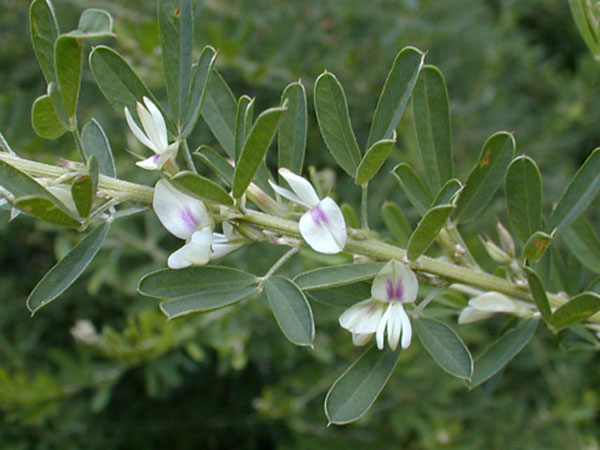
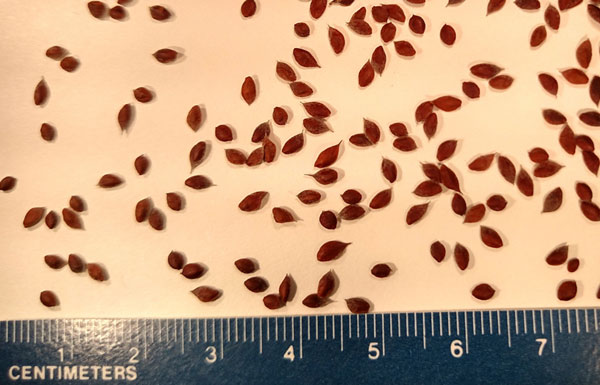
Figure 1. Sericea plant flowering with characteristic white flowers dotted with purple accents (top) and an example of sericea seed (bottom). Photo credit: Mike Haddock/Kansas Wildflowers & Grasses (top); Molly Reichenborn, K-State Extension (bottom).
Prescribed Fire
Research from K-State and Oklahoma State University has shown that prescribed fires in August and September are effective tools for sericea control. Prescribed burns at this time of year coincide with a vulnerable period in growth, when sericea plants are entering their reproductive cycle and, as we get closer to the dormant season, are moving carbohydrates into their roots. Sericea cover and seed production can be reduced with August and September burns as opposed to early-season spring burns, which can increase the germination of sericea seeds from the soil and ultimately increase your sericea cover if not combined with another control method to target new seedlings (e.g., herbicide application).
While prescribed burns during this time of year can be a useful tool for sericea control, the risk of limited vegetation regrowth increases as we approach the first fall freeze dates. Maintaining residual vegetation cover over the winter is important for protecting the soil surface from erosion and capturing precipitation until the following growing season. This risk is buffered in part due to the nature of growing season burns: summer vegetation has high water content, and will often burn incompletely in a patchy pattern on the landscape that leaves more residual vegetation than we would expect in a dormant season burn with dry, dormant vegetation. If vegetation is dry due to drought and/or available soil moisture is low (check out the K-State Mesonet Soil Moisture Map), the risk of low regrowth before first frost is higher, and prescribed burning should be considered carefully.
Sheep and Goat Grazing
Sheep and goats can tolerate the condensed tannins produced by sericea that deter cattle from grazing this species, and can be another tool for reducing sericea. Going into the fall, condensed tannin content in sericea starts to decline, and sheep and goats will more readily consume sericea, especially as other forage resources have already been consumed or become less palatable later in the growing season. In addition to reducing sericea cover, grazing sericea during this time of the year can also reduce seed production.
Herbicide Application
After sericea begins to bud and flower, herbicides containing triclopyr (e.g., Remedy, PastureGard) commonly used for early-summer control of sericea are expected to be less effective. Herbicides containing metsulfuron (e.g., Escort, Chaparral, others) are more effective during later stages of sericea growth during this time of year. Escort can be broadcast applied at 0.5 to 1 oz/acre or 1 oz/100 gallons with an adjuvant for spot spraying. Additional information on herbicide options for sericea control are available in K-State’s 2026 Chemical Weed Control Guide.
Combining Methods
Using multiple methods to control invasive plant species, such as sericea, is often more effective than using a single control method alone. If you remove sericea growth this season via burning, grazing, or another method (e.g., mowing, haying), following up with herbicide application can significantly increase your sericea control. Herbicide can be applied in the same year following a burn, grazing, or other removal treatment. Depending on growing season conditions and when the first frost falls, sericea plants may not have sufficient regrowth to adequately absorb and transport herbicide through their leaf tissue following a late-season burn, grazing, or other removal treatment. Herbicide applications in the next growing season can provide the benefit of a combined approach while allowing additional time for regrowth; however, so mark your calendars for an herbicide follow-up next year to build on your sericea control efforts this fall.
The use of trade names is for clarity to readers and does not imply endorsement of a particular product, nor does exclusion imply non-approval. Always consult the herbicide label for the most current use requirements.
Molly Reichenborn, Range Management Extension Specialist
mreichenborn@ksu.edu