Grain Sorghum Yield Components and Estimating Yield Potential
The time when farmers can start estimating sorghum yields is upon us. In the most recent USDA-NASS Kansas Crop Progress and Condition report (Aug. 30), sorghum in Kansas was 83% headed, 39% coloring, and 11% mature, which were all near or slightly behind average. Even though estimating crop yields before harvest can be difficult, these estimates are valuable to producers, as they help them make informed decisions about inputs and crop storage.
When can I start making sorghum yield estimates?
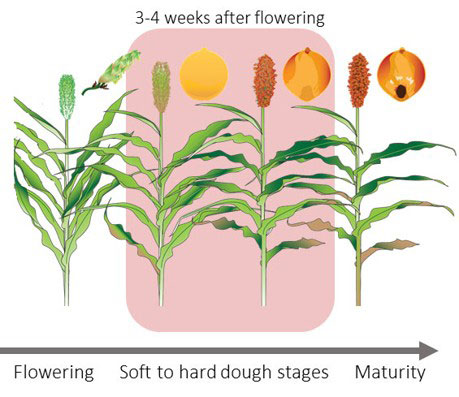
Figure 1. Sorghum flowering stages. Image credit: K-State Research and Extension.
As the sorghum crop approaches maturity, yield estimates will become more accurate. Nonetheless, we can start estimating yield three to four weeks after flowering (from soft to hard dough stages), though the final seed number can change. In addition to the seed number, the seed weight will be only partially determined – approximately 50 to 75% of dry mass accumulation as compared to the final weight attained at maturity.
Understanding sorghum yield components and management/environmental impacts
- Plants per acre, planting date: These affect the plant's ability to tiller. The more plants per acre, the less tillering. Earlier (mid-to-late May) planted sorghum tends to tiller more than later (mid-to-late June) planted sorghum.
- Environment, final head number, and size: Heat and drought stress will reduce the plant’s ability to tiller more and could severely reduce the tiller survival rate. The total number of seeds per head will be determined from 1 to 2 weeks before flowering through the milk-to-soft-dough stages (approximately 2 to 3 weeks after flowering).
- End-of-season seed size: Sorghum grains have already accumulated about 50% of the final dry mass during the soft dough stage (15-25 days post-flower). Thus, the period around flowering is critical for determining the final number of grains per head and the maximum potential kernel size. The final seed weight will be determined when the grains reach physiological maturity (as indicated by a “black layer” near the seed base). From this time until harvest, the grains will dry down from approximately 35% to 20% moisture content.
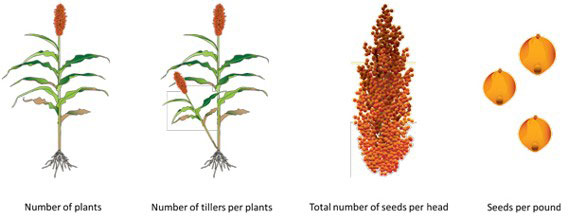
Figure 2. The four main components of sorghum yield are the number of plants, tillers, seeds per head, and seed size. Graphic by Ana P. Carcedo.
Variability within the field
The interaction among all four components will determine the final yield, but a wide range of variation is expected across these main yield-driving forces. When estimating sorghum yields using the “on-farm approach,” the variability between plants needs to be properly accounted for. Another important factor is the variation across different areas of the field, with yield estimates conducted in at least 5 to 10 sections.
On-farm approach for estimating sorghum yields
The sorghum yield estimates should consider these main driving forces:
- Total number of heads per unit area [number of plants per acre x heads per plant]
- Total number of seeds per head
- Number of seeds per pound
- Pounds per bushel, or test weight, which for sorghum is 56 lbs/bushel
Step 1. Number of heads per unit area
For this on-farm approach, start by counting the number of heads along a 17.4-foot length of row at 30-inch row spacing (this represents 1/1000th of an acre). As the rows become narrower, we count more rows. 15-inch rows would have two rows accounted for, while narrowing to 7.5-inch spacing requires four rows.
Take head counts in several different field areas to properly account for the potential yield variability. If the proportion of smaller heads (less than 3 inches in height) is very low (< 5%), then those heads could be excluded to reduce the proportion used in the final yield estimate.
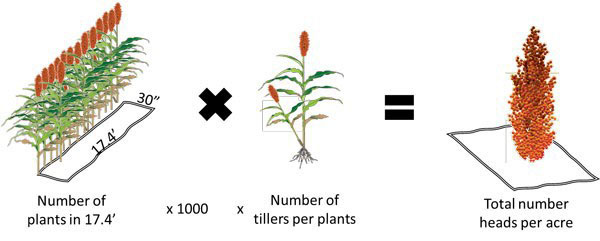
Figure 3. Calculating the total number of heads per acre.
Step 2. Estimating the number of seeds per head
The seed number is one of the most complicated yield components to estimate. The total number of seeds per head can range from 100 to 5,000, but most of the time it is around 1,500 to 2,500.
The method of estimating seed counts is summarized in Table 1.
- If conditions were very poor during pollination and grain set in a low-yielding environment, then the total number of seeds per head would average around 900 seeds per head.
- If conditions around flowering were very favorable in a high-yielding environment, then the number of seeds per head could be around 2,500.
- Intermediate yield-environment scenarios can occur if portions of the 3- to 4-week period around flowering were a mix of favorable and unfavorable conditions. In that case, the number of seeds per head could average around 1,745.
This information is provided only for general guidance on estimating sorghum yield potential using the on-farm approach.
Table 1. Total number of seeds per head and seed weight components.
|
Yield range (bu/acre) |
Crop condition |
Average seeds per head |
Average seed weight (g/1000) |
Number of observations |
|
<50 |
Very poor |
900 |
24.5 |
154 |
|
50-100 |
Poor |
1500 |
25.5 |
391 |
|
100-150 |
Fair |
2000 |
26.2 |
495 |
|
150-200 |
Good |
2500 |
25.6 |
129 |
|
>200 |
Excellent |
3330 |
25.5 |
5 |
Step 3. Estimating seed weight
A similar procedure can be followed to estimate the seed weight (Table 1). For the seed weight component, there is much less variation than in the seed number. Generally, lower seed weight is expected at low yield, but the differences among yield levels are negligible. Table 2 shows the conversion from average seed weight to seeds per pound.
Table 2. Seed weight, seeds per pound.
|
Yield range (bu/acre) |
Crop condition |
Average Seed weight (g/1000) |
Seeds per pound |
|
<50 |
Very poor |
24.5 |
18520 |
|
50-100 |
Poor |
25.5 |
17793 |
|
100-150 |
Fair |
26.2 |
17318 |
|
150-200 |
Good |
25.6 |
17723 |
|
>200 |
Excellent |
25.5 |
17793 |
Step 4. Final calculation using the “On-Farm” Yield Estimation Approach:
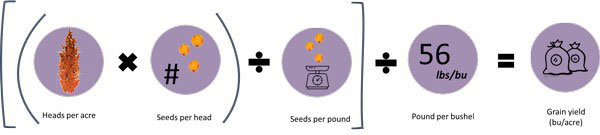
Example calculation for dryland sorghum in Kansas
Dryland sorghum with 45,000 heads/acre, fair flowering (2000 seeds/head), and fair grain filling (17,318 seeds/pound):
Yield Estimation = [(45,000 x 2,000) ÷ 17,318] ÷ 56 = 93 bu/acre
Logan Simon, Southwest Area Agronomist
lsimon@ksu.edu
Tina Sullivan, Northeast Area Agronomist
tsullivan@ksu.edu
Lucas Haag, Agronomist-in-Charge at Tribune
lhaag@ksu.edu
Jeanne Falk Jones, Northwest Area Agronomist
jfalkjones@ksu.edu