Alfalfa Management: Deciding When to Make the Final Cuts
In alfalfa production, the crop needs to winterize before dormancy and stops growing after the first hard freeze (< 26°F), which in Kansas occurs on average around October 15. However, in some years, frost can occur as early as October 1 or as late as November 1. The final cut decision should be weather-based at this time of the year because the timing of the last two cuttings impacts the winter survival and productivity of the stand in the following year.
Historical Viewpoint on Final Cut: Calendar Dates
The last cutting should be made based on expected crown regrowth rather than one-tenth bloom because of the decreasing photoperiod. The last cutting should be made when there is 8 to 12 inches of foliage, or 4 to 6 weeks of growth time, before the first killing frost to allow adequate time for replenishment of root reserves. This means the second-to-final cutting should occur around early September. As the days get cooler and shorter, drying final cutting hay in a timely manner can become risky. Though tempting to bale before it's properly dry, heat damage, mold, or spontaneous combustion fires occur commonly in fine-stemmed, high-quality, tightly packed bales. The additional factor of moisture makes the ideal environment for heat-producing microbes.
At this stage of the growing season, alfalfa plants need to store enough carbohydrates to survive the winter. If root reserves are not replenished adequately before the first killing freeze in the fall, the stand is more susceptible to winter damage than it would be normally. Winter damage can result in slower greenup and early growth next spring and, in some cases, stand loss due to winter kill. The potential of the alfalfa crop to grow new foliar tissue in the spring is greater with greater root reserves in the fall; thus, root reserves this fall are the main driver of the next crop’s yield and quality. Varieties are continually being selected for winter hardiness, but it is still important to manage varieties for the best success. Otherwise, spring growth can be reduced, and stand loss can occur.
The final cutting should occur right after the first killing freeze, before too many leaves have dropped. Producers should be prepared to enter the fields as soon as soil moisture conditions allow. After a killing freeze, the remaining forage (if any) can be hayed safely. However, the producer should act quickly because the leaves will soon drop off and lower the forage quality
A Calculated Approach to Final Cut: Growing Degree Day-Based
Based on research from Wisconsin and relying less on calendar days, since each year is different, researchers found that Growing Degree Days (GDD) are a more accurate method. Dr. Dan Undersander (University of Wisconsin) calculated winterkill risk, using GDD based on a 41°F base, accumulating until a killing frost of 24°F, with two GDD thresholds of importance: 500 and 200. If the weather promotes accumulating at least 500 base 41°F GDD after harvest, his research showed that there was sufficient time for alfalfa to winterize. When harvest occurred with under 200 GDD remaining, the alfalfa had too little season left to regrow, limiting the use of stored carbohydrates needed for winterization. With this, the numbers to remember are: greater than 500 is okay to cut; less than 200 is okay to cut; the danger zone is the accumulation between 200–500 GDD.
GDD calculations allow growers to consider their current weather patterns, forecasted weather patterns, and historical values for a more accurate decision-making tool for alfalfa. No matter the option – specific number of weeks before historical freeze or GDD – cutting timing for dry down must be considered.
The K-State Mesonet offers a free Degree Days tool. If you navigate to “Agriculture,” then to “Degree Days,” choose the closest station, and scroll down in the “Calculation” drop-down menu to “Custom.” There, users can change the Max, Min, and Base to match the explanation outlined above. Other GDD calculators are readily available on several websites through an internet search.
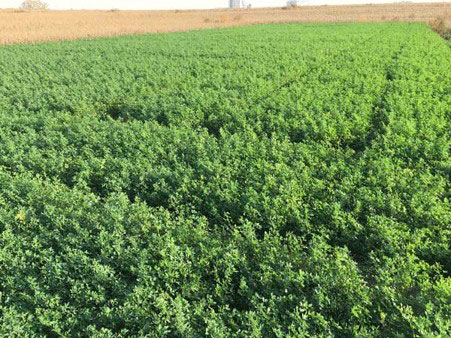
Figure 1. Alfalfa stand with approximately 12 inches of top growth prior to winter dormancy. The last cut in this stand was performed in early September, and this photo was taken in late October. This stand will be hayed immediately following the first killing frost. Photo by Romulo Lollato, K-State Research and Extension.
Consider Soil Sampling Alfalfa Fields Now
Late fall is also a great time to collect soil samples from alfalfa fields. This timing allows for an accurate assessment of available soil nutrients and provides enough time to make nutrient management decisions before the crop breaks dormancy in the spring. Key soil tests include pH, phosphorus, and potassium, and to a lesser extent, sulfur and boron. Potassium and winter survival are interrelated, resulting in having plant available potassium in an optimum range before winter is important. Kansas soils are commonly high in soil K values, but alfalfa is a K-demanding crop with each ton removing 60 lbs of K2O. When sampling for immobile nutrients, the sampling depth should be six inches, while mobile nutrients (sulfur) should be sampled to 24 inches. Based on the soil test, a fertility program can be established to ensure nutrient replenishment and maintain productivity.
To submit soil samples to the K-State Research and Extension Soil Testing Laboratory, see this website: https://www.agronomy.k-state.edu/outreach-and-services/soil-testing-lab/.
Tina Sullivan, Northeast Area Agronomist
tsullivan@ksu.edu
John Holman, Cropping Systems Agronomist, Southwest Research-Extension Center
jholman@ksu.edu
Romulo Lollato, Wheat and Forages Specialist
lollato@ksu.edu