Final Irrigation of the Growing Season - Timing is Everything
Rain events across the state have been highly variable this year, resulting in some irrigators being ahead on crop needs while others are employing deficit irrigation strategies. As we look towards the end of the irrigation season, producers can improve their water productivity by properly timing their final irrigation application. Early termination of irrigation can result in reduced grain yield, mainly due to reduced kernel weight. Conversely, late irrigation termination results in increased pumping and energy consumption, soil compaction risks at harvest due to increased soil water content, and the risk of losing water to drainage from the soil profile over the winter
Understanding crop water-use requirements late in the growing season ensures we meet those needs without over-irrigating. Table 1 shows anticipated water use for corn, grain sorghum, soybeans, and dry beans from various growth stages to physiological maturity. This total water use can come from seasonal precipitation, applied irrigation, and stored soil water.
Table 1. Anticipated water use for corn, grain sorghum, soybeans, and dry beans at various growth stages.
|
Crop Stage |
Growth stage |
Approximate days to maturity |
Water use to maturity (inches) |
|
Corn |
|||
|
|
Blister |
45 |
10.5 |
|
R4 |
Dough |
34 |
7.5 |
|
R4.7 |
Beginning dent |
24 |
5 |
|
R5 Progression |
½ Milk Line or Full dent |
13 |
2.5 |
|
R6 |
Black layer |
0 |
0 |
|
Grain sorghum |
|||
|
GS6 |
Mid-bloom |
34 |
9 |
|
GS7 |
Soft dough |
23 |
5 |
|
GS8 |
Hard dough |
12 |
2 |
|
GS9 |
Black layer |
0 |
0 |
|
Soybeans |
|||
|
R4 |
Full pod |
37 |
9 |
|
R5 |
Beginning seed |
29 |
6.5 |
|
R6 |
Full seed |
17 |
3.5 |
|
R6.5 |
Yellowing Leaves |
10 |
1.9 |
|
R7 |
Full maturity |
0 |
0 |
|
Dry Beans |
|||
|
R5 |
Early seed fill |
35 |
7.0 |
|
R6 |
Mid-seed fill |
25 |
4.2 |
|
R7 |
Beginning maturity |
15 |
2.0 |
|
R8 |
Harvest maturity |
0 |
0 |
Corn, sorghum, and soybean data adapted from K-State MF2174, Rogers and Sothers. Dry beans data adapted from University of Nebraska-Lincoln, NebGuide G1871.
Western Kansas research has shown the importance of keeping the management allowable depletion (MAD) limited to 45% during the post-tassel period or maintaining available soil water contents above 55%. By knowing the anticipated water use for a given growth stage and the remaining soil water in the profile, producers can apply just enough irrigation water to meet that demand and maintain available soil water content in the profile above 55%, while adjusting for any precipitation that may be received.
End-of-season soil moisture measurements are critical for meeting this target. Irrigators can use a soil probe to assess the appearance and feel of the soil to estimate soil water (L795 Soil Water Measurements: An Aid to Irrigation Water Management. Irrigation Management Series) or one of the soil water sensors on the market (Tips on Selecting a Soil Water Sensor).
By closely following the crop growth and development, one can know when physiological maturity has been reached, i.e., the black layer in corn or sorghum. Physiological maturity means the crop water needs for grain production have ceased, and additional irrigation will not increase yield.
Termination Based on Calendar Date
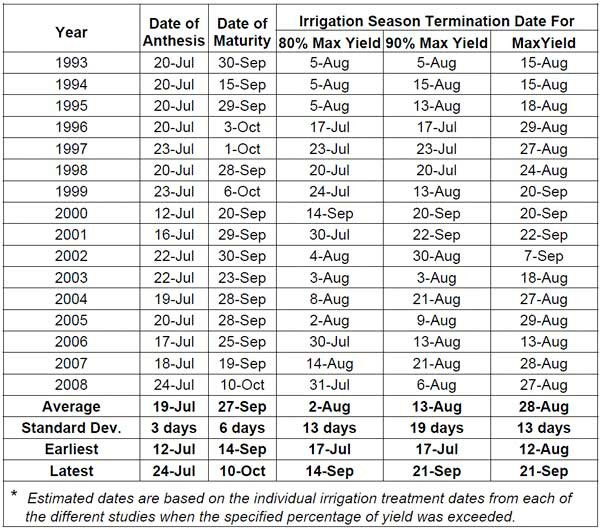
Traditionally, many producers have used a fixed calendar date to determine their final irrigation. Long-term studies conducted by Freddie Lamm at the Northwest Research-Extension Center at Colby show the potential problems in this approach. Table 2 shows the silking, maturity, and irrigation termination dates for a long-term corn study. For this study, the irrigation termination date for maximum grain yield varied from August 12 to September 21. This is a significant departure from the general rule of thumb using Labor Day as a termination date. As shown, using a fixed date on the calendar without regard to crop progress, soil water status, or ET demand would have resulted in both forfeited yield and wasteful pumping across this timeframe.
Table 2. Silking, maturity, and irrigation termination dates for a long-term corn study.
Consequences of Excess Late-Season Irrigation
In the silt-loam soils common in western Kansas, drainage from the soil profile begins when the soil water content exceeds 60% of available soil water. The rate of drainage loss increases rapidly with increasing water content. Late-season irrigation in excess of crop water use results in increased water accumulation in the profile, which is subject to drainage losses. A survey of irrigated corn fields was conducted in 2010 and 2011 (Figure 1). Fields were surveyed after corn harvest across three east-west transects in western Kansas.
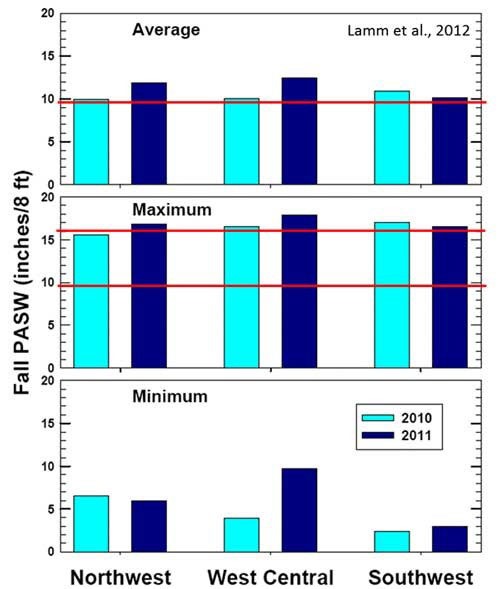
Figure 1. Results from a 2-year survey of irrigated corn fields. Fields were surveyed after harvest across three east-west transects in western KS.
The line at 9.6 inches of plant-available soil water (PASW) denotes the approximate water content at which drainage losses would begin. On average, most producer fields were near this level of soil water storage, indicating a good management strategy as drainage losses had been minimized while maintaining adequate soil water to complete grain fill.
Producer fields near the minimum observed values likely lacked sufficient soil moisture to achieve maximum grain yields. The most concerning scenario, however, is the fields at the upper end of soil water values, such as the maximum observation. The red line at 16 inches PASW represents field capacity, the point at which free drainage and significant water losses from the profile would occur. In the wettest producer fields, in all three regions, significant amounts of free drainage and water loss would have been occurring at the time of crop maturation and harvest.
Key Points for Timing the Final Irrigation
- Determine crop growth stage and anticipated remaining water use
- Determine soil water status in the field by probe or calibrated soil sensor technology
- Determine the irrigation strategy necessary to meet the remaining crop water use while maintaining soil water content at or above 55% (limit depletion to 45%).
- Be ready to make adjustments based on changes in ET demand, precipitation, and other factors.
Additional information, including a step-by-step procedure, can be found in the publication MF2174: “Predicting the final irrigation for corn, grain sorghum, and soybeans” - http://www.bookstore.ksre.ksu.edu/pubs/MF2174.pdf
Special Note: Much of the data in this article was collected by Freddie Lamm, Irrigation Engineer at the Northwest Research-Extension Center at Colby. Freddie passed away in May 2022, just months short of completing his 43rd year of irrigation research at the NWREC. A tribute to Freddie’s career can be found at: https://newprairiepress.org/cgi/viewcontent.cgi?article=8336&context=kaesrr
Lucas Haag, Agronomist-in-charge – Tribune
lhaag@ksu.edu
Tina Sullivan, Northeast Area Agronomist
tsullivan@ksu.edu