Summer Weed Control Options in Smooth Bromegrass Hayfields and Pastures
Questions are arising regarding weed management in smooth bromegrass pastures and hay meadows. The smooth bromegrass stands in many of these fields were damaged by fall armyworm infestations in the recent past. These thin stands, coupled with good growing conditions for summer annual weeds, have resulted in weed infestations that need to be addressed if the bromegrass is to recover or be reseeded this fall (Figure 1). Herbicides labeled for use in smooth bromegrass are described in Table 1.
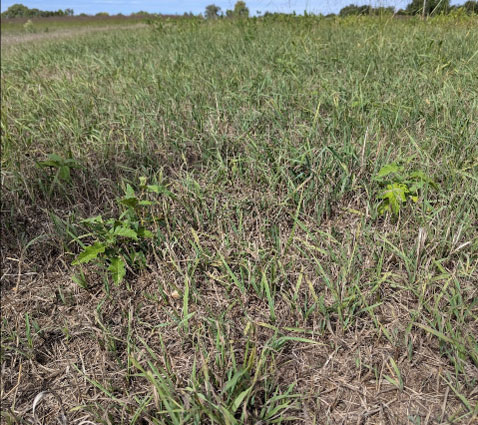
Figure 1. Broadleaf weed horsenettle encroaching into a fall armyworm-damaged smooth brome hayfield in Jackson County. Photo by Tina Sullivan, K-State Extension.
Actively growing summer annual weeds that have not yet produced seed can be controlled now by timely herbicide applications. Examples of these species include common ragweed or common sunflower. Herbicides that include 2,4-D, dicamba, aminopyralid (Milestone, others), or metsulfuron (Escort, others) could be considered for these applications.
If annual grassy weeds, such as weedy bromes, foxtail species, or large crabgrass, have already set seed, waiting until next spring may actually be the most cost-effective strategy, as a herbicide application now will do little to control these unwanted species. Herbicides such as quinclorac (Facet, others) can be used to control foxtails or crabgrass if applied when seedlings are about 2 inches tall. An application of pendimethalin (Prowl H2O, others) can also be effective if applied prior to germination. Weedy bromes are more challenging. There is some evidence that aminopyralid (Milestone, others) will suppress seed production when applied to downy brome between the seedling and boot growth stages.
Perennial weeds may be controlled with late-summer applications, but in some cases, the best time for application may have passed. For example, hemp dogbane is best controlled by applications of fluroxypyr (Vista, others) before the bud stage.
Factors to Consider
There are a couple of points to keep in mind, regardless of the target weed species and herbicide application timing.
- First, know the future plans for the area. If the area might be reseeded in the future, it is important to understand the planting interval between herbicide application and seeding.
- Second, ensure good herbicide contact with the target weed or, in the case of residual herbicides, the soil. Haying the area before making herbicide applications can help by removing forage biomass to increase herbicide deposition on the target.
Table 1. Herbicides labeled for post-emergence weed control in smooth bromegrass. Consult the label for the appropriate rate and adjuvant selection.
|
Herbicide |
Active ingredient |
Weeds controlled |
Growth stage restriction |
Plant-back interval |
Smooth brome suppression |
|
2,4-D |
2,4-D |
Broadleaf |
After 6-leaf stage |
30 days |
Unlikely |
|
Amber |
Triasulfuron |
Broadleaf |
60 days after emergence |
4 months |
Unlikey |
|
Chaparral |
Metsulfuron + aminopyralid |
Broadleaf |
None |
1 year |
Likely |
|
Cimarron Plus |
Metsulfuron + chlorsulfuron |
Broadleaf |
6 months after seeding |
2 months |
Likely |
|
Clarity, others |
Dicamba |
Broadleaf |
None |
45 days per 16 fl oz/A |
May be injured with > 16 fl oz/A |
|
Crossbow |
2,4-D + triclopyr |
Broadleaf |
None |
3 weeks |
Possible |
|
DuraCor |
Aminopyralid + florpyrauxifen |
Broadleaf |
None |
45 days |
Likely |
|
Escort, others |
Metsulfuron |
Broadleaf |
6 months after seeding |
2 to 4 months |
Likely |
|
Facet, others |
Quinclorac |
Grass/broadleaf |
None |
10 months |
Unlikely |
|
Grazon P+D |
Picloram + 2,4-D |
Broadleaf |
None |
60 days |
Likely |
|
GrazonNext HL |
Aminopyralid + 2,4-D |
Broadleaf |
No |
Grasses may be reseeded in the fall after a spring or early summer application |
Likely |
|
Milestone |
Aminopyralid |
Broadleaf |
No |
1 year |
Likely |
|
PastureGard HL |
Triclopyr + fluroxypyr |
Broadleaf |
After tillering |
3 weeks |
Possible |
|
Plateau, others |
Imazapic |
Grass/broadleaf |
No |
26-36 months |
Likely |
|
Range Star |
2,4-D + dicamba |
Broadleaf |
> 6 leaves |
3 weeks per quart |
Possible |
|
Rave |
Triasulfuron + dicamba |
Broadleaf |
60 days after emergence |
4 months |
Possible |
|
Remedy Ultra, others |
Triclopyr |
Broadleaf |
No |
3 weeks |
Possible |
|
Tordon 22K |
Picloram |
Broadleaf |
After tillering |
Grasses may be reseeded in the fall after a spring or early summer application |
Likely at rates > 1 qt/A |
|
Yukon |
Dicamba + halosulfuron |
Broadleaf |
No |
2 months |
Possible |
Always consult current herbicide labels and the 2026 Chemical Weed Control for Field Crops, Pastures, Rangeland, and Noncropland guide before making application decisions (https://www.bookstore.ksre.ksu.edu/pubs/CHEMWEEDGUIDE.pdf ).
The use of trade names is for clarity to readers and does not imply endorsement of a particular product, nor does exclusion imply non-approval. Always consult the herbicide label for the most current use requirements. Users should read and follow all label directions.
Sarah Ganske, Weed Management Specialist
slancaster@ksu.edu
Molly Reichenborn, Range Management Specialist
mreichenborn@ksu.edu
Tina Sullivan, Northeast Area Agronomist
tsullivan@ksu.edu