Estimating Corn Yield Potential Using the Yield Component Method
Many Kansas corn fields are in reproductive stages (or are close to flowering in late-planted fields), so it is time to assess grain yield potential. As of July 19, corn silking was 61%, near 60% for both last year and the five-year average. Dough was 26%, near 22% last year, and ahead of 18% average.
Successful pollination is a critical aspect that farmers can evaluate by examining ear silks. When conditions favor synchrony between the pollen shed by the tassels and the silks, the exposed silks should turn brown and easily separate from the ear when the husks are removed.
Corn Flowering
Water stress around flowering time (R1, http://www.bookstore.ksre.ksu.edu/pubs/MF3305.pdf) will negatively impact pollination due to a lack of synchrony between pollen release and silk emergence, a process that requires substantial water. Heat stress around flowering will mainly impact the pollen viability. , under Kansas dryland conditions, water and heat stress happen together. Unsuccessfully pollinated silks remain green, possibly growing several inches long, looking for pollen (Figure 1). Unpollinated silks will also be connected securely to the ovaries (the undeveloped kernels) when the husks are removed.
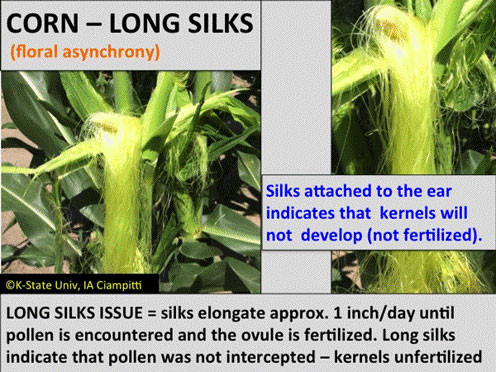
Figure 1. Long silks primarily reflect floral asynchrony. Silks that are not successfully pollinated will remain green. Infographic by I. Ciampitti.
Corn Yield Potential Estimation
Once pollination is complete or near completion, farmers could begin to estimate corn yield potential. To obtain a reasonable estimate, corn should be at least in the milk stage (R3). Corn can move quickly from silking to milk stage. Before the milk stage, since grain abortion is still possible under stress conditions (mainly due to drought and/or heat stresses), it is difficult to tell which kernels will develop and which ones will abort.
To estimate yields, we can use the yield component method (Figure 2). This approach uses a combination of known and projected yield components. It is considered “potential” yield because one of the critical yield components, kernel size, remains unknown until physiological maturity or black layer (R6). Therefore, we can only make an estimate of predicted yield based on expected conditions during the grain filling period (e.g., favorable, average, or poor).
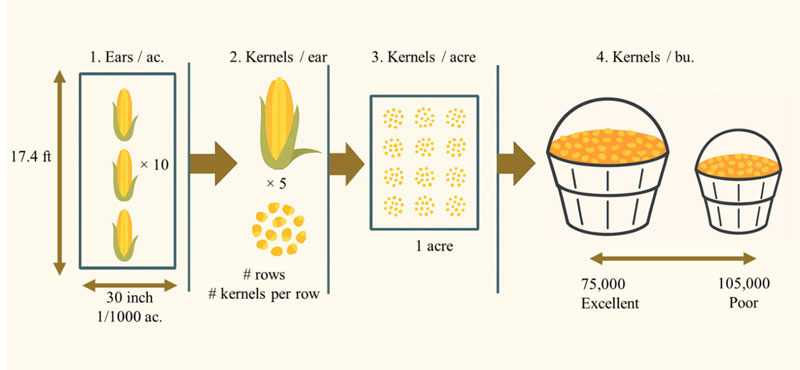
Figure 2. Example of corn yield estimation under the “yield components method”. Graphic by Tina Sullivan, K-State Extension.
Steps to estimate corn yield using yield components:
Step 1. Ears per acre via ear count in a known area, [Figure 2, step 1]
- With 30-inch rows, 17.4 feet of row = 1,000th of an acre. The number of ears in 17.4 feet of row x 1,000 = the number of ears per acre. Counting a longer row length is fine, just be sure to convert it to the correct portion of an acre when determining the number of ears per acre.
- Make ear counts in 10 to 15 representative parts of the field or management zones to get a good average estimate. The more ear counts you make (assuming they accurately represent the field or zone of interest), the more confidence you have in the yield estimate.
- Example: (25 + 24 + 25 + 21 + 24 + 26 + 23 + 21 + 25 + 23)/10 = 23.6 ears. Scaling up to an acre: 23.6 x 1,000 = 23,600 ears per acre.
Step 2. Kernels per ear, [Figure 2, step 2]
- There are two sub-components of kernels per ear: (i) the number of rows per ear and (ii) the number of kernels within each row. Most likely, the number of rows will be around 16, and ears always keep an even number of rows.
- The number of kernels per row depends on multiple factors, starting from the hybrid, but mainly on the growing conditions around flowering.
- To arrive at kernels per ear, multiply the two sub-components (number of rows x kernels per row).
- Note: do not count aborted kernels or the kernels on the butt of the ear; count only kernels that are in complete rings around the ear. Do this for every 5th or 6th plant in each of your ear count areas. Avoid odd, non-representative ears.
- Counting 5 ears from each 17.4-foot area had an average of 16 rows and 27 kernels per row: 16 x 27 = 432 kernels per ear
Step 3. Kernels per acre = Ears per acre x kernels per ear, [Figure 2, step 3]
- 23,600 ears per acre x 432 kernels per ear = 10,195,000 kernels per acre
Step 4. Kernels per bushel, [Figure 2, step 4].
- This must be estimated until the plants reach physiological maturity.
- Common values range:
- Excellent: 75,000 to 80,000 for excellent
- Average:85,000 to 90,000
- Poor: 95,000 to 105,000
- At this point, the best you can do is estimate a range of potential yields depending on expectations for the rest of the season.
- Example: Under a scenario of temperatures above 100°F for the next 7-14 days and lack of rains (and if these conditions persist), it might be more than reasonable to assume below-average grain-filling conditions producing overall medium to small kernels. Based on the projected weather, a reasonable value might be 100,000 kernels per bushel. Note - this is just an example value for this scenario.
Step 5. Bushels per acre:
- 10,195,000 kernels per acre ÷ 100,000 kernels per bushel ~ 102 bushels per acre
Final Considerations
If these estimates are close to correct, the example field used here is probably worth taking to grain harvest. Past experience indicates that this method of estimating yield usually provides somewhat optimistic estimates. Please consider these points when doing these field estimations.
Tina Sullivan, Northeast Area Agronomist
tsullivan@ksu.edu
Logan Simon, Southwest Area Agronomist
lsimon@ksu.edu
Lucas Haag, Northwest Area Agronomist
lsimon@ksu.edu