Control Options for Warm-Season Perennial Grasses
Grass species such as tumble windmillgrass, tumblegrass, and purple three-awn are challenging to control when they have established a perennial stand. There is little information available for the control of tumblegrass or purple three-awn. However, previous research showed that tumble windmillgrass can be controlled with timely, proactive preemergence and postemergence herbicide programs applied to seedlings through the tillering stage.
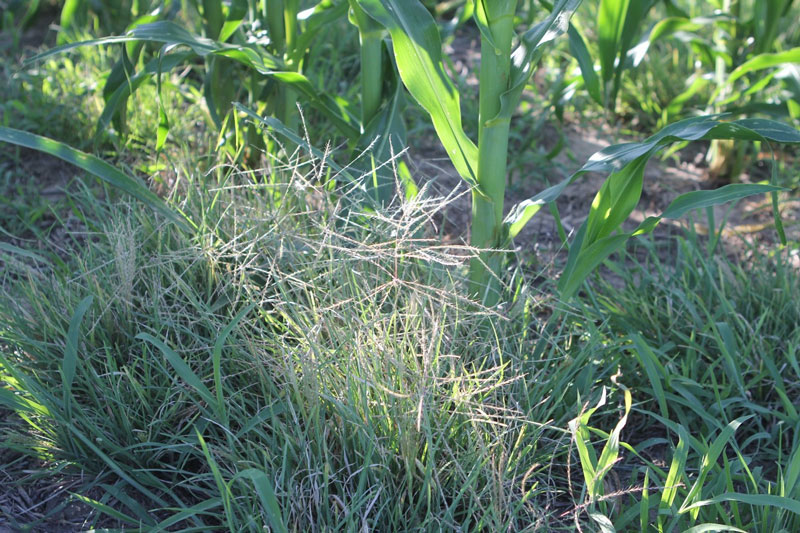
Figure 1. Tumble windmillgrass plants growing in a corn field. Photo by Jeremie Kouame, K-State Extension
Control improves when seedlings and plants are sprayed at the tillering stage
Previous greenhouse research (early 2000s) showed that four weeks after treatment (4 WAT), Poast, Select Max, and Assure controlled100% of tumble windmillgrass when applied to 2- to 4-inch tall seedlings, and control was greater than 90% injury when plants were tillering (5 to 10 tillers per plant) (Figure 2). Tumble windmillgrass injury increased as the rate of glyphosate increased.
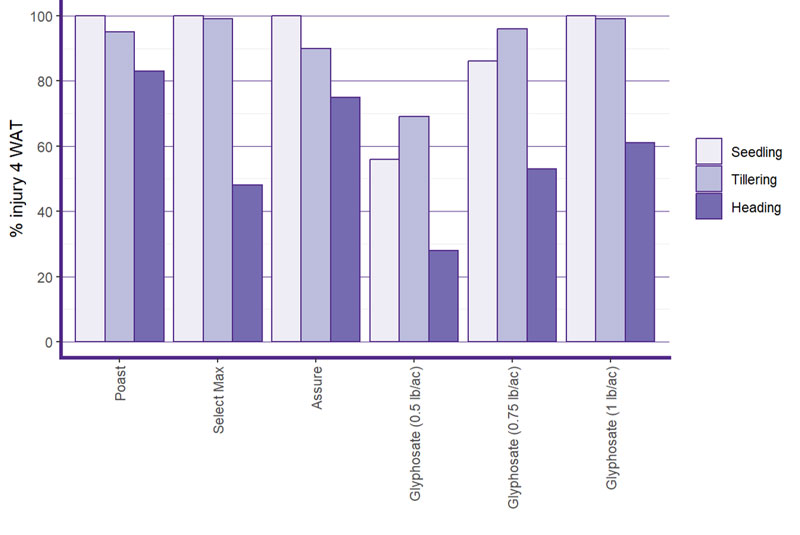
Figure 2. Tumble windmill injury 4 weeks after applications of glyphosate, Poast, Select Max, and Assure to seedling (2- to 4-inch tall), tillering (5 to 10 tillers per plant), and heading (when the first seed head is emerging) stages.
Herbicide Programs for Tumble Windmillgrass Control
Field research (2001 and 2002) with preemergence and postemergence (applied to 1- to 2-inch tall tumble windmillgrass seedlings) herbicides in no-till corn showed that:
- All PRE treatments provided at least 90% control of seedling tumble windmillgrass each year at 6 WAT.
- All POST treatments provided at least 90% control of seedling tumble windmillgrass in both years by 6 WAT, with the greatest control provided by the sequential application of glyphosate in both years.
- All herbicide treatments provided 100% control of seedling tumble windmillgrass at corn harvest, except alachlor + atrazine, with 89%.
A study in 2024-2025 on established tumble windmillgrass evaluated the impact of a fall application of either Callisto or Valor SX, followed by (fb) a spring application of Sinate, Select Max, Assure II, or RoundUp PowerMax 3 alone or a mixture of RoundUp PowerMax 3 and Select Max or RoundUp PowerMax 3 and Assure II. At the Southwest Research-Extension Center in Garden City, Callisto fb Roundup PowerMax 3 alone or Callisto fb Roundup PowerMax 3 + Assure II provided 86 to 89% control 5 weeks after the spring application. Valor fb PowerMax 3 alone or Valor fb PowerMax 3 + Assure II, or PowerMax 3 + Select Max, provided 84 to 85% control. At the Agricultural Research Center in Hays, all herbicide programs that included a spring application of PowerMax 3, either alone or in a tank mixture, provided 86 to 89% control 5 weeks after the spring application. In contrast, control was lower when Assure II, Select Max, or Sinate alone were applied in the spring.
Another trial in established tumble windmillgrass was conducted during 2022 and 2023 near Russell. Two applications of clethodim provided the best control of tumble windmillgrass in both no-till and minimum-tilled plots. Tillage with a sweep plow provided greater control over no-till in the first year after tillage. However, tumble windmillgrass control was similar for all treatments after 18 months
Strategic Tillage
Implementing a one-time strategic tillage with the sweep plow in long-term no-till plots showed a significant reduction in the density of purple three-awn and tumble windmillgass, the two predominant perennial grasses at the site. It can be inferred that strategic tillage would be effective for all three grasses, as they are most problematic on long-term no-till acres. However, it is unclear how frequently strategic or occasional tillage of no-till fields is required to keep them free of these perennial grasses. Observations suggest that one tillage pass every three or six years in summer fallow ahead of wheat is likely adequate. Tillage should be implemented with a sweep plow equipped with pickers on a hot, dry day for the most effective control.
Timely Controlled Burns
For tumblegrass, grazing has limited effectiveness as a management tactic due to its unpalatable nature. However, practices that avoid overgrazing can aid in preventing the invasion of all three of these perennial grasses in rangelands. Tumblegrass is a fire-adapted species; thus, burning is also not likely to be an effective control strategy. Regarding purple three-awn, research from USDA ARS has shown that, under controlled conditions, burning killed 36% of purple three-awn and reduced its biomass by 61%. The same authors reported that summer fires are more effective for suppressing purple three-awn compared to fall burns, particularly after a wet spring. Little information exists regarding the effectiveness of burning for tumble windmillgrass control. However, given its role in the native ecosystem, burning is unlikely to be an effective management tool.
The use of trade names is for clarity to readers and does not imply endorsement of a particular product, nor does exclusion imply non-approval. Always consult the herbicide label for the most current use requirements and follow all label instructions.
Sources
Hennigh et al. (2005), Dhanda et al. (2023), Obour et al. (2021)
Jeremie Kouame, Weed Scientist, Agricultural Research Center
jkouame@ksu.edu
Logan Simon, Southwest Area Agronomist, Southwest Research-Extension Center
lsimon@ksu.edu
Sarah Lancaster, Weed Management Specialist
slancaster@ksu.edu
Jeanne Falk Jones, Multi-County Agronomist
jfalkjones@ksu.edu
Patrick Geier, Weed Scientist, Southwest Research-Extension Center
pgeier@ksu.edu