Identifying Nutrient Deficiency Symptoms in Soybeans
As the soybean growing season progresses, plants may begin showing signs of chlorosis or other leaf discoloration in parts or all of the field. There may be many causes of this discoloration. Nutrient deficiencies are one possibility. Compared to corn, wheat, and sorghum, soybeans remove relatively large amounts of nutrients per bushel harvested. High-yielding soybeans can remove substantial amounts of nutrients from the soil.
General Considerations
The relative mobility of the nutrient within the plant will determine whether the deficiency symptom is first noticeable on the lower leaves or the upper leaves.
Mobile Nutrients
These nutrients can be transferred from older tissues to the youngest tissues within the plant. Deficiency symptoms are first noticeable on the lower, oldest leaves. Mobile nutrients include: nitrogen (N), phosphorus (P), potassium (K), and magnesium (Mg)
Immobile Nutrients
These nutrients are not easily transferred within the plant. Therefore, symptoms occur first on the upper, youngest leaves. Immobile nutrients include: boron (B), calcium (Ca), copper (Cu), iron (Fe), manganese (Mn), Molybdenum (Mo), sulfur (S), and zinc (Zn).
Possible causes of nutrient deficiencies include:
- Low soil levels of the nutrient
- Poor inoculation (in the case of N deficiency)
- Unusually low or high soil pH levels, depending on the nutrient in question
- Roots are unable to access sufficient amounts of nutrients due to poor growing conditions, excessively wet or dry soils, cold weather, or soil compaction
- Root injury due to mechanical, insect, disease, or herbicide injury
- Genetics of the plant
The following briefly describes the symptoms of some of the most common nutrient deficiencies in soybeans.
Nutrient deficiency symptoms
Nitrogen. Chlorotic or pale green plants start with the lower leaf (Figure 1a). Within the plant, any available nitrogen (N) from the soil or nitrogen fixation within nodules on the roots first goes to the new growth. Soybeans prefer to take N from the soil solution as much as possible since this requires less energy than the nitrogen fixation process. However, both sources of N are important for soybeans since they are a big user of N. Nitrogen deficiency can be associated with poor nodulation (Figure 1b).
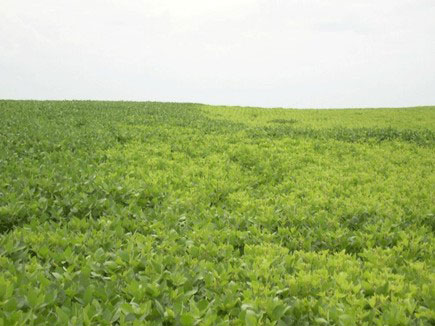
Figure 1a. Soybean field showing signs of chlorosis. Photo by Dorivar Ruiz Diaz, K-State Extension.
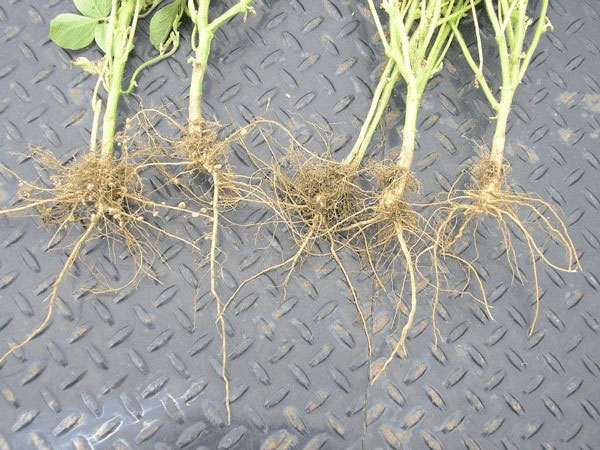
Figure 1b. Lack of nodulation on the far right soybean plants. Photo by Dorivar Ruiz Diaz, K-State Extension.
Iron. Iron chlorosis occurs in calcareous soils (containing calcium carbonates) with high soil pH. The classic symptom is chlorosis (yellowing) between the veins of young leaves since iron is not mobile within the plant (Figures 2 and 3). A side effect of iron deficiency can be N deficiency since iron is necessary for nodule formation and function. If iron is deficient, N fixation rates may be reduced. Iron deficiency occurs on calcareous soils; in addition to high pH, plant stress can favor the development of iron chlorosis, and therefore, the severity can vary significantly from year to year in the same field. Iron chlorosis can be a big limitation in some regions of western Kansas.
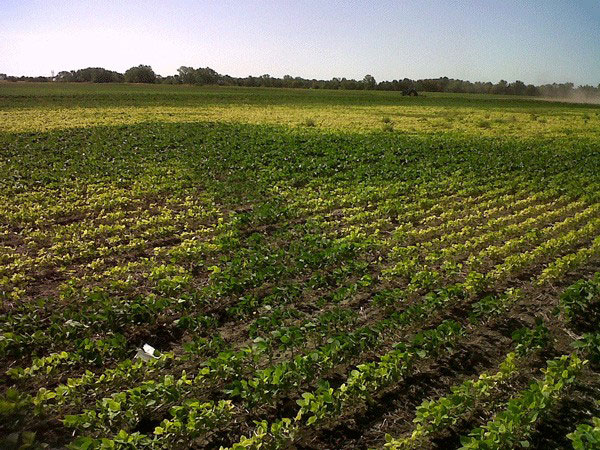
Figure 2. Iron chlorosis in soybeans; the upper leaves become chlorotic. Photo by Dorivar Ruiz Diaz, K-State Extension.
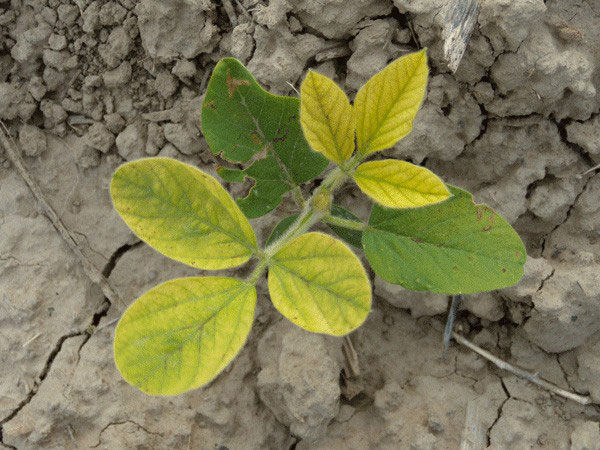
Figure 3. Close-up of iron chlorosis in soybeans. Photo by Dorivar Ruiz Diaz, K-State Extension.
Magnesium. Lower leaves will be pale green, with yellow mottling between the veins. At later stages, leaves may appear to be speckled bronze. This deficiency may occur on very sandy soils.
Manganese. Stunted plants with interveinal chlorosis (Figure 4). It can be a problem in soils with high pH (>7.0) or on soils that are sandy or with a high organic matter content (>6.0% OM). Manganese activates enzymes that are important in photosynthesis, as well as nitrogen metabolism and synthesis. Symptoms are hard to distinguish from iron chlorosis.
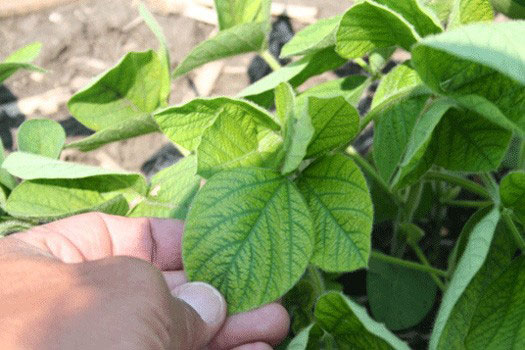
Figure 4. Manganese deficiency symptoms are similar to symptoms of iron chlorosis in soybeans. Photo by Jim Camberato, Purdue University.
Phosphorus. Phosphorus deficiency may cause stunted growth, dark green leaf coloration, necrotic spots on leaves, purple leaves, and leaf cupping. These symptoms occur first on older leaves. Phosphorus deficiency can also delay blooming and maturity. This deficiency may be noticeable when soils are cool and wet due to decreased phosphorus uptake.
Potassium. Soybeans typically require large amounts of potassium. Like phosphorus deficiency, potassium deficiency occurs first on older leaves. Symptoms include chlorosis at leaf margins and between veins (Figure 5). In severe cases, all but the very youngest leaves may show symptoms.
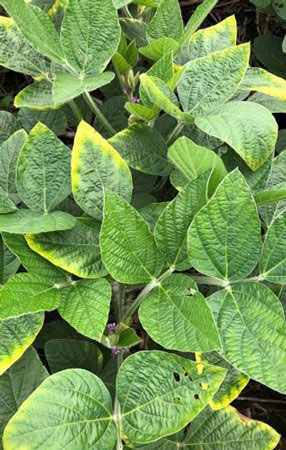
Figure 5. Potassium deficiency: chlorosis of the lower leaves. Photo by Dorivar Ruiz Diaz, K-State Extension.
Sulfur. Stunted plants have a pale green color, similar to N deficiency, except the chlorosis may be more apparent on upper leaves. Sulfur deficiencies are becoming more common due to reduced atmospheric deposition (cleaner air) and more frequent use of high-yielding soybean varieties. Plant-available sulfur is released from organic matter. Deficiency is most likely during cool, wet conditions or on sandy soils with low organic matter content.
For more information, see K-State Research and Extension publication MF-3028, Diagnosing Nutrient Deficiencies in the Field at: http://www.ksre.ksu.edu/bookstore/pubs/MF3028.pdf
Dorivar Ruiz Diaz, Nutrient Management Specialist
ruizdiaz@ksu.edu