Herbicide Application Cutoffs for Flowering Soybeans
All postemergence herbicides have application cutoffs, or preharvest intervals, that ensure both crop productivity and consumer safety. In soybeans, the reproductive growth stages (Figure 1), especially R1 (beginning flower) and R2 (full bloom), are the application cutoffs for important herbicides that are applied postemergence. Table 1 serves as a quick reminder of application cutoffs for some key herbicides.
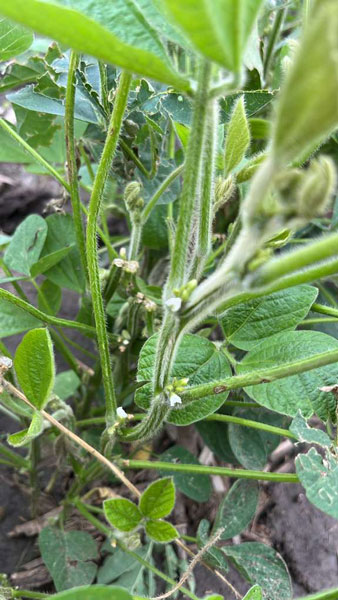
Figure 1. Soybeans at the R1 growth stage. When flowers reach the two uppermost nodes, the plant has entered the R2 growth stage. Photo by Isaac Goncalves, K-State Agronomy.
Table 1. Application cutoffs by soybean growth stage for various herbicides (postemergence and residual).
|
Active ingredient |
Example product |
Application cutoff |
|
Postemergence Herbicides* |
||
|
Glufosinate |
Liberty Ultra |
Before R1 |
|
2,4-D |
Enlist One |
Through R1 |
|
Dicamba |
Stryax |
Through R1 |
|
Glyphosate |
Roundup PowerMAX3 |
Through R2 |
|
Residual Herbicides |
||
|
Pyroxasulfone |
Zidua |
V6 |
|
Dimethenamid |
Outlook |
V5 |
|
Acetochlor |
Warrant |
Before R2 |
|
Clethodim |
SelectMax |
60 days before harvest |
|
S-metolachlor |
Dual Magnum |
75 days before harvest |
*Only for resistant varieties.
Other Important Application Restrictions
In addition to growth stage or calendar date cutoffs, all products have restrictions for wind speed and other weather conditions. Over-the-top applications of dicamba are subject to additional restrictions on temperature, time of day, and expected rainfall. Opportunities to make legal applications of these products will be very limited in the weeks ahead. Based on 6 years of wind speed and temperature data from 5 locations in Kansas, an average of 9 days in July had 2 or more hours when weather conditions would permit a legal application of over-the-top dicamba products (Figure 2).
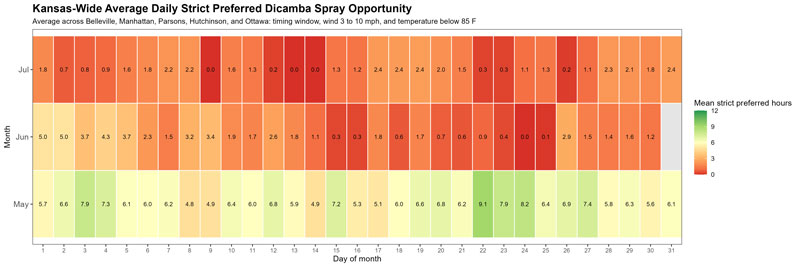
Figure 2. Average hours per day with wind speed and temperature that would allow over-the-top dicamba applications to an entire field. Data recorded from Mesonet stations at Bellville, Hutchinson, Manhattan, Ottawa, and Parsons from 2020 to 2025. Boxes shaded green indicate days with 6 or more suitable hours, boxes shaded red indicate days with less than 1 suitable hour, and other shades are intermediate. Figure by Yasir Parrey, K-State Agronomy.
The use of trade names is for clarity to readers and does not imply endorsement of a particular product, nor does exclusion imply non-approval. Always consult the herbicide label for the most current use requirements.
Additional information can be found in the 2026 Chemical Weed Control for Field Crops, Pastures, Rangeland, and Noncropland, https://bookstore.ksre.ksu.edu/pubs/SRP1194.pdf
Sarah Ganske, Weed Management Specialist
slancaster@ksu.edu