Fall Armyworms are Now Active in Kansas
Fall Armyworms, Spodoptera frugiperda, can damage several important Kansas crops as well as pasture, turf, and home landscaping. This insect does not overwinter in Kansas. Rather, it is native to the tropical regions of the western hemisphere and is active year-round along the Gulf Coast and southern Florida, migrating to northern states from these locations each year. At least two full generations are possible in Kansas, with defoliation and grain damage being the biggest concerns. Each generation’s abundance and distribution across the landscape are usually different; the first generation does not necessarily impact the abundance of the second generation.
Feeding damage from fall armyworms during the vegetative stage in corn and sorghum causes chewed-up and ragged-looking leaves. In fact, one of the common names for the fall armyworm at this stage is “ragworm”. Sorghum is particularly at risk during grain fill, as fall armyworms will completely consume berries as they develop. Additionally, these caterpillars have been causing significant problems in eastern Kansas brome fields in recent years.
Based on pheromone trap counts, fall armyworms began arriving in Kansas in mid-June, and trap numbers are increasing (Figure 1), so scouting should begin for caterpillars in at-risk crops and on a weekly basis for the remainder of the growing season.
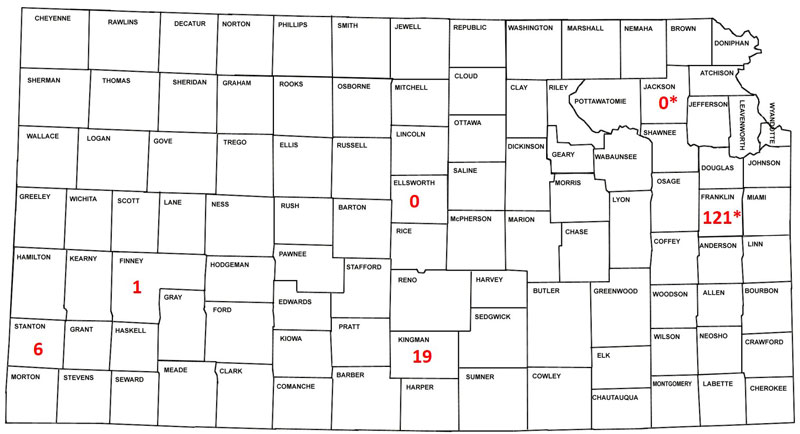
Figure 1. Total fall armyworm moths caught in pheromone traps as of June 22, 2026. * indicates multi-county totals. Map created by Anthony Zukoff, K-State Extension.
Caterpillars increase in size at an exponential rate, and most of the feeding occurs during the later stage of development. It is critical to scout early and treat, if needed, when the caterpillars are less than a half-inch long. Larger caterpillars are harder to control and do the most damage. Often, infestations are discovered after it is too late to treat. Recommended thresholds can be found below.
Fall Armyworm Thresholds
Alfalfa: 1-2 caterpillars per square foot can destroy seedling alfalfa. 10-15 per square foot can destroy 12-inch tall plants.
- Corn: damage to the whorl stage in early summer is typically not a concern and will not impact yield. Bt corn may prevent ear damage.
- Sorghum: damage to the whorl stage in early summer is typically not a concern. 1-2 larvae/head during flowering to soft dough reduces yield 5-10%.
- Pasture/Brome: treatment is warranted with 3 to 5 caterpillars per square foot. If weather conditions are delaying growth, plants may be at higher risk from caterpillars. Scouting early and often is highly recommended.
- Wheat: In the fall, larval “window-paning” in early-planted wheat indicates young caterpillar activity. Very late second-generation fall armyworm will be the biggest concern for wheat. If 25-30% of plants show damage, examine the field frequently. Treat at 2-3 active larvae/ft.
For more information regarding fall armyworm management, take a look at the following Insect Pest Management Guides:
Corn Insect Pest Management
https://bookstore.ksre.ksu.edu/item/corn-insect-pest-management-2026_MF810
Sorghum Insect Pest Management
https://bookstore.ksre.ksu.edu/pubs/sorghum-insect-pest-management-2025_MF742.pdf
Wheat Insect Pest Management
https://bookstore.ksre.ksu.edu/pubs/wheat-insect-pest-management-2025_MF745.pdf
Track weekly counts of fall armyworm by county during the 2026 season at the website below:
Great Lakes and Maritimes Pest Monitoring Network
Monitoring fall armyworm activity in 2026 would not be possible without the help of: Amanda Burnett (Greeley Co.), Kayla Jones (Stanton Co.), Grace Schneider (Kingman Co.), Craig Dinkel (Ellsworth Co.), David Hallauer (Jackson, Jefferson, Nemaha Cos.), Ryan Schaub (Osage, Franklin, Anderson Cos.) and James Coover (Neosho, Labette Cos)
Anthony Zukoff, Extension Entomology Specialist, Garden City
azukoff@ksu.edu