Drone Imagery and Artificial Intelligence for Weed Mapping and Postemergence Herbicide Applications
Timely scouting is an important part of any successful weed control program, including those aimed at managing herbicide-resistant (HR) weeds. Good scouting helps identify the best herbicide program for the weeds present and evaluate if pre-planting actions, such as tillage or residual herbicides, have performed as expected. It also helps determine whether additional residual herbicide treatment is needed before the first herbicide dissipates.
The success of most POST herbicides depends on application timing and weed size. Delayed scouting or applications can reduce herbicide effectiveness and increase the risk of HR. Most herbicides are less effective on large, fast-growing HR weeds such as amaranth species. For example, Palmer amaranth control was reduced when sprayed at 6 inches or taller compared to when sprayed at 2 inches1. However, scouting takes a lot of time, and any delay in scouting or applying herbicides can be costly.
Scouting with Drones and Weed Maps
Drones equipped with high-resolution cameras (RGB, multispectral, hyperspectral, and thermal) can identify, map, and assess weed-infested areas within crops. They can quickly scout entire fields and generate prescription maps (Figure 1), resulting in more comprehensive and efficient assessments.
Drone imagery can distinguish weed species based on differences in plant architecture, canopy shape, growth habit, color, texture, and spectral reflectance. As such, broadleaf weeds like Palmer amaranth and kochia can be differentiated from grassy weeds such as johnsongrass and shattercane. When combined with AI-based image analysis, these features can be used to classify and map weed infestations with greater accuracy than visual scouting alone. Weed maps (Figure 1B) generated from drone imagery can be integrated into precision sprayer systems for targeted herbicide applications, helping farmers save on herbicide costs.
Artificial Intelligence (AI) Can Help with Scouting
AI and computer vision allow the detection of weeds within crops, for targeted spraying of only weeds and preserving crops (Figure 2). Scientists can train and evaluate AI models to detect weeds in fallow and in-crop scenarios (Figures 2 and 3). Several researchers developed smart sprayer prototypes by training AI models, achieving weed control efficacy of up to 96%2. The trained AI models allow detection sensitivity to be adjusted, ultimately affecting performance. The detection of small or early-stage weeds is improved with high-resolution images.
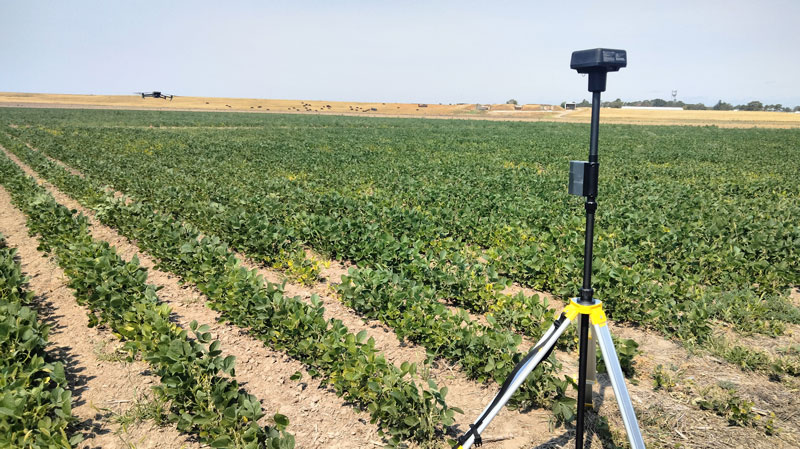
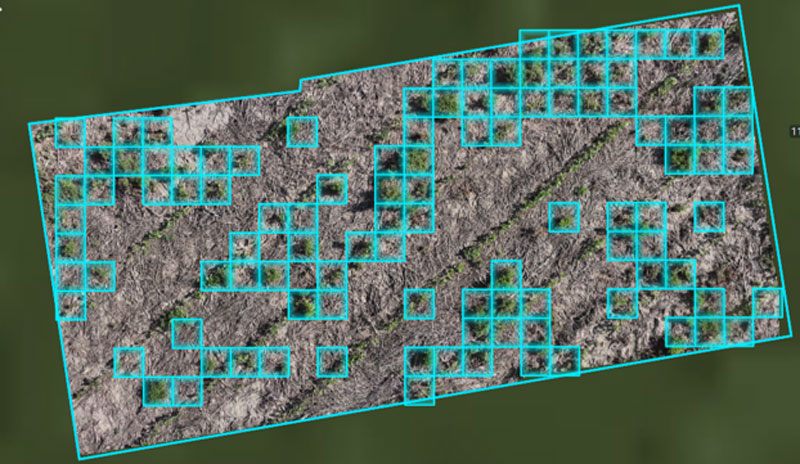
Figure 1. Early-season mapping of kochia infestation in a soybean plot at the Agricultural Research Center, Hays, KS. Imagery by Jeremie Kouame, K-State Extension.
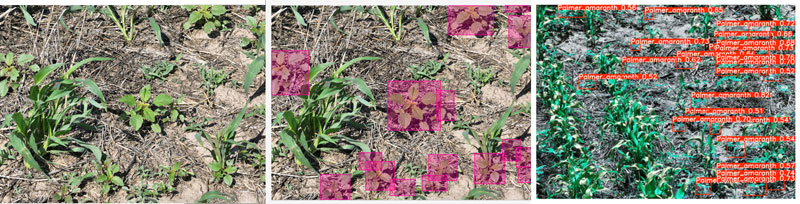
Figure 2. From left to right: Original image collected in the field, annotated image with bounding boxes for training an AI model and prediction of Palmer amaranth in a grain sorghum field in no-till dryland production systems of western Kansas. AI model trained by Jeremie Kouame, K-State Extension.
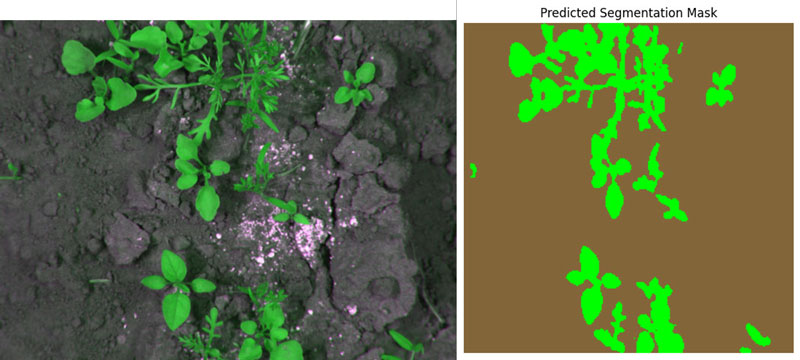
Figure 3. From left to right: input image and predicted mask of a weed with a trained AI model on a public dataset. AI model trained by Jeremie Kouame, K-State Extension.
Potential Economic Returns of Targeted Weed Control Scenarios
Targeted herbicide applications can reduce herbicide costs by limiting treatments to areas where weeds are present. The following scenarios illustrate the potential economic returns of this approach.
A major factor in achieving effective weed control and maximizing herbicide savings with targeted herbicide application includes low overall weed pressure (Table 1), the use of pre-emergence residual herbicides, and early-POST applications. Increased cost savings will generally be found in fields with lower weed pressure at the time of spraying. Therefore, fields with strong soil-applied residual herbicide programs will offer greater potential for herbicide savings.
Scenario 1: A farmer decides to apply Huskie FX (18 oz/ac) + Atrazine 4L (1 pt/ac) + AMS (8.5 lb/100 gal) + NIS (0.25% v/v) to a 100-acre grain sorghum field as a postemergence herbicide program. The cost of a uniform broadcast application of this herbicide program is $22.89 per acre, totaling $ 2,289 for 100 acres. Assuming scouting the field with a drone and processing the imagery to map the weeds in the 100-acre field took 10 hours, and that labor costs $20 an hour, the cost of generating the prescription map would be $200.
Table 1. Savings from targeted weed control depend on the percentage of weedy areas
|
Percent Weedy Area |
Weed-Free Area |
Cost of Broadcast |
Targeted Herbicide Cost Savings |
|
10% |
90 acres |
|
$1,860 |
|
25% |
75 acres |
|
1,517$ |
|
50% |
50 acres |
$2,289 |
$945 |
|
75% |
25 acres |
|
$372 |
|
90% |
10 acres |
|
$29 |
|
Map Cost |
|
|
$200 |
Scenario 2: The farmer’s grain sorghum field is infested 45% of the area with broadleaves and 25% of the area with grasses (johnsongrass and shattercane). The sorghum planted is a Double Team hybrid, which allows for application of FirstAct herbicide to control grasses. They decide to apply Huskie FX (18 oz/ac) + Atrazine 4L (1 pt/ac) + AMS (8.5 lb/100 gal) + NIS (0.25% v/v) to the areas infested by broadleaves and FirstAct (11 oz/ac) + AMS (8.5 lb/100 gal) + COC (1% v/v) on the area with grass (johnsongrass and shattercane) infestation.
Table 2. Cost savings of spraying two postemergence herbicide programs to only weed-infested areas based on a prescription map
|
Herbicide Program |
% Weedy Area* |
Non-Sprayed Area |
Broadcast Herbicide Cost |
Targeted Herbicide Cost Savings |
|
Huskie FX (18 oz/ac) + Atrazine 4L (1 pt/ac) + AMS (8.5 lb/100 gal) + NIS (0.25% v/v) |
45% |
55 acres |
$2,289 |
$1,259 |
|
|
|
|
|
|
|
FirstAct (11 oz/ac) + AMS (8.5 lb/100 gal) + COC (1% v/v) |
25% |
75 acres |
$1,775 |
$1,331 |
|
Total cost of broadcast |
|
|
4,064 |
|
|
Map Cost |
|
|
|
$200 |
|
Herbicide Cost Savings |
|
|
|
$2,390 |
* % weedy area means percent weedy area, broadcast herbicide cost is the cost of applying the herbicide to the whole field (100 acres), targeted herbicide cost savings means applying the herbicides only where weeds are, based on the prescription map for targeted application.
Note: the cost of map generation is based on an assumption and is likely to change. Also, the cost of software licensing, drones, and sensors was not accounted for.
Challenges
Drone mapping can be effective, but performance depends on weed growth stage, camera resolution, flight height, flight speed, light conditions, etc. Pre-flight imaging, followed by offline analysis and subsequent spraying, enables high-resolution mapping and species distribution analysis but introduces a time lag between data collection and treatment execution. Delays in implementing control measures can result in discrepancies between processed imagery and the field conditions at herbicide application, leading to targeted weed species being larger. Consequently, the selected control measures may lose efficacy, reducing their effectiveness in managing weed populations.
The prices of the herbicides Huskie FX ($128.50/gal) + Atrazine 4L ($26.70/gal) and FirstAct ($174.40/gal) were obtained from the K-State 2026 Chemical Weed Control for Field Crops, Pastures, Rangeland, and Noncropland. The prices of ammonium sulfate ($0.40/lb), nonionic surfactant ($26.0/gal) and crop oil concentrate ($15/gal) were obtained from the 2025 Guide for Weed, Disease, and Insect Management in Nebraska.
For more detailed information, see the “2026 Chemical Weed Control for Field Crops, Pastures, and Noncropland” guide available online at https://www.bookstore.ksre.ksu.edu/pubs/CHEMWEEDGUIDE.pdf or check with your local K-State Research and Extension office for a paper copy.
The use of trade names is for clarity to readers and does not imply endorsement of a particular product, nor does exclusion imply non-approval. Always consult the herbicide label for the most current use requirements. Users should read and follow all label directions.
1Kouame et al. 2024; 2Calvert et al. 2021
Jeremie Kouame, Weed Scientist
jkouame@ksu.edu
John Holman, Cropping Systems Agronomist
jholman@ksu.edu
Gaurav Jha, Precision Agronomist
gjha@ksu.edu
Sarah Ganske, Weed Management Extension Specialist
slancaster@ksu.edu
Patrick Geier, Weed Scientist
pgeier@ksu.edu
Augustine Obour, Soil Scientist - Hays
aobour@ksu.edu
Deepak Joshi, Precision Agriculture Extension Specialist
drjoshi@ksu.edu
Tina Sullivan, Northeast Area Agronomist
tsullivan@ksu.edu
Lucas Haag, Agronomist-in-Charge at Tribune
lhaag@ksu.edu
Jeanne Falk Jones, Northwest Area Agronomist
jfalkjones@ksu.edu
Logan Simon, Southwest Area Agronomist
lsimon@ksu.edu