Managing Soil Compaction: Is Deep Tillage the Answer?
With row crop harvest complete across much of Kansas, some producers may be considering deep tillage to alleviate soil compaction. Last week's eUpdate article discussed how to examine the soil profile for signs of compaction. But before making a deep tillage pass, producers should consider several important questions: How deep should tillage occur? Will it improve crop yields, and how long will the benefits last? What are the potential risks and costs? The following discussion addresses these questions and offers strategies for preventing future compaction.
How deep should the tillage operation occur?
That is best answered by taking a spade or soil probe out in your field and digging a few holes. Ideally, you should dig down to about 18 inches. You are looking for dense layers that restrict plant roots. If you encounter “platy” soil structure, characterized by thin, horizontal layers approximately ¼ to ½ inch thick, examine whether roots have penetrated through the compacted zone. If roots have successfully penetrated the layer, the compaction may not be severe enough to restrict root growth. If you see a lot of roots that are growing horizontally, or if they appear stubby and gnarled, lacking many root hairs, that can also be a sign that the roots are having trouble making it through this layer.
If you see a dense zone that ends at around 8 inches, you’d only want to go about 9 inches deep with the tillage operation. As you double the depth of the tillage operation, you quadruple the power requirement, so going too deep is a waste of time and energy. Also, there is no point in going deeper and potentially damaging the soil profile even further (risks are explained below).
Will deep tillage benefit future crop yields?
In research studies, it is commonly concluded that deep tillage is only beneficial if the zone of compaction is truly root-limiting. If it isn’t, deep tillage probably won’t be of much benefit. One way to evaluate the benefits of deep tillage is to leave three to five untilled strips across the field and compare yields in those areas with the tilled portions the following growing season. Mark the locations of the strips so yield monitor data can be used to assess whether the tillage operation provided a measurable benefit.
How long does the effect produced by deep tillage last?
Tillage can temporarily loosen soil, but because it breaks natural soil structure into smaller pieces, eventually, tilled soils re-compact and become denser with time. If the field is subsequently conventionally tilled, and particularly if the traffic is not controlled or limited to certain tire track paths, the benefit will only last a few years due to the many trips made across the field with various tillage and other implements. If the field is subsequently no-tilled and traffic is controlled, the effect of a single deep tillage operation might last longer.
Are there any negative side effects of deep tillage?
If tillage is performed when the soil is too wet, the compaction zone could be moved even deeper. To know if the soil is too wet for tillage, try to make a ribbon out of the soil without wetting it. If you can make a ribbon, it is too wet. Alternatively, if you can roll out a “snake” of soil by rubbing it between your palms, it’s too wet. This is called “plasticity,” and if the soil is plastic (bendable), it can smear and compact easily. You’ll need your shovel or soil probe to test this to the entire depth that you want to till.
Your goal is to create fracture, so the soil has to be dry enough to shatter rather than smear. To see if you’re achieving this, dig between the shanks with a spade and see if the soil is loosened. If you bring up large clods, the soil isn’t shattering, and it would be better to wait until it is drier. Straight shanks will cause the least soil disturbance, as shown in the photos below.
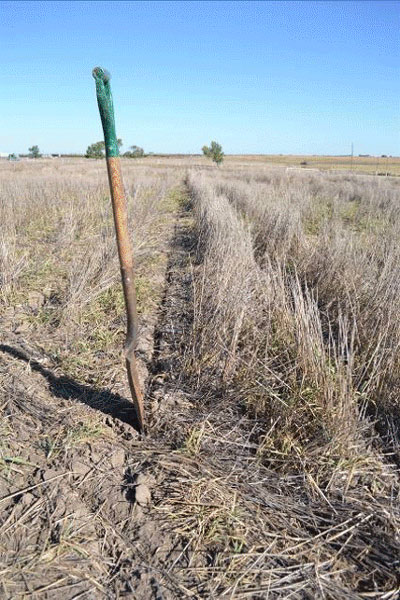
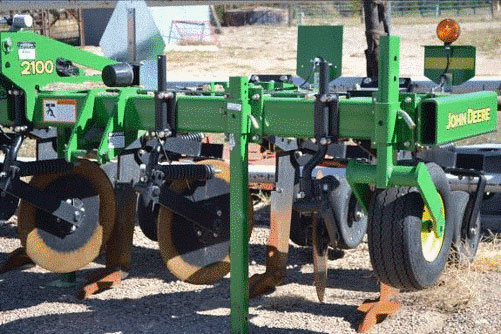
Figure 1. (Top photo) This image was taken 6 weeks after tillage with a ripper designed for minimum surface disturbance, as it has straight shanks. The spade could be easily pushed all the way into the soil. The area between the shanks was easy to dig, except in the end rows, where there was a lot of traffic from heavily loaded grain carts. (Bottom photo) This is the implement used in the field described above. Photos by DeAnn Presley, K-State Research and Extension.
Also, remember that certain field areas are probably more compacted than others. Compacted areas might not be ready for deep tillage at the same time as the rest of the field because compacted areas tend to stay wetter for longer. A case in point is a visit to an Ellis County producer’s farm. Soil shattering was observed from deep tillage across the entire 30 inches between the shanks in the “average” part of the field, but in the end rows where the grain cart was driven, excavated clods were about one cubic foot in size, most likely because those more compacted areas of the field were wetter.
Is deep tillage economical?
Only if a root-limiting layer is really present, and even then, it’s not an easy decision because this is a costly operation. Deep tillage requires a lot of power. Deep tillage is slow-going, and the implements are not very wide. As a result, deep tillage requires a lot of time and diesel fuel. Custom rates for tillage operations vary depending on many factors, including location, type of soil, tillage practice, size and shape of field, and the size of equipment. The 2026 custom rates for various types of tillage operations by district are available on the K-State AgManager website at https://www.agmanager.info/machinery/papers/custom-rates-survey.
How can you prevent compaction?
Deep compaction is caused by heavy axle loads. Research indicates that axle loads greater than 10 tons can cause compaction as deep as 12 to 18 inches, and many modern implements weigh well over 10 tons per axle. The only way to reduce axle weight is to decrease the load weight or add axles — axle load cannot be reduced by adding more or larger tires, unfortunately. Shifting to continuous no-till can help soils become more resistant to subsequent compaction, and long-term research conducted in the Great Plains shows that no-till is more resistant to compaction at wetter soil moisture levels (Figure 2).
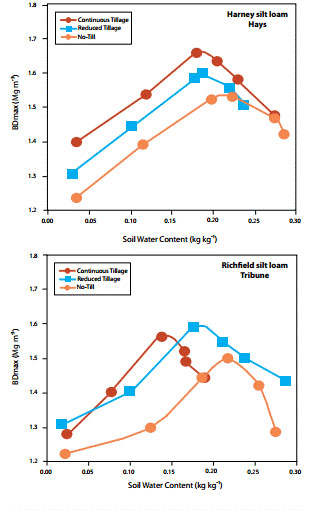
Figure 2. Tilled soils are more easily compacted than those under no-till. Also, no-tilled soils can better withstand machinery traffic at higher water contents compared to conventional and reduced-tilled soils; MF3066 Efficient Crop Water Use in Kansas https://www.bookstore.ksre.ksu.edu/pubs/MF3066.pdf (Source of original data: Blanco-Canqui, et al., 2009. No-till induced increase in organic carbon reduces maximum bulk density of soils. Soil Science Society of America Journal 73:1871-1879).
Take Home Message
Deep tillage should be considered only when a root-limiting compacted layer has been identified. Before making a tillage pass, evaluate the depth of compaction, soil moisture conditions, potential yield benefits, and costs. Long-term practices that reduce heavy equipment traffic and improve soil structure may be more effective at preventing future compaction than repeated deep tillage operations.
DeAnn Presley, Soil Management Specialist
deann@ksu.edu