Winter Annual Grass Control in Wheat
Beneficial rains have brought much-needed moisture to the Kansas wheat crop. However, moisture can also trigger winter annual weeds, especially in fields with poor wheat stands or in those with continuous wheat or wheat-fallow rotations. This article will focus on the grass weeds common in wheat.
Like wheat, winter annual grasses typically emerge in the fall (though early-spring emergence is possible). They go dormant during the coldest months, then resume growth and produce seeds in the spring. The weedy brome species cheatgrass (also known as downy brome), Japanese brome, and cheat are among the grass weeds most commonly found in Kansas wheat (Figure 1). Jointed goatgrass and feral rye are also prevalent and are especially challenging to control. Cheat and feral rye are typically found in the eastern parts of the state, whereas cheatgrass and jointed goatgrass are more often found in the west. Table 1 lists postemergence herbicides labeled for these species and their efficacy against each species.
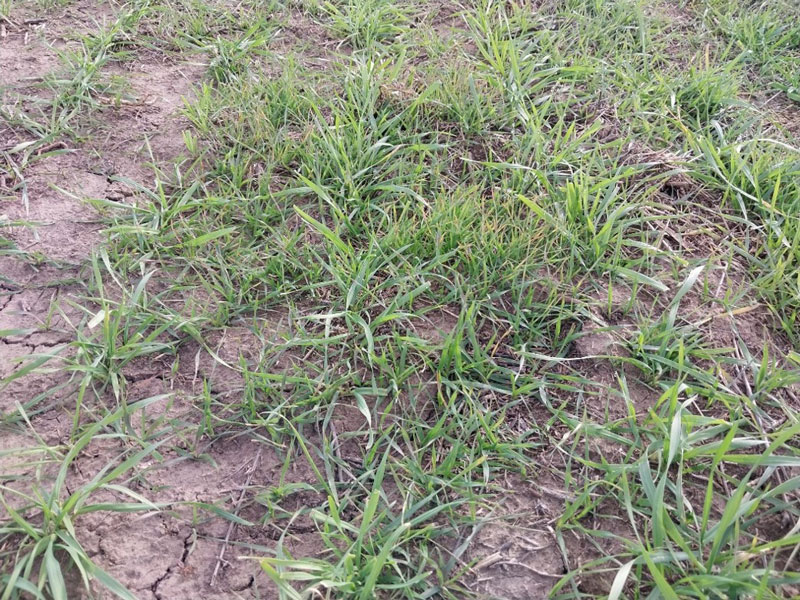
Figure 1. Cheatgrass (downy brome) growing in winter wheat. Photo by Patrick Geier, K-State Research & Extension.
Table 1. Postemergence herbicides for winter annual grass control in Kansas1.
|
Herbicide (Group) |
Example products |
Cheat |
Cheatgrass (Downy brome) |
Japanese brome |
Jointed goatgrass |
Feral rye |
Italian ryegrass |
|
Quizalofop (1) (CoAXium wheat only)2 |
Aggressor |
G-E |
G-E |
G-E |
G-E |
G-E |
G-E |
|
Pinoxaden (1) |
Axial, others |
- |
- |
- |
- |
- |
E |
|
Imazamox (2) |
Beyond Xtra |
E |
G-E |
E |
E |
G |
E |
|
Flucarbazone (2) |
Everest 3.0, others |
G-E |
P-F |
G-E |
- |
- |
- |
|
Propoxycarbazone (2) |
Olympus, others |
E |
F-G |
E |
P |
- |
P |
|
Mesosulfuron (2) |
Osprey, others |
F |
F |
F |
- |
- |
- |
|
Sulfosulfuron (2) |
Outrider, others |
G-E |
F-G |
G-E |
- |
- |
- |
|
Pyroxsulam (2) |
Powerflex HL, others |
E |
F-G |
E |
- |
- |
- |
|
Metribuzin (5) |
Tricor, others |
F-G |
F |
G |
- |
- |
- |
|
1 Ratings: E = excellent, G = Good, F = fair, P = poor, - = weed not listed on herbicide label. Products with residual activity are in bold. |
|||||||
Considerations for Herbicide Applications
As a general rule, fall applications will provide better control of these weeds than spring applications. However, it is important to remember that weeds must be actively growing for herbicides to be effective. Be aware of the temperatures in your area to ensure weeds are not dormant. One temperature guideline to consider is low temperatures above freezing and high temperatures above freezing for three to five days before and after the application. Delaying applications until spring, when herbicides can be mixed with top-dress fertilizer, is an option, although this can lead to greater yield loss due to competition and reduced herbicide efficacy. Furthermore, spring applications may not meet crop rotation intervals. Always read the herbicide label to determine recropping intervals and adjuvant requirements.
The growth stage is also important when applying several of these herbicides. For example, Aggressor herbicide should be applied between the 4-leaf and jointing stages, before grassy weeds exceed the 4- to 5-leaf stage. Beyond Xtra can be applied to one-gene Clearfield varieties between tiller initiation and jointing, and the two-gene Clearfield Plus varieties between the 2-leaf and the second joint stage of growth. Batalium Amped can be applied starting at the 2-leaf stage. Outrider can be applied after wheat reaches the two-leaf stage but before the jointing stage in the spring. Olympus can be applied after emergence but before the jointing stage. However, applications before wheat tiller initiation have a greater risk of stunting the crop.
While scouting for the winter annual grasses, winter annual broadleaves may also be found in the field. Many of the herbicides in Table 1 also have activity on broadleaf winter annual weeds, such as mustard species, bushy wallflower, field pennycress, shepherdspurse and henbit. Two herbicides that do not have activity on broadleaf weeds are quizalofop (Aggressor) and pinoxaden (Axial). For the other herbicides, the response for broadleaf winter annual weeds can be found on page 87 of the K-State Chemical Weed Control Guide.
Other Options: Crop Rotation and Seed Destruction
Crop rotation is an effective method of preventing winter annual weeds in wheat. One or more summer annual crops between wheat crops disrupts the life cycle of winter annual weeds, allowing for the use of other cultural and chemical methods for their control. Narrower row spacings or increased wheat seeding rates can make wheat more competitive with weeds. In dry environments, seeding wheat deeper into moist soil may allow it to emerge before weedy brome seeds that must germinate from dry soil near the surface. Alternatively, delaying planting until after the first flush of weedy grasses has been controlled may also be an effective cultural management practice when moisture is abundant.
Seed destruction of some winter annual grasses (cheatgrass, feral rye, and jointed goatgrass) at wheat harvest may be a viable option to reduce the amount of weed seed that returns to the soil seedbank, which may reduce the density of winter annual grasses in the following seasons.
Take-home Message
Several effective options exist to control weedy brome species. Jointed goatgrass and feral rye control options are more limited and will likely require planting either a Clearfield or CoAXium wheat variety. In fields where winter annual grasses are a problem, cultural practices can be implemented to reduce their impact, such as using an herbicide-resistant wheat variety or rotating to a summer crop.
For additional information about these herbicides, see 2026 Chemical Weed Control for Field Crops, Pastures, Rangeland, and Noncropland, K-State publication SRP-1194.
The use of trade names is for clarity to readers and does not imply endorsement of a particular product, nor does exclusion imply non-approval. Always consult the herbicide label for the most current use requirements.
Patrick Geier, Weed Scientist, Garden City
pgeier@ksu.edu
Logan Simon, Southwest Area Agronomist, Garden City
lsimon@ksu.edu
Sarah Ganske, Extension Weed Management Specialist
slancaster@ksu.edu
Jeremie Kouame, Weed Scientist, Agricultural Research Center – Hays
jkouame@ksu.edu
Jeanne Falk Jones, Northwest Area Agronomist, Colby
jfalkjones@ksu.edu