Basal Bark and Cut-Stump Herbicide Applications for Woody Plant Control
The dormant season is an excellent time to treat unwanted stands of woody plants with non-foliar application methods. Scattered stands of trees can be treated individually using the basal bark method (for trees less than 6 inches in diameter) or the cut-stump treatment method. These methods work by applying herbicide to the living cambium layer of woody plants, either by applying an herbicide mixed with an oil carrier that penetrates the outer bark to reach this layer (basal bark) or by cutting down trees and applying an herbicide mixture directly to the exposed outer 1” surface ring of the cambium (cut stump). Herbicide will then be translocated to other structures in the plant, reducing or eliminating resprouting following treatment. Basal bark and cut-stump treatments can be applied at most any time of the year. However, the basal bark treatment should not be applied when the bark is wet from rain or snow, as the wet bark will repel the oil carrier and herbicide mixture. Also, some herbicide labels may caution against using either application method during heavy upward sap flow in the spring.
Basal bark application method
Producers can treat small-diameter (typically less than 6 inches) susceptible woody plants individually this fall by spraying the basal trunk with triclopyr (e.g., Remedy Ultra, Pathfinder II, Garlon 4 Ultra) plus an oil carrier such as diesel fuel, kerosene, or a commercial basal oil. The lower 12-15 inches of the stems or trunks should be thoroughly wetted on all sides with a triclopyr mixture (Figure 1). The basal bark recommendation for Remedy Ultra is a 20-30% solution in an oil carrier on a volume:volume (v/v) basis. PastureGard HL is a premix of triclopyr and fluroxypyr and can be applied as a basal bark or cut-stump treatment as a 25% solution in oil. Crossbow, a mixture of triclopyr and 2,4-D, can also provide control of certain woody plants as a 4% solution in an oil carrier. Pathfinder II is a ready-to-use product and does not require mixing with a carrier. The above triclopyr products work well on many trees but may be less effective on locust. Milestone, with the active ingredient aminopyralid, is very effective on black and common honey locust. Mix Milestone at 5% v/v with an oil carrier compatible with a water-soluble herbicide.
Not all carriers are compatible with all herbicides. Be sure to check the herbicide label and the oil manufacturer's label before mixing to ensure compatibility. You can also conduct a clear jar test before committing to large tank mixes to test compatibility.
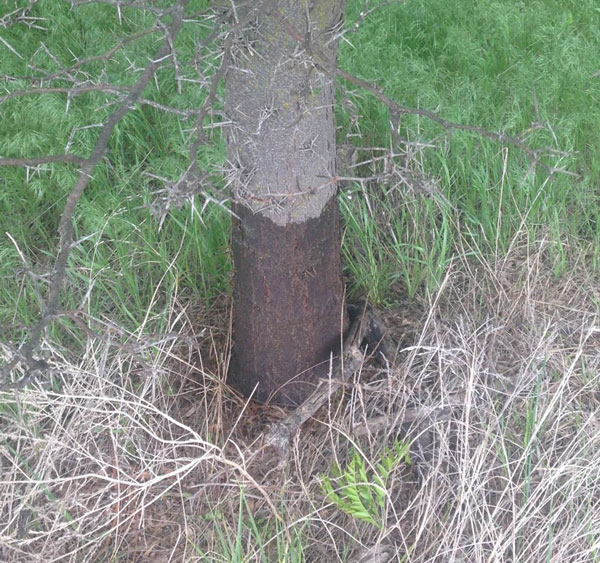
Figure 1. Basal bark treatment of a 6-inch diameter common honey locust. Photo credit: Keith Harmoney, K-State Hays Agricultural Research Center.
Cut-stump method
If the woody plant is greater than 6 inches in diameter, treating trees with the cut stump method is recommended. To apply a cut-stump treatment:
- Cut the tree at ground level, clearing any sawdust or debris off of the cut surface.
- Treat the cut surface with the recommended herbicide mixture (see Table 1) immediately after cutting and no more than 30-60 minutes before the sap seals over the exposed area.
- Focus herbicide application on the cambium and neighboring light sapwood (Figure 2). Apply enough herbicide that it pools on the cut surface.
- Treat any exposed trunk or exposed roots.
The stump of ash, cottonwood, elm, oaks, persimmon, willow, and Russian olive can also be treated with a 1:1 ratio of dicamba (Clarity, Sterling Blue) in water instead of triclopyr. Common trees in Kansas that re-sprout after cutting include: ash, cottonwood, elm, oaks, Osage orange (hedge), persimmon, black and common honey locust, salt cedar, and Russian olive. In sprouting species, new shoots arise from dormant buds at or below the ground, often resulting in a multi-stemmed clump around the cut tree base. Honey locust is also able to sprout from buds along the root system (root suckering). Treating cut stumps with an effective herbicide should prevent this sprouting from occurring. The stumps of Eastern red cedar do not need to be treated because, unlike many woody plants, this species does not root sprout. Simply cutting Eastern red cedar below the lowest green branch will kill it.
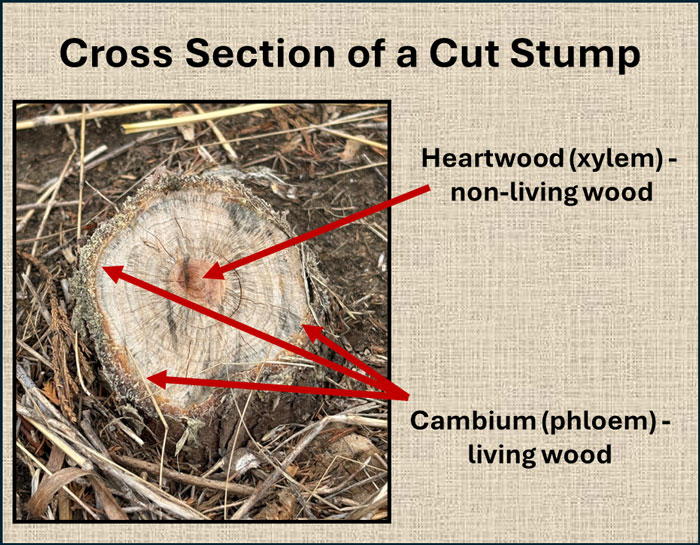
Figure 2. Treat the cambium tissue for cut-stump treatments, typically the outer 1” ring of the stump. Photo credit: Keith Harmoney, K-State Hays Agricultural Research Center.
Table 1. Cut-Stump Herbicides
|
Herbicide |
Active ingredients per gallon |
Rate |
|
Crossbow1 |
2 lb 2,4-D + 1 lb triclopyr |
4% in oil |
|
Remedy Ultra1 |
4 lb triclopyr |
20-30% in oil |
|
Pathfinder II1 |
0.75 lb triclopyr |
Ready to use |
|
PastureGard HL1 |
3 lb triclopyr + 1 lb fluroxypyr |
25% in oil |
|
Milestone |
2 lb aminopyralid |
10% in water |
|
Sterling Blue/Clarity |
4 lb dicamba |
25-50% in water |
|
Roundup PowerMAX |
5.5 lb glyphosate |
50-100% in water |
|
Arsenal |
2 lb imazapyr |
10% in water |
|
Tordon 22K2 |
2 lb picloram |
10% in water |
|
Capstone |
0.1 lb aminopyralid + 1 lb triclopyr amine |
Undiluted |
1Can also be used at the listed rate for basal bark applications. 2 Tordon 22K requires a supplemental label for cut stump treatments.
Table 2. Cut-Stump Treatments
|
Species |
Herbicides |
|
Ash |
Crossbow, Pathfinder II, PastureGard HL, Banvel/Clarity, Arsenal, Capstone |
|
Common honey locust |
Remedy Ultra, Pathfinder II, PastureGard HL, Milestone, Sterling Blue/Clarity, Tordon 22K1, Capstone |
|
Cottonwood |
Crossbow, Remedy Ultra, Pathfinder II, Sterling Blue/Clarity, Arsenal, Capstone |
|
Elm |
Crossbow, Remedy Ultra, Pathfinder II, PastureGard HL, Banvel/Clarity, Arsenal, Tordon 22K1, Capstone |
|
Oaks |
Remedy Ultra, Pathfinder II, PastureGard HL, Banvel/Clarity, Roundup PowerMAX, Arsenal, Tordon 22K1, Capstone |
|
Osage orange (hedge) |
Remedy Ultra, Pathfinder II, PastureGard HL |
|
Persimmon |
Remedy Ultra, Pathfinder II, PastureGard HL, Sterling Blue/Clarity, Arsenal, Capstone |
|
Russian olive |
Crossbow, Pathfinder II, Sterling Blue/Clarity, Arsenal |
|
Salt cedar |
Remedy Ultra, Pathfinder II, PastureGard HL, Roundup PowerMAX, Arsenal |
|
Willow |
Crossbow, Remedy Ultra, Pathfinder II, PastureGard HL, Roundup PowerMAX |
1 Tordon 22K requires a supplemental label for cut stump treatments.
Tordon RTU and Pathway can be used on cut surfaces in noncropland areas such as fence rows, roadsides, and rights-of-way. However, Tordon RTU and Pathway are not labeled for use on range and pasture. Glyphosate labels vary on which sites are labeled for cut-stump application on rangeland. Roundup PowerMAX can be applied on any terrestrial site. Roundup ULTRA can only be applied as a cut-stump treatment on non-cropland. Be sure to check the label, as rangeland is sometimes included as a site under non-cropland on some glyphosate labels.
Application equipment for cut-stump application includes pressurized hand sprayers, small backpack sprayers, sprayers mounted on ATVs with a handheld gun, hydraulic tree shears or saws with an attached spray nozzle, or even a paintbrush. Two of the more common pieces of heavy equipment for cutting woody plants are the turbo saw and the hydra clip (Figure 3).
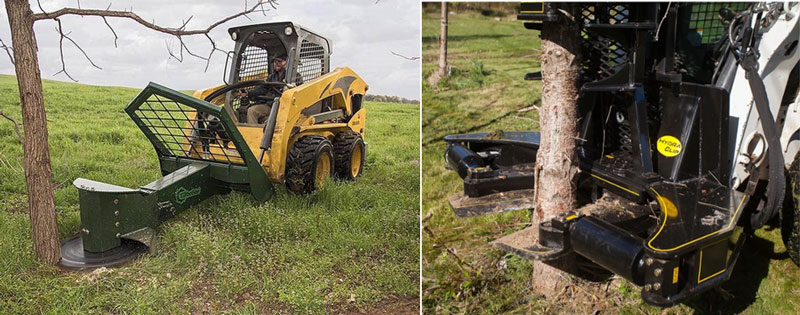
Figure 3. Turbo saw (left) and hydra clip (right). Photo credit: Skid Steer Solutions (left) and John Deere PrairieLand Partners (right).
Although animal exposure to the herbicide is reduced by basal and cut-stump treatments compared with foliar treatments, grazing and haying restrictions must still be followed. There are no restrictions before grazing with any of the herbicides discussed here that are labeled for use in pasture and rangeland. Check labels for restrictions for use before hay harvesting, removal of animals before slaughter, and for use around lactating dairy animals.
The use of trade names is for clarity to readers and does not imply endorsement of a particular product, nor does exclusion imply non-approval. Always consult the herbicide label for the most current use requirements.
Molly Reichenborn, Range Management Extension Specialist
mreichenborn@ksu.edu
Keith Harmoney, Range Scientist - Hays
kharmone@ksu.edu