Wet Weather Can Affect Soybean Seed Quality at Harvest
Recent rainfall across parts of Kansas has provided welcome moisture for wheat planting, but it may create additional challenges for soybean harvest. As mature soybeans remain in the field during wet weather, producers should be aware of potential seed-quality problems, including pod shattering, seed splitting, sprouting, discoloration, and seed diseases. Early identification of these issues can help in making timely harvest decisions to minimize losses.
The combination of mature soybeans, warm temperatures, high humidity, and repeated rainfall can create conditions favorable for seed deterioration. At the same time, wet fields may delay harvest, extending the time mature pods and seeds are exposed to these conditions.
Scout fields while waiting for harvest
Producers should regularly scout fields as conditions allow, especially in areas that received the most rainfall, in fields with lodging, and in low-lying zones, to build confidence in making timely decisions.
Look inside the pods to check for healthy seeds (Figure 1A) and seeds with changes in appearance. Purple discoloration can be associated with purple seed stain (Figure 1B), while cracked, shriveled seed with white, chalky fungal growth may indicate Diaporthe seed decay (Figure 1C).
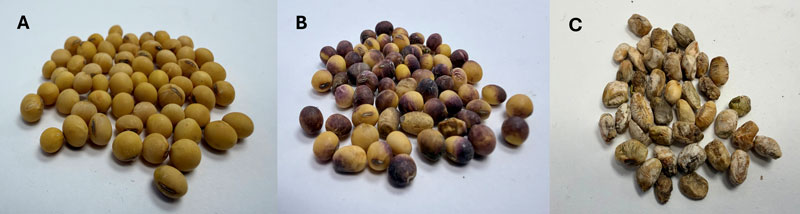
Figure 1. Soybean Seed Quality. Healthy soybean seeds (A), purple seed stain symptoms on soybean seeds (B), and Diaporthe-infected soybean seeds (C). Photos by Rodrigo Onofre, K-State Extension.
Disease development is not necessarily uniform across a field. A field that appears relatively healthy from the road may still have areas where seed quality has deteriorated. Sampling several locations within a field can provide a better indication of the overall condition of the crop.
Watch for sprouting and pod shattering
Repeated wetting and drying can also cause problems even when no fungal disease is present. Mature soybean pods can absorb moisture during rainfall, allowing seeds to swell. If conditions subsequently become warm and dry, pods may split and release seed before the combine reaches the field.
In-pod sprouting is another concern when mature soybeans experience prolonged periods of wet weather. Seeds can absorb enough moisture to begin germinating while still inside the pod. Split pods and sprouted seeds may then contribute to harvest losses and reduced grain quality.
Pod shattering can become particularly important as soybean moisture declines. K-State research has shown that soybean dry-down can occur relatively rapidly under favorable conditions, so producers should monitor fields closely rather than assuming that wet conditions will persist. Soybeans are generally harvested at about 13% moisture; harvesting at excessively low moisture increases the risk of shattering and mechanical damage.
Harvest when field conditions allow
When fields become dry enough to support equipment, producers should prioritize soybean fields where seed quality is deteriorating or where significant shattering or lodging is occurring, such as fields with visible seed loss or lodged plants in contact with wet soil.
This does not mean harvesting whenever the soil surface becomes marginally dry. Running equipment through saturated soils can cause significant soil compaction and rutting. However, once field conditions are suitable, unnecessary delays may increase the risk of additional seed loss and quality deterioration.
Fields should be prioritized based on more than just maturity. Consider:
- Seed quality: Check pods and seeds for discoloration, cracking, sprouting, or fungal growth.
- Pod shattering: Fields with dry, brittle pods or visible seed loss should receive higher priority.
- Lodging: Lodged plants in contact with wet soil are more susceptible to deterioration and may be more difficult to harvest.
- Field conditions: Avoid creating unnecessary compaction or rutting by entering fields before they are sufficiently dry.
Pay attention to what goes into the truck
Seed quality problems may not be obvious from the combine cab. Before hauling soybeans to an elevator, inspect representative samples from the field and from harvested loads to catch issues such as seed damage or discoloration early.
Elevators may evaluate loads for factors such as split or damaged seed, foreign material, discoloration, and other quality concerns. Discounts or rejection thresholds can vary among elevators, so producers should understand the quality standards at their delivery point.
This is particularly important for fields that have experienced prolonged wet conditions. A quick inspection of the grain before hauling can help identify potential problems before an entire load is delivered.
Keep scouting until harvest
Continue scouting until harvest, so producers can adapt to changing weather and field conditions, ensuring optimal seed quality and harvest timing. For now, the best approach is to monitor fields closely, identify areas where seed quality is declining, and be prepared to harvest when field conditions permit. A few minutes spent opening pods and examining seeds can help determine which fields should move to the front of the harvest schedule.
Logan Simon, Southwest Area Agronomist
lsimon@ksu.edu
Rodrigo Onofre, Row Crop Plant Pathology Specialist
onofre@ksu.edu