New Pesticide Label Requirements Comply with the Endangered Species Act
The way pesticide use is regulated to protect threatened or endangered species is evolving as the Environmental Protection Agency (EPA) works to meet its obligations under the Endangered Species Act. The new application requirements focus on reducing drift and/or runoff, especially in areas where protected species may be affected. Applicators will need to check a website for additional pesticide use limitations that apply in these areas.
How to find additional requirements
Some of the updated drift and runoff mitigations will be listed on the label and apply to all applications. The process to identify application requirements for a field is outlined below.
- Check Bulletins Live! Two (BLT) within six months prior to the day of application.
- Enter the EPA registration number of the pesticide and the application month to obtain the bulletin. Figure 1 displays a screenshot of the information needed for an early spring application of a new herbicide, Empera Herbicide, in east central Kansas.
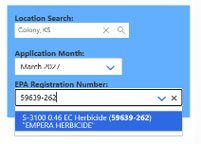
Figure 1. Search fields required to obtain an Endangered Species Protection Bulletin from Bulletins Live! Two.
- Determine whether a Pesticide Use Limitation Area (PULA) applies to the application site. Figure 2 shows a map of PULAs for an Empera Herbicide application near Colony, KS. Even though all new herbicide labels have instructions to check BLT, not all will have a PULA. For example, both Storen and Liberty Ultra require checking BLT, but there are currently no PULAs in Kansas for these products (Figure 3).
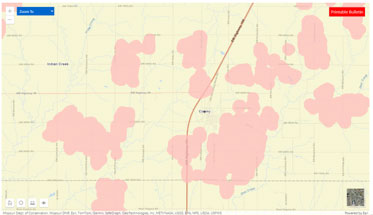
Figure 2. Pesticide use limitation areas (PULAs) that require additional protections for threatened and/or endangered species for a March application of Empera Herbicide are highlighted in pink on the map.
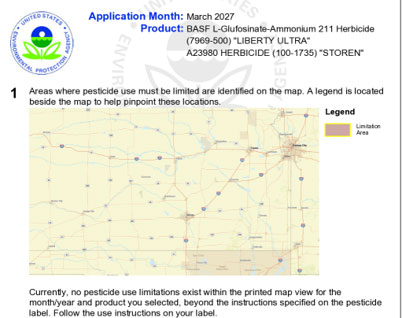
Figure 3. The labels for Liberty Ultra and Storen require applicators to check BLT, but there are no PULAs in Kansas.
- Follow the additional limitations for the PULA. Figure 4 shows the drift and runoff mitigations required inside one of the PULAs from Figure 2. These limitations are in addition to any drift and runoff mitigations listed on the label.
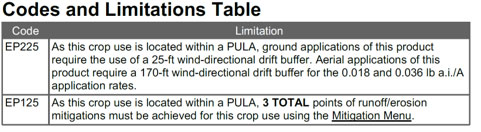
Figure 4. In the selected field, an Empera Herbicide application requires both runoff and drift mitigation. Nearby areas only require runoff mitigation.
- Keep a copy of the bulletin with your spray records. If the field is not in a PULA, you still need to document that no additional requirements were posted when you looked for a bulletin.
Mandatory spray drift mitigation
Spray drift management is not a new requirement, but it is being mitigated in new ways.
- Restrictions on wind speed may differ from older requirements.
- Labels or bulletins may specify downwind buffers. Areas that can be included as the buffer may be listed on the label or discussed in the mitigation menu.
- Buffer reduction options are also listed on the label or the bulletin.
- The EPA has an Ecological Spray Drift Buffer Reduction Calculator that can be used to determine the required buffer distance after buffer reduction options are considered.
Mandatory runoff mitigation
Runoff restrictions are not new to herbicide labels, either. But new mitigation requirements are based on a point system.
- Runoff mitigation is not required if the area 1,000 ft down-slope of the application contains managed areas, and in other special situations.
- Applications may require 0 to 9 mitigation points.
- Some fields may have up to 6 mitigation points based on runoff vulnerability
- Additional points can be earned by tracking mitigations and using soil conservation practices. These are described in the EPA’s mitigation menu.
- Coordination with the landowner and/or farm manager may be necessary for some mitigation options because required mitigation may involve changes to field or land-management practices.
In addition to the websites referenced above, the EPA has developed a Pesticide App for Label Mitigations (PALM) to provide guidance for applicators. PALM is a web-based, mobile-friendly application that includes both a runoff and drift calculator. It does provide a summary of the calculations for record-keeping purposes.
Many pesticide applications include multiple active ingredients. As with all label restrictions, the most restrictive label requirements for drift and runoff mitigation should be followed.
Take Home Message
Pesticide labels will now direct applicators to EPA websites to determine additional site-specific restrictions. Applicators should complete these checks before application and document the steps they took to comply. Documentation will be key to determining compliance with these new requirements.
Frannie Miller, Pesticide Safety and IPM Coordinator
fmiller@ksu.edu
Sarah Ganske, Extension Weed Specialist
slancaster@ksu.edu