Understanding Nutrient Testing in Agriculture: Extraction vs. Digestion
Background
Nutrient testing is an important tool for nutrient management in agriculture. Laboratory analyses provide information about the nutrient content of soils, compost, manure, fertilizers, and other materials and can help guide management decisions. Crop residues, food industry by-products, sediments from retention ponds and lagoons, and other materials entering or leaving an agricultural system may also be analyzed. Because of the wide variety of materials and nutrients being tested and the various end uses of test results, laboratories use a variety of analytical methods. Most fall into two general approaches: extraction and digestion. These approaches answer fundamentally different questions, and understanding the difference is important when interpreting lab results (Figure 1).
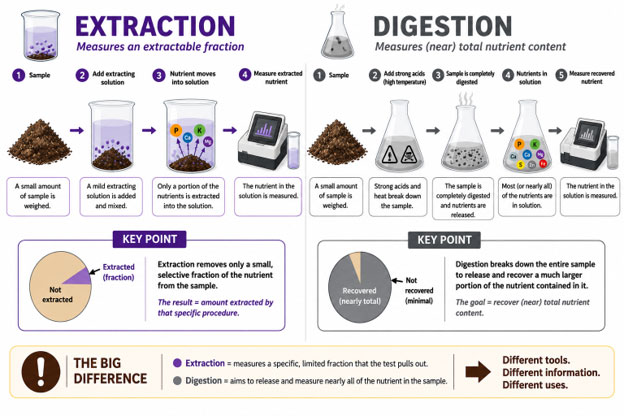
Figure 1. Extraction and digestion methods answer different questions. Extraction measures a specific nutrient fraction removed by a chemical solution, while digestion is used to measure the total nutrient content of a material. The meaning and usefulness of the results depend on the material being tested and the purpose of the analysis. Graphic created by Gustavo Roa with assistance from ChatGPT (OpenAI).
What is digestion?
Generally speaking, a digestion is used to answer the question:
How much of this nutrient is contained in this material?
During digestion, the goal is to break down the sample material to release all, or nearly all, of the nutrient so it can be measured. This often requires high heat, strong acids, and/or oxidizers to break down and dissolve the sample.
The resulting measurement is used to determine the total nutrient content of the material, as defined by the analytical method.
Digestion in agricultural soils
A total nutrient value tells us how much of a nutrient is present in the soil, but it does not tell us how much may become available to the crop. Nutrient availability in soil is controlled by several chemical and biological processes that a total measurement does not capture. Therefore, total nutrient measurements have limited value for routine soil testing and fertilizer recommendations. Unlike established soil-test extractions, total nutrient measurements generally have not been correlated and calibrated with crop response to provide a reliable basis for fertilizer recommendations.
Digestion in agricultural amendments
For agricultural amendments, such as manure and compost, total nutrient analysis answers a different and very practical question:
How much nutrient is contained in the material?
This information helps determine the nutrient concentration of the material and how much nutrient is being added to a field. Standard manure-analysis procedures use digestion to measure several nutrients.
However, total nutrient content is not the same as nutrient availability. Not all of the nutrients measured by digestion will become available to a crop immediately. Nutrients can occur in different forms and may be released as the material decomposes in the soil.
What is extraction?
Extraction asks a different question:
How much of a nutrient can be removed from this material under a specific set of chemical conditions?
Extractions are designed to measure a specific portion of a nutrient rather than the total amount. As a result, extraction procedures intentionally avoid breaking down the sample material. Rather than using strong acids and high heat, extractions are often performed at room temperature and use relatively dilute salt-based solutions.
Different extracting solutions are used for different nutrients and purposes. For example, Bray-1 is commonly used to extract phosphorus, ammonium acetate is used to extract potassium, and Mehlich-3 is a multi-nutrient extraction that can measure several nutrients from the same soil sample.
Unlike digestion, an extraction does not attempt to recover the total amount of a nutrient. It measures the fraction extracted under the specific conditions of that test.
Extraction in agricultural soils
For soil testing, an extraction can provide a useful measurement of soil nutrient status. However, the extraction itself does not automatically tell us how much fertilizer to apply.
To use an extraction for fertilizer recommendations, researchers conduct correlation and calibration studies to establish relationships among soil-test results, crop response, and fertilizer application. Once adequately correlated and calibrated, the soil-test extraction can be used to support fertilizer recommendations.
Extraction in agricultural amendments
For agricultural amendments such as manure and compost, there is limited practical value in simply applying a soil-test extraction such as Mehlich-3 to the material.
Mehlich-3 can extract nutrients from amendments, but the result should not automatically be interpreted as plant-available nutrients. Most of the nutrients in manure or compost only become available as they decompose in the soil. This occurs rapidly enough in field settings for the crop to utilize much of these nutrients, but they are not measured by the extractions used in soil tests. As a result, the amount extracted by Mehlich-3 does not tell us how much of that nutrient a crop will obtain after the amendment is applied.
For amendments, determining nutrient availability requires research that follows nutrient release over time and relates that release to crop uptake or crop response.
An example of extraction versus digestion
The difference between these approaches can be seen in a forage sample submitted to the K-State Soil Testing Lab for total nitrogen and nitrate-nitrogen (NO3-N) analysis (Figure 2). Both tests provide valuable information about the nutritional value of the forage. Total nitrogen is directly related to crude protein, while nitrate-nitrogen is important because excess nitrate can cause toxicity in livestock.
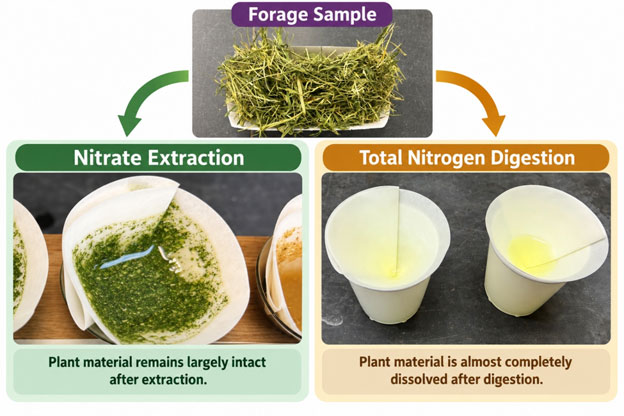
Figure 2. Comparison of a dried forage sample (top center) with the amount of plant material left after nitrate extraction (bottom left) and a nitrogen digestion (bottom right). Photo credit: Bryan Rutter and K-State Soil Testing Laboratory.
The Take-Home Message
- Digestion and extraction answer different questions. The usefulness of either method depends on the question we are trying to answer.
- For soil fertilizer recommendations, use a soil-test extraction that has been appropriately correlated and calibrated with crop response.
- For manure, compost, and other amendments, a total nutrient analysis can tell us how much nutrient is in the material, but it does not tell us how much or how quickly that nutrient will become available to a crop.
- Extractions used for soil fertility analysis are generally not useful for manure and compost. Make sure to select the appropriate tests from the lab. Traditional soil tests will vastly underestimate the nutrient content of manure and compost.
- Before interpreting a nutrient test, know what was measured. Ask the laboratory what analytical method was used and whether the reported value represents total nutrient content or a specific extracted fraction, if it is not clearly stated on the report.
Gustavo Roa, Postdoctoral Research Associate
groa@ksu.edu
Bryan Rutter, KSRE Soil Testing Lab Manager
rutter@ksu.edu; soiltesting@ksu.edu
Dorivar Ruiz Diaz, Soil Fertility & Nutrient Management Specialist
ruizdiaz@ksu.edu
Lucas Haag, Agronomist-in-Charge, Tribune
lhaag@ksu.edu