Management Adjustments When Planting Wheat Late
Some producers have delayed planting due to ongoing summer crop harvest or wet conditions following recent fall rains. Planting in early October is just beyond the optimal range for northwest Kansas and moving towards the latter part of the optimal range for north-central Kansas. Planting in late October to early November remains acceptable in southeast and far south-central Kansas, but is considered late for most other regions and beyond the cutoff for full crop insurance coverage. Although reasonable yields can still be achieved, late-planted wheat typically experiences cooler fall temperatures and has less time to tiller before winter dormancy (Figure 1). This limited fall growth reduces yield potential and increases the risk of winter injury.
Research conducted by Merle Witt with late-sown wheat in Garden City from 1985 through 1991 is summarized in Figure 2. Averaged across all these years, delaying wheat sowing from October 1 to November 1 delayed the heading date by 6 days and decreased wheat yields by 23%. The grain-filling period was progressively shortened by about 1.7 days and occurred under hotter temperatures (about 1.5°F) for every month of delay in sowing date.
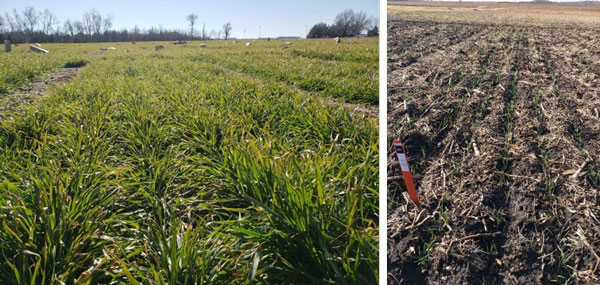
Figure 1. Differences in fall growth and development of wheat crops planted in late September (left) versus late October (right) near Hutchinson, in south central Kansas. Photos taken mid-December of the planting year by Romulo Lollato, K-State Wheat and Forage Extension Specialist.
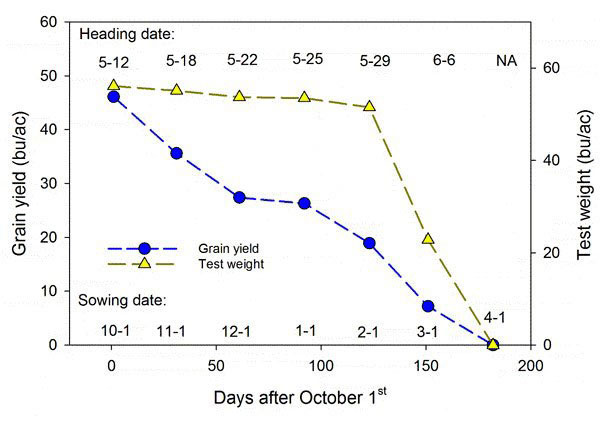
Figure 2. Wheat grain yield, test weight, and heading date responses to sowing date between 1985 to 1991. Data adapted from Kansas Agric. Exp. St. SRL 107.
Under these circumstances, some management adjustments can be made to compensate for the consequences of late planting. These adjustments include:
Increase seeding rate
Increasing seeding rate with delayed planting is likely the most important management adjustment farmers can make. Late-planted wheat usually produces fewer fall tillers than wheat sown at the optimal time. Because fall tillers contribute more to yield than spring tillers, increasing seeding rates can help produce the final head density needed capture yield potential. Recommended seeding rates for Kansas vary by precipitation zone (Table 1) and should be increased for each week planting is delayed beyond the optimal window: about 150,000 – 225,000 seeds per acre (or 10 to 15 lb/acre) in western Kansas, or 225,000 – 300,000 seeds per acre (15 – 20 lb/acre) in eastern Kansas.
Avoid excessive seeding rates since they increase the potential for lodging and greater early-season water use. This can increase the risk of “haying off,” where high fall biomass and limited spring moisture reduce yield, as seen in the 2023–24 season.
Table 1. Seeding rates for grain-only wheat production in Kansas at optimum planting dates. Upward adjustments to these rates are needed when planting late.
|
Kansas Region |
Seeds/acre* |
Seeds/ft2** |
|
Western |
750,000-900,00 |
17-21 |
|
Central |
900,000-1,125,000 |
21-26 |
|
Eastern |
1,125,000-1,350,000 |
26-31 |
|
Irrigated |
1,200,000-1,500,000 |
28-34 |
*To convert seeds/acre to pounds/acre, divide by the number of seeds per pound (e.g., 900,000 seeds = 56 lb for 16,000 seeds/lb, or 82 lb for 11,000 seeds/lb).
**To determine the row length needed for one square foot based on row spacing, divide 12 by the row spacing (e.g., if row spacing is 7.5 inches, 12/7.5 = 1.6 feet, or 19.2 inches of row are needed to be equivalent to one square foot).
A four-year study was conducted at Colby to investigate of increasing seeding rates could overcome the effects of late planting. Figure 3 shows the 4-year average yields from that study.
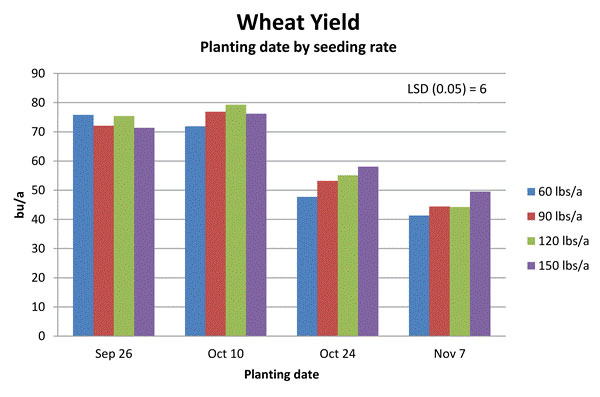
Figure 3. Wheat grain yield response to sowing date and seeding rate between 2009 to 2012 at Colby, Kansas.
The following conclusions can be made from this study:
- Wheat yields were much higher when planted at, or soon after, the optimal time: Sept. 26 or Oct. 10.
- At the earliest planting date, seeding rate had no effect on grain yield. This is because the plants had plenty of time to tiller, especially at the lower seeding rates.
- At the Oct. 10 planting date, seeding rate did impact yield with the 120 lbs/acre seeding rate yielding more than the 60 lbs/acre rate.
- When planting dates were later than optimal, increasing the seeding rate improved yields significantly. However, the higher seeding rates did not fully compensate for the effect of delayed planting. Even with increased seeding rate, the combined effect of reduced tillering and lack of time for development of the crown resulted in lower yield potential.
- Increasing the seeding rate at late planting dates has the potential to compensate for the decreased tillering potential of wheat planted late, and increases yields compared to the lower seeding rates – although no amount of seed at a late planting date can overcome the overall effects of late planting.
Maintain the optimal planting depth (1 to 1.5 inches)
Wheat requires at least 4 to 5 leaves and 1 to 2 tillers before winter dormancy to achieve maximum cold tolerance. Late-planted wheat will most likely have fewer tillers and leaves than wheat planted at the optimal timing and, therefore, will be more susceptible to winter kill. Proper depth ensures good root anchorage and crown insulation for winter survival. Shallow seeding increases the risk of winter injury, while planting too deep may reduce emergence in cool soils. Aim for a uniform 1–1.5 inches below the soil surface.
Apply starter phosphorus (P) fertilizer with the seed
Phosphate-based starter fertilizer promotes early-season wheat growth and tillering, which can help compensate for the delayed sowing date. Additionally, P is less available under colder soil temperatures, which can result in P deficiency under cold weather conditions. When planting late, producers should strongly consider using about 20-30 lbs/acre of actual P (applied as 11-52-0 or 18-46-0) directly with the seed, regardless of soil P levels. This placement ensures roots access the P quickly, supporting early development. In-furrow P is particularly valuable for:
- Late-planted wheat
- Wheat for grazing
- Wheat in acidic soils
- Fields with low soil phosphorus levels
Use a fungicide seed treatment and/or certified seed
Cold, wet soils delay emergence and increase the risk of seed and seedling diseases. Fungicide seed treatments protect against these conditions and improve stand establishment. Ensure thorough seed coverage for full protection. For fungicide seed treatment options, please refer to the K-State fungicide seed treatment chart available at: https://www.bookstore.ksre.ksu.edu/pubs/MF2955.pdf. Using certified seed may also be warranted to ensure good seed viability and quality, as well as variety purity.
Variety selection
Although it may be too late to change varieties this season, keep in mind that varieties differ in tillering capacity and maturity. High-tillering and early-maturing varieties generally perform better when planted late than low-tillering, later-maturing varieties. Late-planted wheat can translate into delayed development in the spring, which can result in plants being exposed to heat stress during grain filling, reducing the duration of the grain filling period and therefore grain yield (Figure 4). When planting late, avoid varieties that require strong fall growth for optimal yield. In central and eastern Kansas, K-State wheat variety trials often include fields planted late after soybean harvest; these results can help identify varieties suited for delayed planting in your region. For more information on selecting a wheat variety, please refer to the Kansas Wheat Variety Guide at https://bookstore.ksre.ksu.edu/item/kansas-wheat-variety-guide-2025_MF991.
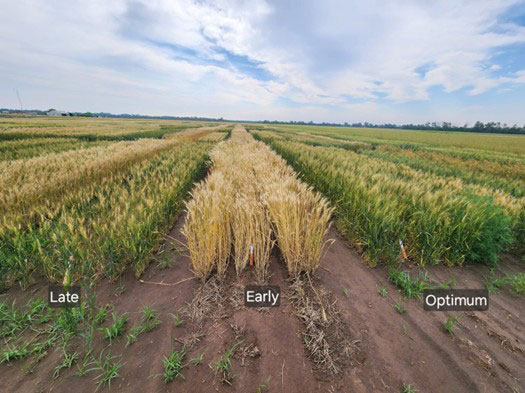
Figure 4. Winter wheat variety by management by planting date study near Hutchinson, KS, demonstrating how different planting dates result in different spring development. Photo taken on June 4, 2025, by Jazmin Gastaldi, MS student in the Wheat and Forage Extension program at K-State.
Romulo Lollato, Wheat and Forages Specialist
lollato@ksu.edu
John Holman, Cropping Systems Agronomist – Garden City
jholman@ksu.edu
Lucas Haag, Agronomist-in-Charge, Tribune
lhaag@ksu.edu
Logan Simon, Southwest Area Agronomist
lsimon@ksu.edu
Jeanne Falk Jones, Northwest Area Agronomist
jfalkjones@ksu.edu