Rate of Dry Down in Grain Sorghum Before Harvest
The dry-down rate of grain sorghum is a common question as harvest approaches. Based on previous research, the average dry down rate depends on weather, primarily temperature and moisture conditions; however, modern hybrid data are limited.
The latest Crop Progress and Condition report from Kansas Agricultural Statistics, on September 27, stated that grain sorghum maturity was 59%, ahead of last year (47%) and the 5-year average (50%). Harvest is at 12% this year, ahead of last year (7%) and near the 5-year average (11%). Crop condition was rated 39% poor to very poor, 37% fair, and 24% good to excellent.
Recent Temperature and Precipitation Patterns
The weather conditions from early September to early October are critical for sorghum, as they affect the grain-filling rate and the final grain weight. While September began with very unseasonably hot conditions, temperatures trended cooler but still above normal towards the end of the month(Figure 1, top map). The heatwave to start the month resulted in numerous days with high temperatures above 100° F, with lows only dropping into the 50° F range for a few days.
Conditions were very dry to begin the month. However, widespread heavy rainfall occurred as the calendar turned to October. Localized, very heavy precipitation in some areas, primarily west and southwest Kansas, resulted in these locations observing 300%+ of normal rainfall (Figure 1, bottom map). These areas have experienced persistent moisture, yielding good soil moisture profiles in these locations. However, the heavy nature of the precipitation resulted in runoff, especially in western and northern Kansas. Other areas, such as far eastern Kansas, were drier than normal and observed some drought expansion. These wet conditions don’t well represent the early month extreme dry conditions for the month of September.
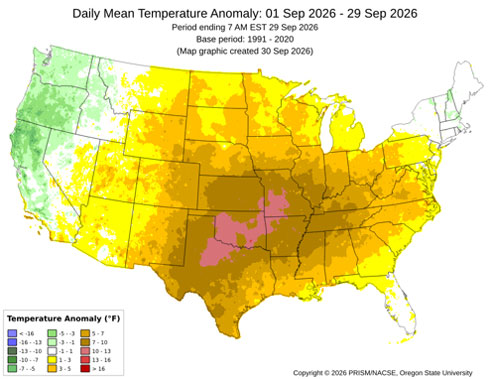
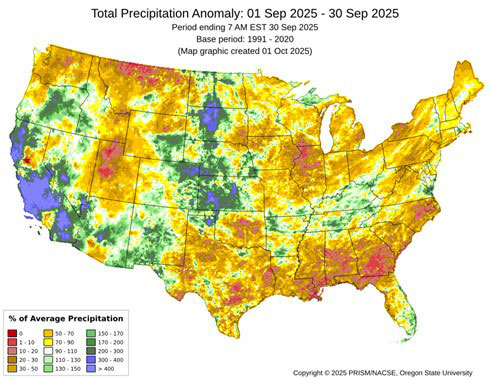
Figure 1. Departure from normal temperatures (top map) and percent of normal precipitation (bottom map) from September 1 – 30, 2025. Maps by PRISM.
Weather Outlook for October and November
The recent transition towards much wetter conditions will yield slow short term drying. Additionally, the net effect of high soil moisture and standing water will result in warm overnight temperatures (despite cooler afternoons expected) and overall high humidity until a longer period of dry weather becomes established.
The weather outlook for October favors continued (but moderated) above-normal temperatures and equal chances of at/above or below-normal moisture. However, the next two weeks are expected to favor much drier conditions than those over the past week. As the calendar turns to November, average precipitation continues to decrease each month through the winter. With the current trends in ocean temperatures favoring El Niño, another one or potentially two high-impact storms are possible, which may lead to an average above normal precipitation through late October/November. Despite periods of drier weather, like that expected into mid-October, these periods of potentially heavy rain may result in much higher humidity and challenges in adequately drying down.
Understanding growing degree days (GDD) and crop maturity helps predict dry-down timing, especially since some Kansas fields may not reach harvest-ready moisture before frost.
From a crop perspective, the cumulative GDD from flowering to maturity is about 800 for short-season hybrids to 1200 for full-season hybrids (based on 50°F as the base temperature). At this time, there remains acreage of grain sorghum in central and western Kansas that has yet to exert heads, which understandably presents concerns about production of any mature grain by the end of the growing season or first killing frost, which generally ranges from early October in northwest Kansas to late October in south central Kansas. In many cases, this stunting of growth was due to persistent drought across the region throughout the growing season. On average, GDDs remaining to be accumulated from September 28 to October 15 in the region range from 205 to 229, which would not be enough to mature grain sorghum that has not yet reached the soft dough stage.
As grain sorghum progresses from soft dough to maturity, grain moisture content declines from 80-90% to around 30%, when the black-layer is formed (Figure 2). From maturity (seen as a “black-layer” near the seed base; Figure 2) to harvest time, sorghum grain will dry down from about 30 to 13% moisture, but the final maximum dry mass accumulation and final nutrient content will have already been attained at black layer.
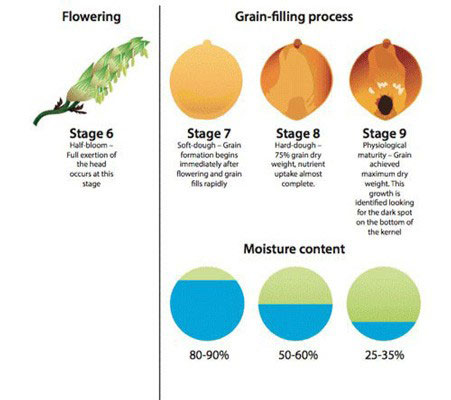
Figure 2. Sorghum growth stages include half-bloom and grain filling (including soft dough, hard dough, and physiological maturity). Infographic representing changes in grain coloration and moisture content during the grain filling period until black layer formation (maturity). For further reference on sorghum growth and development, please check: https://bookstore.ksre.ksu.edu/pubs/MF3234.pdf. Graphic by K-State Research and Extension.
Dry down process for grain sorghum
Grain water loss occurs at different rates but with two distinct phases: 1) before “black-layer” or maturity (Figure 2), and 2) after black-layer. For the first phase, Figure 2 illustrates the changes in grain moisture from soft dough to physiological maturity in sorghum.
To answer the rate of dry down question, a study was conducted to investigate the effect of the grain dry down rate from the moment of “black-layer” until commercial harvest grain moisture is reached. For the conditions experienced in 2019, 2021, and 2022 (from early September until mid-October), the overall dry-down rate was around 0.7% per day (from 31-34% to 16-17% grain moisture), taking about 30 days. This is slower than the average daily drying rate for corn (1%) and for soybeans (3%).
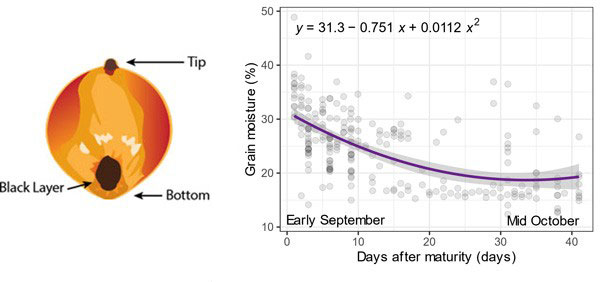
Figure 3. Grain moisture dry-down across different sorghum hybrids in a study near Manhattan, KS (2019, 2021, and 2022 growing seasons). The graphic in the left panel illustrates the black layer stage of sorghum grain. Graphics from K-State Research and Extension.
This dry-down process can be delayed by:
- Low temperatures
- High humidity
- High grain moisture content at black layer (38-40%)
It is expected that the dry down rate will decrease to around<0.5% per day for late-planted sorghum entering reproductive stages later in the growing season. A similar decrease is expected for sorghum exposed to late-season stress conditions (e.g., drought, heat, and freeze). Under these conditions, maturity may be reached with high grain water content, and the last stages after black layer formation could face lower temperatures and higher humidity. These main factors should be considered when it is time to harvest.
You can track temperature and humidity levels on the Kansas Mesonet website at http://mesonet.k-state.edu/weather/historical/ by selecting the station and time period of interest.
Lucas Haag, Agronomist-in-Charge at Tribune
lhaag@ksu.edu
Logan Simon, Southwest Area Agronomist
lsimon@ksu.edu
Jeanne Falk Jones, Northwest Area Agronomist
jfalkjones@ksu.edu
Christopher “Chip” Redmond, Kansas Mesonet Manager