Sudden Death Syndrome in Soybeans: Symptoms, Diagnosis, and Management
Sudden Death Syndrome (SDS) has been reported in soybean fields from south central to northeast Kansas in previous years. In some areas, such as the Kansas River Valley, it is a perennial problem, especially in irrigated fields. Wet soils typically trigger SDS development, and if late-summer rains occur, we can expect to see more symptoms, especially in fields with a known history of SDS. The earlier foliar symptoms appear in the season, the greater the severity and the greater the yield loss.
SDS is a disease caused by the soilborne fungus Fusarium virguliforme. This fungus prefers wet conditions and is therefore usually most severe in irrigated fields or dryland fields that receive significant rainfall during the early-to-mid-reproductive stages. SDS tends to be most severe on well-managed soybeans with a high yield potential. It also tends to be more prevalent in fields that are:
- Infested with soybean cyst nematode
- Planted early when the soil is cool and wet
- Compacted
Historical yield losses from this disease generally range from 1 to 25 percent.
Disease Symptoms
Symptoms of SDS are easily recognizable. SDS begins as small, bright, pale green to yellow circular spots on the leaves during late vegetative or early reproductive growth stages (Figure 1). As the disease progresses, the tissue in these spots starts to die and enlarges to form brown streaks between the veins (Figure 2). Symptoms are more pronounced on the top leaves. As the disease further develops, the leaflets drop off, but the petioles remain attached (Figure 3).
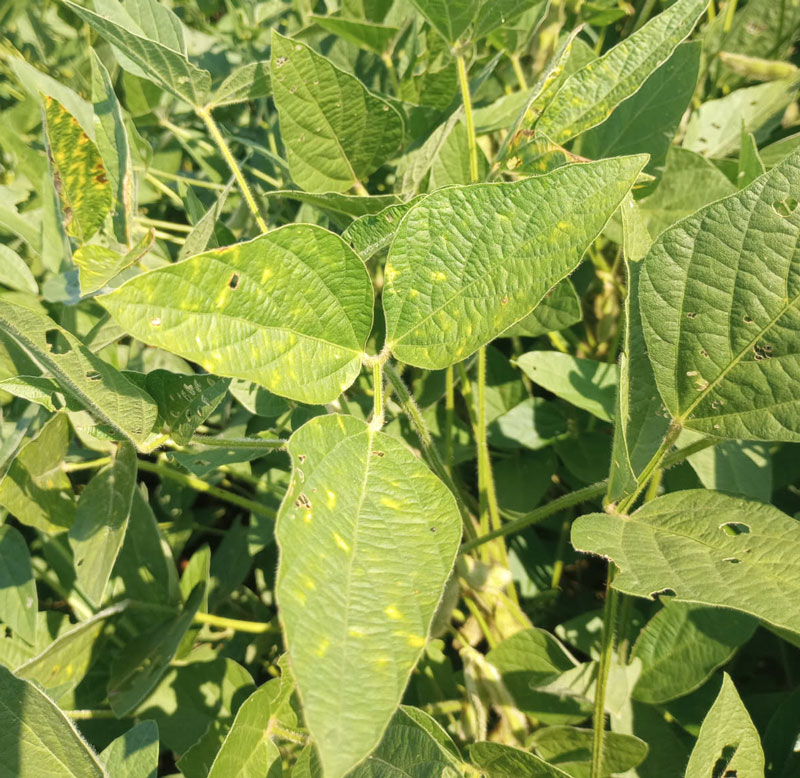
Figure 1. Scattered yellow spots (chlorosis) are the early leaf symptoms of SDS. Photo by Eric Adee, K-State Research and Extension.
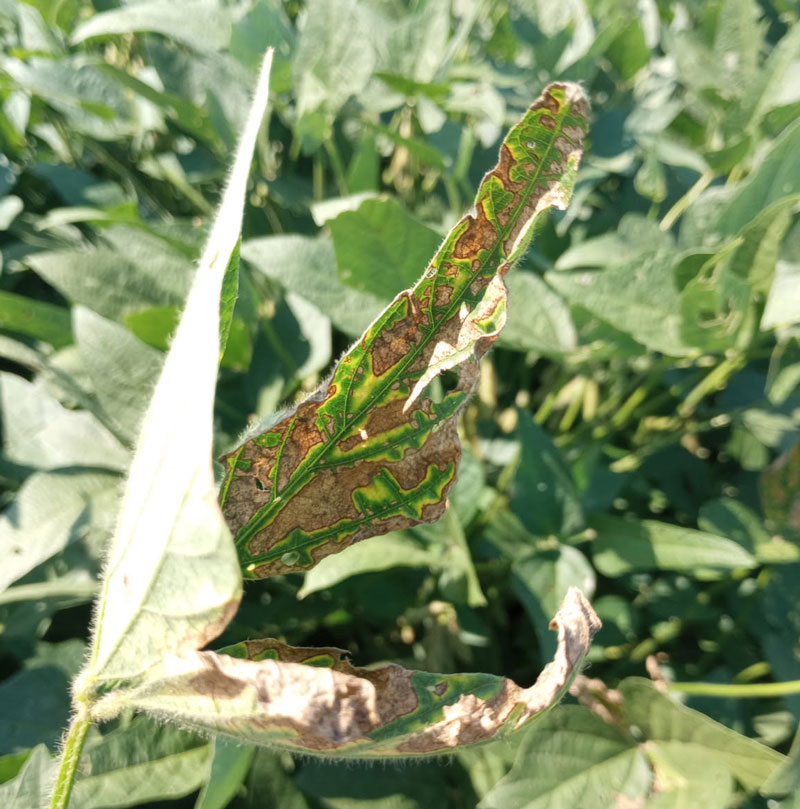
Figure 2. The tissue in the yellow spots will begin to die and enlarge, forming brown streaks between the veins. Photo by Eric Adee, K-State Research and Extension.
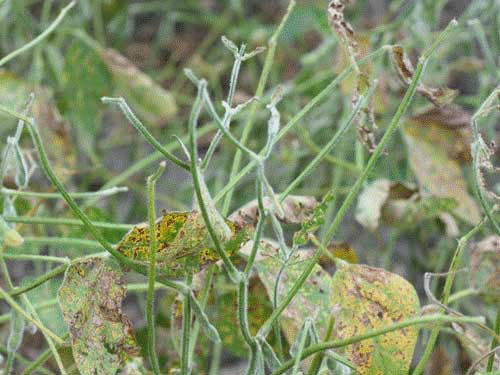
Figure 3. A soybean plant with leaf petals dropped, but the petioles remain attached.
Flowers and pods may abort or not fill. Another key symptom of SDS is substantial root decay and discoloration of the roots and crown (Figure 4).
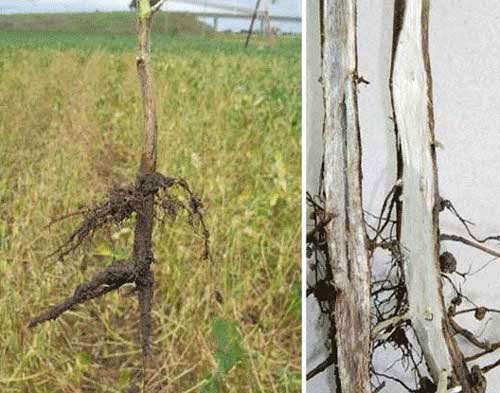
Figure 4. Root rot occurs on plants infected with the SDS pathogen. This symptom distinguishes SDS from brown stem rot and stem canker. Left image by Jim Shroyer, K-State Research and Extension; right image courtesy of Iowa State University.
Diseased plants are easily pulled from the ground because their taproots and lateral roots have deteriorated. Symptoms present on both the leaves and roots are diagnostic for SDS. A positive diagnosis of the inner tap root is key to identifying the disease. Other problems, such as triazole fungicide “burn,” and the diseases stem canker and brown rot, can give similar foliar symptoms. Please be sure to check the tap roots when making a diagnosis.
Yield Loss Potential
Soybean yield losses from SDS depend on both the variety and stage of crop development when the symptoms first appear. Appearance of the disorder at early pod fill is more damaging than its appearance at a later stage of plant development. Yield reduction is the result of reduced photosynthetic leaf area, defoliation, flower and pod abortion, and reduced seed size.
Management Options
Variety Selection
Effective management of SDS requires an integrated approach. Management starts with the planting of SDS-resistant varieties (Figure 5). Most varieties are susceptible to some degree, and very few have excellent resistance. The most susceptible varieties yield 40 to 50 percent less than the resistant varieties at locations where SDS is present, and yield levels are in the range of 60+ bushels per acre.
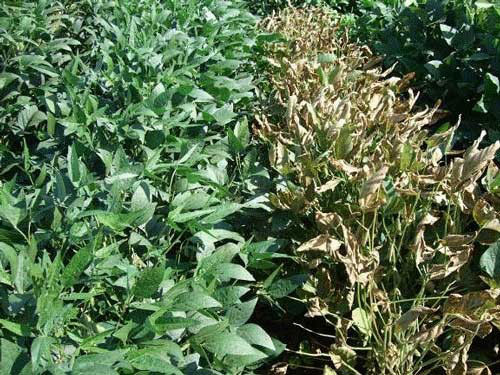
Figure 5. The variety on the right in a recent K-State performance test was susceptible to SDS. The foliage was completely dead by early pod fill. Photo by Bill Schapaugh, K-State Research and Extension.
Seed companies have SDS ratings for most of their varieties, and there is typically wide variation among them. There is little to no correlation between a variety's maturity group and its SDS resistance rating.
SDS and Soybean Cyst Nematodes
The presence of SDS is strongly correlated with soybean cyst nematode (SCN). Therefore, where SDS is present, soil samples should be taken to determine the level of SCN present, and it will need to be managed along with the SDS. However, producers cannot manage SDS by selecting varieties with SCN resistance alone. Some varieties with good resistance to SCN are highly susceptible to SDS, and some varieties that are susceptible to SCN are quite resistant to SDS. Ideally, producers should select varieties that are resistant to both SDS and multiple races of SCN.
Seed Treatments
In addition to resistant varieties, a second line of defense is the use of a planting time seed treatment, such as ILeVO, which contains the active ingredient fluopyram, or Saltro, which contains pydiflumetofen. These products have performed well in several K-State research trials. Other seed treatments evaluated were not as effective as ILeVO or Saltro. The cost of these products has come down since they were first introduced, but it is still costly insurance in fields not known to have SDS, and we recommend its use only in fields with a history of the disease. More information on soybean fungicide seed treatments for SDS is available from the Crop Protection Network. https://cropprotectionnetwork.s3.amazonaws.com/printable_fungicide-efficacy-for-management-of-soybean-seedling-diseases.pdf
Cultural Management Practices
There are some cultural practices that can reduce the risk of SDS infection, including:
- planting SDS-infested fields last (when soil temperatures are warmer); however, K-State research has shown that early planting of a more tolerant variety with a seed treatment for SDS can increase yields in the presence of SDS
- avoiding planting into overly wet soils
- reducing compaction problems within a field
Producers with fields experiencing compaction should make every effort to correct the problem before planting soybeans next season.
Crop rotation has limited effect on SDS, as the fungus has been shown to invade corn debris and survive saprophytically in the absence of a soybean crop.
Testing for Sudden Death Syndrome
SDS testing is currently ongoing at the K-State Plant Disease Diagnostic Lab. Submitting a good sample includes:
- Collecting around 6 symptomatic whole plants.
- Carefully digging up the plants and shaking the soil off.
- Bag the roots and then re-bag the whole sample to keep the plants fresh.
- Keep plants cool until shipped.
Plants sent by UPS or FedEx arrive in good shape. The lab submission form and test fees can be found online at: https://www.plantpath.k-state.edu/extension/plant-disease-diagnostic-lab/
Take Home Message
Sudden death syndrome can cause significant soybean yield loss, particularly when symptoms appear early in the reproductive stages. Scout fields for the characteristic leaf symptoms and confirm the diagnosis by checking for root decay and discoloration. While there are no in-season rescue treatments, the best management strategies are selecting resistant varieties, managing soybean cyst nematode, and using effective seed treatments in fields with a history of SDS.
Eric Adee, Agronomist, Kansas River Valley Experiment Field
eadee@ksu.edu
Judy O’Mara, Plant Disease Diagnostic Laboratory
jomara@ksu.edu