Pesticide Safety Label Acronyms: What do they mean?
Reading and following the pesticide label is the first step toward conducting safe and legal pesticide applications. Labels have multiple acronyms that can be challenging to sort through, but are important to understand when reading the label. This article will discuss some of those acronyms.
PPE = Personal Protective Equipment
Personal protective equipment refers to clothing or devices worn to protect the body from pesticide exposure. Examples of PPE include long-sleeved shirts, long pants, chemical-resistant coveralls, footwear, gloves, aprons, respirators, goggles, face shields, and headgear. An applicator reduces pesticide exposure by wearing the required PPE listed on the label. It is also important to remember to handle your PPE with care.
Before mixing and spraying any pesticide, read the PPE section of the label and make sure the appropriate PPE is available. Inspect gloves and respirators for any damage. Wash reusable PPE after use and store it away from pesticides. Common mistakes include wearing cotton or leather gloves instead of chemical- resistant gloves.
WPS = Worker Protection Standard
The Worker Protection Standard is a federal regulation that protects workers and handlers from exposure to pesticides. The purpose of the regulation is to reduce pesticide-related illnesses and injuries among workers and handlers. The WPS requirements are outlined under the “Agricultural Use Requirements” on the label.
Make sure all workers and handlers are properly trained in the required information. Ensure they are provided with and wear the required PPE.
REI = Restricted Entry Interval
The restricted entry interval indicates how much time must pass before workers are allowed back into treated areas without proper protective equipment. Toxicity of the pesticide, application rate, crop type, and working practices all affect the length of the restricted entry interval.
A typical REI ranges from 4 hours for low-risk products to more than 7 days for highly toxic fumigants. A fungicide with a 12-hour REI means workers cannot enter the field without PPE until 12 hours after application.
Before allowing workers into a treated area, check the REI on the label. Post warning signs if required. Record the application time, so workers know when re-entry is allowed. Do not enter fields before the REI expires.
PHI = Post-Harvest Interval
The post-harvest interval is the minimum number of days after application that the crop can be harvested. It is a pre-harvest restriction that ensures pesticide residues are below safe levels before the crop is marketed or sold. Pesticide, crop type, chemical formulation, and application method all impact the post-harvest interval length. Some pesticides have a zero-day PHI to more than 14 days for some fruit pesticides. The PHI is a crop safety requirement that must be followed before harvest. A pesticide with a 7-day PHI applied to tomatoes on June 1 cannot be harvested until June 8.
Check the PHI before selecting a product to apply to fruits, vegetables, and other crops. Do not assume all products have the same PHI.
Take Home Message
Follow the label checklist below to ensure safe and legal pesticide applications.
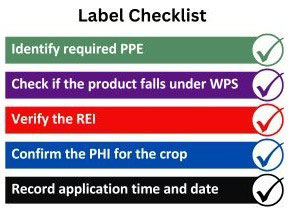
It is important to remember to keep good records of all applications. Understanding these acronyms is more than just memorizing terms; it is essential for protecting applicators, workers, consumers, and the environment while staying compliant with pesticide laws.
Frannie Miller, Pesticide Safety and IPM Coordinator
fmiller@ksu.edu
Sarah Ganske, Weed Science Extension Specialist
slancaster@ksu.edu