Southern Rust Continues to be Detected at Low Levels Across Kansas
Southern corn rust continues to spread and has been detected at trace levels in several Kansas counties (Figure 1). Unlike other important corn diseases, such as tar spot and gray leaf spot, southern rust does not overwinter in Kansas. Instead, the pathogen is introduced each year by wind currents from more tropical regions. In previous years, southern rust was typically detected by early July, and by this point in the growing season, higher disease levels would generally have been reported across the state. However, the 2026 southern rust season has progressed more slowly, with disease incidence remaining lower than is typical.
Most corn fields in eastern Kansas are now at or beyond the optimal fungicide application window and are therefore at reduced risk of significant yield loss. In contrast, late-planted corn in central and western Kansas remains at a higher risk of disease infection and should be monitored closely for disease development. The severity of southern rust is influenced by weather conditions, with disease development favored by daytime temperatures near 90°F (32°C), warm nighttime temperatures, and high relative humidity.
In cooperation with K-State Plant Pathology Department, the Kansas Corn Commission has launched an online Corn Disease Resource Center (https://kscorn.com/corndisease/) to help corn growers identify what diseases to watch for in their geographic area.
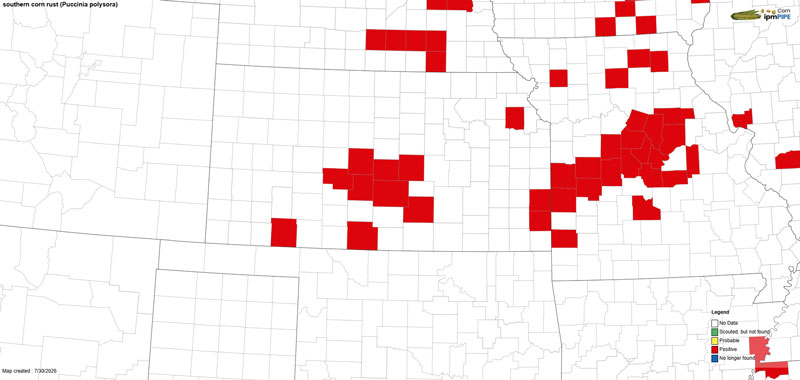
Figure 1. Southern corn rust (Puccinia polyspora) in Kansas as of July 30, 2026. Source: https://kscorn.com/corndisease/
Frequently Asked Questions About Managing Southern Rust:
Should I apply a fungicide prior to observing southern rust?
Applying fungicide to control southern rust is not recommended unless the disease has been observed in the canopy. Now that southern rust has been reported in Kansas, it is time to scout corn fields. Once pustules are observed, the pathogen can reproduce rapidly if temperatures and humidity are high.
What factors should I consider when deciding whether to spray for southern rust?
It is important to consider hybrid susceptibility, disease incidence (the number of plants affected), and the crop's growth stage. Infection early in the season on a susceptible hybrid, coupled with favorable weather conditions, poses the greatest risk of yield loss.
If I apply a foliar fungicide at tasselling (VT) or silking (R1) to control tar spot and gray leaf spot, will this application have efficacy against southern rust?
Yes. Most fungicides labeled for tar spot and gray leaf spot are also effective for southern rust. Depending on the product, they will have residual activity for approximately three weeks after application. Fields should be carefully monitored for disease development.
What fungicides are best to control southern rust?
Efficacy ratings for corn fungicide management of southern rust have been compiled by a working group of corn researchers and can be found here: Crop Protection Network
How do I know if what I’m seeing is southern rust?
Southern rust produces characteristic orange pustules of spores, primarily on the upper side of the leaf (Figure 2). If you run your finger across the pustules, the orange spores will be visible on your hand.
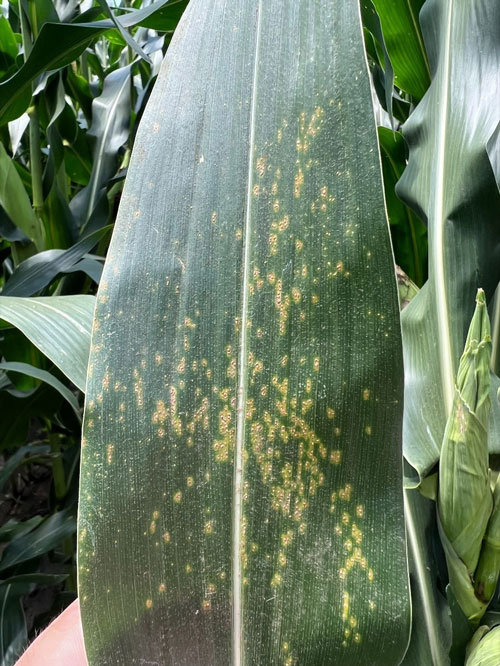
Figure 2. Southern rust on corn. Photo courtesy of Rodrigo Borba Onofre, K-State Plant Pathology.
Help Us Track Corn Southern Rust
If you suspect a field has Southern Rust, contact Rodrigo Onofre directly at 785-477-0171 and/or submit a sample to the K-State Plant Disease Diagnostic Lab at https://www.plantpath.k-state.edu/extension/diagnostic-lab/documents/2021_PP_DiseaseLabChecksheet.pdf.pdf. This will help us monitor the situation in the state. For more information on identifying corn rusts, see K-State Research and Extension Bulletin MF3016, Corn Rust Identification and Management in Kansas.
Rodrigo Borba Onofre, Extension Row Crop Plant Pathologist
onofre@ksu.edu