Herbicide Applications and High Temperatures
Much of Kansas experienced relatively cool, wet weather throughout most of June. However, temperatures climbed quickly this week, and the 30-day forecast from the Climate Prediction Center indicates an increased probability of warmer-than-normal temperatures across most of Kansas. If you are planning herbicide applications, here are some things to consider when applying herbicides during hot weather.
Heat or drought stress slows plant growth processes
This is especially important for systemic herbicides such as glyphosate and grass-killing herbicides like clethodim (Select, others) or quizalofop (Assure II). As temperatures rise above 85°F, many plants slow or stop the metabolic processes that move herbicides throughout the plant, resulting in reduced weed control. In the case of HPPD-inhibiting herbicides (Callisto, others), Palmer amaranth control decreases because of faster herbicide metabolism at high temperatures (90°F and above).
Management: In general, applying systemic herbicides early in the morning, after plants have recovered from heat stress, will give the best chance for the herbicide to reach the active site and effectively kill weeds.
Leaves change in response to heat
To prevent water loss, plant cuticles become waxier in response to heat or drought stress. The greater wax content makes it more difficult for water-based spray solutions to penetrate the plant. In addition, the leaf angle of many plants changes in response to heat or drought stress (Figure 1). This can result in less herbicide contacting the leaf surface to enter the plant.
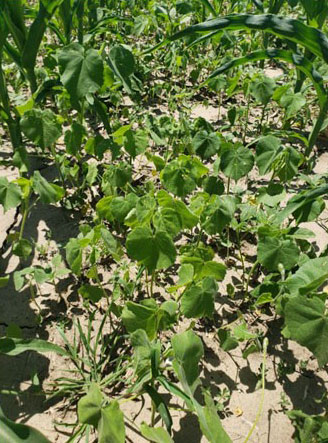
Figure 1. Velvetleaf usually changes leaf angles at night, but the leaves on these plants are vertical in response to high temperatures. Photo by Sarah Ganske, K-State Extension.
Management: Using maximum labeled rates of herbicides and surfactants can help get more spray solution into the plant, increasing effectiveness. Spraying during the cooler parts of the day will reduce the impact of altered leaf angle.
Crop response to foliar-applied, non-translocated herbicides is greater in hot temperatures
When applied in hot, humid conditions, contact herbicides, such as Cobra, Liberty, or Reflex, will likely result in greater foliar injury to crops, but also greater weed control (Figure 2).
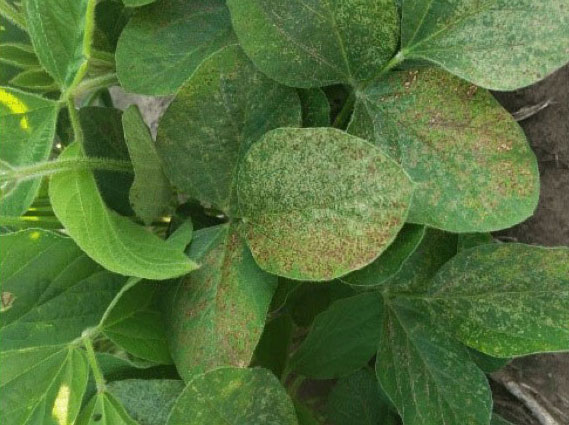
Figure 2. Contact herbicides can cause bronzing of soybean leaves when applied post-emergence. Photo taken 1 week after an application containing flumiclorac (Resource, Perpetuo, others). Photo by Sarah Ganske, K-State Extension.
Management: If possible, postpone application of these herbicides when temperatures exceed 90°F. If weed size requires immediate herbicide application, reduce the herbicide and adjuvant rates and apply later in the day, when the air temperature will decrease after application.
Spray droplets evaporate faster in high temperatures and low humidity
Herbicides must be dissolved in a spray droplet to be absorbed by the plant. If a spray droplet evaporates before or shortly after coming in contact with the target, weed control will be reduced.
Management: Larger droplets will take longer to evaporate, so choose sprayer set-ups that create larger droplets, such as larger nozzle orifices and/or lower spray pressures. Using a drift-reducing adjuvant (DRA) that reduces fine droplets in the spray pattern may also help get more herbicide to the target.
Herbicide volatility increases with high temperatures and low humidity
Herbicides in group four, such as dicamba and 2,4-D, are prone to volatility, meaning they become vapors that can move long distances with even slight breezes. The volatility of these herbicides increases as temperatures rise above 60°F and is greatest above 90°F.
Management: Avoid applying these herbicides when temperatures are over 90°F. This may occur during the morning or late afternoon, when temperature inversions are likely. Herbicides should not be sprayed during inversions, when small spray droplets can become trapped in a layer of cooler air near the earth’s surface. Use larger spray droplets to reduce evaporation, which can be accomplished by reducing spray pressure or increasing nozzle orifice size.
The use of trade names is for clarity to readers and does not imply endorsement of a particular product, nor does exclusion imply non-approval. Always consult the herbicide label for the most current use requirements.
Sarah Ganske, Extension Weed Science Specialist
slancaster@ksu.edu