World of Weeds: Pokeweed
Some questions recently came in about managing pokeweed (Phytolacca americana) in no-till corn and soybean fields. Pokeweed is not closely related to other common weeds or crops. Another common name for pokeweed is inkberry, referring to the reddish-purple stain the berries can leave. All parts of the pokeweed plant are toxic, becoming more so as the plant matures. The root is the most poisonous part, the berries the least. It contains several toxins that can cause symptoms ranging from digestive irritation to seizures. Pokeweed can be fatal to humans. Nonetheless, poke salad (or poke sallet) was once a foraged food made from young pokeweed leaves, which were boiled multiple times to remove the toxins.
Ecology
Pokeweed is an herbaceous perennial plant native to North America. It can be found in cultivated fields, pastures, roadsides, and fencerows. Pokeweed is spread by birds that consume the berries and overwinters as large taproots. In Pennsylvania, pokeweed plants that emerged in May or June grew into perennial plants, producing up to 2,500 seeds.
Identification
Pokeweed cotyledons (Figure 1) are egg-shaped and tinted pink on the underside. The stem is smooth, magenta-tinted, and slightly swollen at the base. Plants can also emerge from fleshy, white taproots that grow up to 6 inches in diameter.
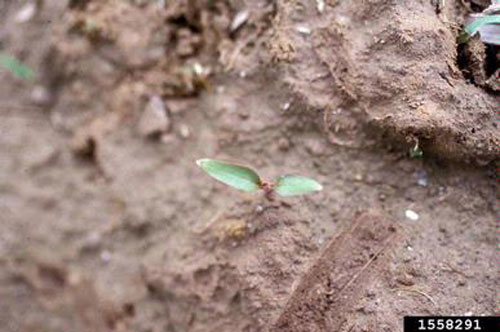
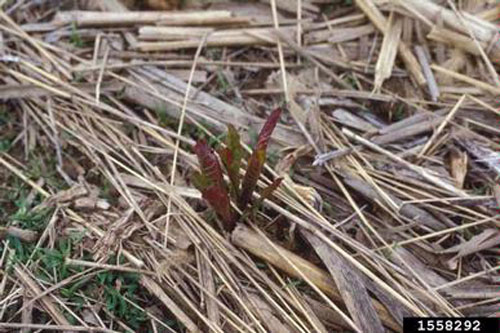
Figure 1. Pokeweed seedlings have large, fleshy cotyledons (top), which are not present on plants that emerge from taproots (bottom). Theodore Webster, USDA Agricultural Research Service, Bugwood.org (top) and Ohio State Weed Lab, The Ohio State University, Bugwood.org (bottom).
The bright magenta-colored stem is succulent. Stems can reach heights up to 10 feet tall and have wide branches in the upper portion of the plant. Large plants can resemble small trees, but their stems are not woody (Figure 2).
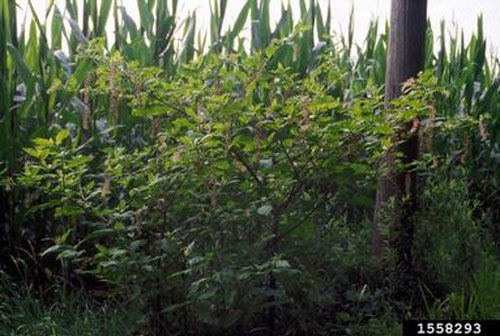
Figure 2. Mature pokeweed plants can resemble a small tree. Image by Theodore Webster, USDA Agricultural Research Service, Bugwood.org.
Wide, oval- to egg-shaped leaves with pointed tips are attached to the stem in alternate positions by a magenta petiole up to 2 inches long. Leaf margins may be slightly wavy with a magenta tint. Leaf surfaces are hairless.
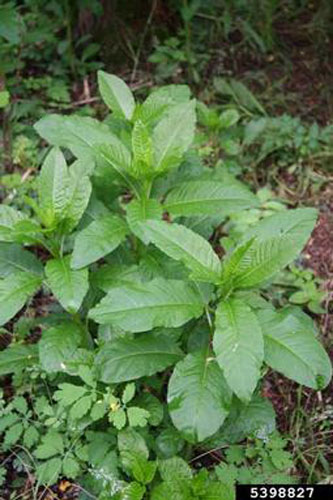
Figure 3. Pokeweed leaves have a pointed tip and may have wavy edges. Image by Robert Vidéki, Doronicum Kft., Bugwood.org.
Flowers are produced throughout the summer on a stalk that is up to 13 inches long that emerges opposite upper leaves. Rounded flowers are greenish and surrounded by white to pink-tinged sepals that look like petals (Figure 4). As plants mature, flowers are replaced by green berries that turn dark purple to black when mature. Each berry contains 10 glossy black, lens-shaped seeds that are about 1/3 inch in diameter.
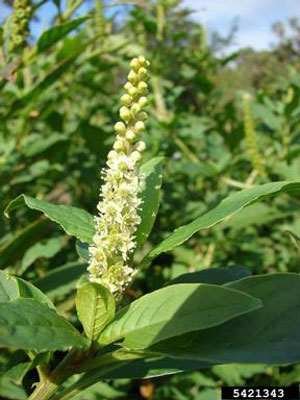
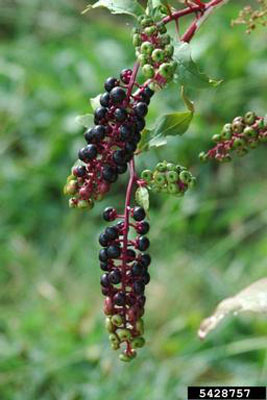
Figure 4. Pokeweed flowers (left) are surrounded by white bracts. Berries (right) are green when immature and turn deep purple to black. Images by Forest and Kim Starr, Starr Environmental, Bugwood.org (left) and Karan A. Rawlins, University of Georgia, Bugwood.org (right).
Management
Because pokeweed is a perennial plant, it will likely take multiple years with multiple herbicide applications to manage established plants. Systemic postemergence herbicides like glyphosate (RoundUp, others), dicamba (Clarity, others), and 2,4-D (Enlist, others) are among the most effective options. Research from Pennsylvania suggests that glyphosate applied alone at 1 lb ae/A or at 0.75 lb ae/A with mesotrione (Callisto, others) can provide up to 80% control by the end of the season. Glyphosate plus dicamba was also effective; however, one year after treatment, the plants recovered. The best application time was when pokeweed was flowering; although crop growth stage may not allow this application.
Pokeweed can emerge throughout the growing season. Preemergence herbicides like atrazine (Aatrex, others), metribuzin (Sencor, others), and sulfentrazone (Spartan, others) applied at planting will control new plants emerging from seeds.
Tillage will control seedlings before the taproot develops, but it is less effective once the plant has become established. Cultural practices like narrow row spacing are also ineffective on established plants.
Carefully monitoring and aggressively managing pokeweed as it becomes established along fencerows and powerlines can help prevent spread throughout the field.
For more information, see the “2026 Chemical Weed Control for Field Crops, Pastures, and Noncropland” guide available online at https://www.bookstore.ksre.ksu.edu/pubs/CHEMWEEDGUIDE.pdf or check with your local K-State Research and Extension office for a paper copy.
The use of trade names is for clarity to readers and does not imply endorsement of a particular product, nor does exclusion imply non-approval. Always consult the herbicide label for the most current use requirements.
Sarah Ganske, Extension Weed Management Specialist
slancaster@ksu.edu