Saving Fertilizer Dollars: Nitrate Testing Irrigation Water
Introduction
Accounting for nitrogen (N) applied with irrigation water can save you money on your fertilizer bill. When not removed with crop harvest, fertilizer, and manure N can leach into the groundwater where it accumulates over time as nitrate. Several factors affect nitrate leaching, such as fertilization rates, precipitation patterns, irrigation rates, soil properties, depth to groundwater, and geology. Therefore, nitrate concentrations in irrigation water are highly variable across the state. Recent analyses of groundwater nitrate in south-central Kansas, for example, showed concentrations ranging from less than 1 ppm to over 50 ppm nitrate-nitrogen (Figure 1).
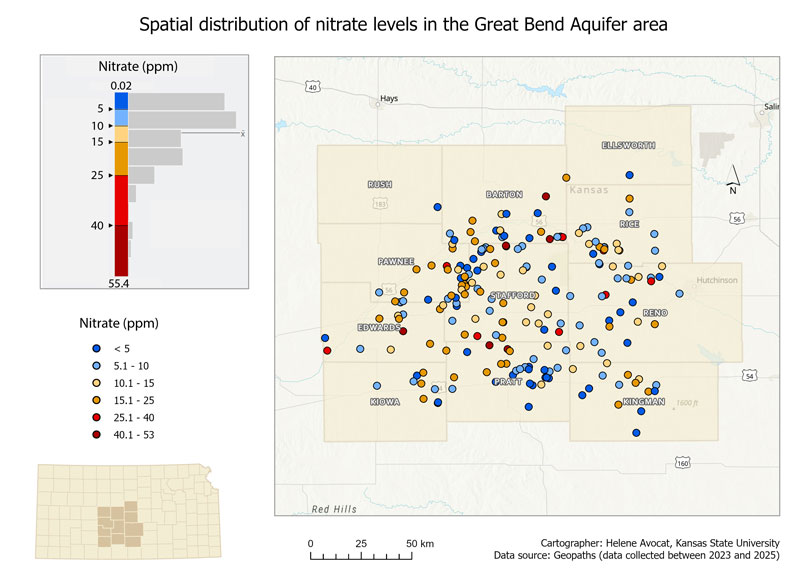
Figure 1. Nitrate-N concentrations in private well water in south-central Kansas, with an average of 12 ppm and a range of 0.02 to 55.4 ppm nitrate-N. These results were produced by students from K-State and Barton and Dodge City community colleges during their participation in the Groundwater Geopaths project.
How much N is applied with my irrigation water?
Estimating the amount of N applied with irrigation water is obtained by multiplying the nitrate concentration in the irrigation water by the irrigation depth and the constant 0.226 (see equation below).

For example, a producer applying 12 inches of water from a well with a nitrate concentration of 15 ppm N would be applying approximately 40 lb N/ac with irrigation water over the growing season (15 ppm x 12 inches x 0.226 = 40.7 lb N/ac).
Recent price increases have raised N near $1/lb of N (28-0-0 selling at $560 per ton), greatly increasing the value of N in irrigation water.
How do I adjust my fertilizer N rates based on irrigation water?
The best strategies for adjusting N fertilizer rates will vary from one producer to another, depending on their nutrient management system. For example, producers who regularly fertigate could reduce fertigation rates based on the N applied through irrigation water earlier in the season. Producers who rely on preplant applications of N should include a credit based on the typical amount of annual irrigation they would apply when calculating their N recommendation (https://bookstore.ksre.ksu.edu/pubs/soil-test-interpretations-and-fertilizer-recommendations_MF2586.pdf).
Producers should consult with their extension agent or agronomist to select the best options for their cropping system. Accounting for N in irrigation water can save producers money on their fertilizer bills and reduce future N leaching, thereby protecting drinking water quality. It all starts with testing the irrigation water.
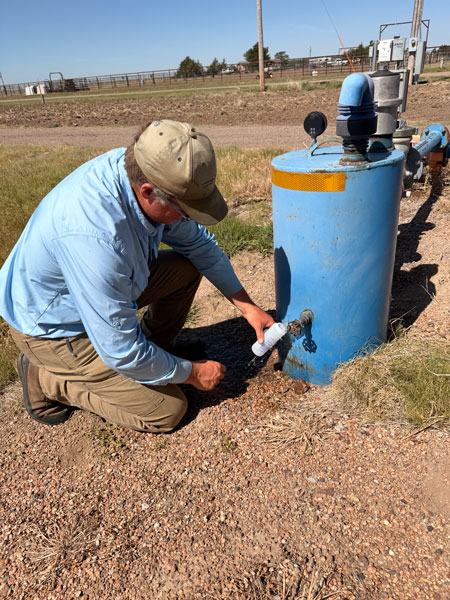
Figure 2. Collecting an irrigation water sample for nitrate analysis. Photo by Lauren Thompson.
How do I test my irrigation water?
Test your irrigation water by collecting a sample in a clean container and sending it to a laboratory that offers irrigation water analysis, such as the K-State Soil Testing lab or a commercial soil and water testing lab.
- Most labs will only need 4 to 8 ounces of water and will supply containers for collecting samples.
- Check with your selected lab to confirm their requirements, fees, and services.
- The container must be clean and free from contaminants. Triple rinse the container with irrigation water before filling.
- Clearly label the bottle as irrigation water, not for human consumption, and add any other information required by the testing lab.
Steps for collecting irrigation water:
- Collect samples after the first irrigation set or cycle has been completed, preferably during the peak of the pumping season.
- Allow the well to run for 1 to 2 hours prior to sampling.
- Allow water to run from the faucet or valve before collecting the sample, i.e., do not catch the first water exiting the valve
- If multiple wells are used to feed the irrigation system, it’s preferable to take the sample from a point after the water has been mixed. Alternatively, the wells can be sampled independently, and a weighted average calculated based on each well’s flow rate,
- Do not collect samples while injecting fertilizer or other chemicals.
- Keep the sample cool and send it to the laboratory as soon as possible.
The best practice is to collect a few samples throughout the summer because nitrate concentrations can vary throughout the season as the well draws water from different parts of the aquifer.
Free Nitrate Testing Available for a Limited Time
100 free nitrate tests available on a first-come, first-served basis.
The Kansas Water Institute is providing a limited number of free nitrate tests. To obtain your free test, complete the online form at https://kstate.qualtrics.com/jfe/form/SV_6yDiv62qL15IGPk and follow the instructions.
Additional Resources
- K-State Soil Testing Lab - https://www.agronomy.k-state.edu/outreach-and-services/soil-testing-lab/
- Nitrate and Groundwater - https://bookstore.ksre.ksu.edu/pubs/nitrate-and-groundwater_MF857.pdf
- Using Irrigation Nitrate Concentrations to Simultaneously Reduce Costs of Fertilizer and Drinking Water Contamination - https://www.agmanager.info/production-economics/production-publications/using-irrigation-nitrate-concentrations-simultaneously
- Don’t Lose Out on Free Nitrogen from Irrigation Water - https://cropwatch.unl.edu/2023/dont-lose-out-free-nitrogen-irrigation-water/
- Long-term (1970s–2016) changes in groundwater geochemistry in the High Plains aquifer in south-central Kansas, USA - https://doi.org/10.1007/s10040-019-02083-z
Nathan Nelson, Soil Fertility Professor
nonelson@ksu.edu
Dorivar Ruiz-Diaz, Soil Fertility Extension Specialist
ruizdiaz@ksu.edu
Peter Tomlinson, Environmental Quality Extension Specialist
ptomlin@ksu.edu
Ron Graber, Watershed Specialist
rgraber@ksu.edu
Logan Simon, Southwest Area Agronomist
lsimon@ksu.edu
Tina Sullivan, Northeast Area Agronomist
tsullivan@ksu.edu
Lucas Haag, Agronomist-in-Charge, Tribune
lhaag@ksu.edu
Matthew Kirk, Hydrogeology Professor
mfkirk@ksu.edu
Helene Avocat, Geography Teaching Assistant Professor
havocat@ksu.edu