Late-Planted Corn in North-Central and Eastern Kansas: Hybrid Selection and Crop Insurance Considerations
In some parts of Kansas, rain has been welcomed to replenish soil profiles and ponds. However, for some corn growers, we have seen planting delays and even replant needs due to washouts on dryland and irrigated acres. This late planting situation raises several considerations for producers, particularly hybrid selection with respect to maturity and potential crop insurance implications of late planting from a risk management standpoint.
Corn Hybrid Maturity
Many growers are familiar with corn hybrid maturity being expressed as days of “relative maturity (RM)” or “comparative relative maturity (CRM). These systems have generally been more effective at comparing hybrid maturities within a company than across companies. Fortunately, in recent years, many seed companies have started providing maturity information expressed as growing degree units (GDU’s). Some companies provide both GDU accumulations to reach silking and to reach maturity. While GDUs are a better measure than RM or CRM, there is still some inconsistency in the marketplace as some companies use GDUs from planting and others count GDUs starting at emergence.
What is a GDU?
Growing degree units (GDU) or growing degree days (GDD) are a weather-based scale to measure the progression of crop phenology in heat-driven crops such as corn. GDDs or GDUs are calculated as:
GDU = (Daily Maximum Air Temperature + Daily Minimum Air Temperature)/2 – 50
For corn, when the maximum air temperature exceeds 86°F, it is set to 86°F, as the rate of growth does not increase with higher temperatures. Similarly, when the minimum air temperature is less than 50°F, we set it to 50°F.
In general, it takes 90-120 GDU’s for corn to emerge; residue and soil conditions contribute a great deal of variability to this range. A 110-day hybrid typically needs around 1500 GDU’s to reach silking and 2670 GDU’s to reach black layer or physiological maturity. To help track corn GDU progress, the Kansas Mesonet provides a GDD calculator for many locations across the state. It is available at https://mesonet.k-state.edu/agriculture/degreedays/.
Probability of Corn Reaching Physiological Maturity based on Location, Planting Date, and Hybrid Maturity
Using historical weather data, the probability of reaching physiological maturity before a 28°F freeze can be calculated. The threshold of 28°F was used because long-term weather records report only the minimum, not the duration of any given temperature. It takes multiple hours at 32°F to kill corn, but only a few minutes at 28°F.
GDU’s were totaled for each year across multiple planting dates to determine cumulative GDU’s. This calculation was performed across 11 planting dates and 8 maturities for several locations in north-central and northeast Kansas. The GDUs needed to reach physiological maturity for a given relative maturity were determined by averaging the GDUs of a given relative maturity across multiple hybrids from multiple companies.
For example, the probability table for Centralia is shown in Table 1 below. This is based on weather records from 1960 through 2006. If a 108-day hybrid was planted on June 19, the probability of reaching physiological maturity before a 28-degree F freeze is 50%. Switching to a 103-day hybrid would improve that probability to 76%.
Table 1. Historical probability of reaching black layer before a 28-degree F freeze for Centralia, KS, 1960-2006. Data compiled and prepared by Lucas Haag, K-State Extension.
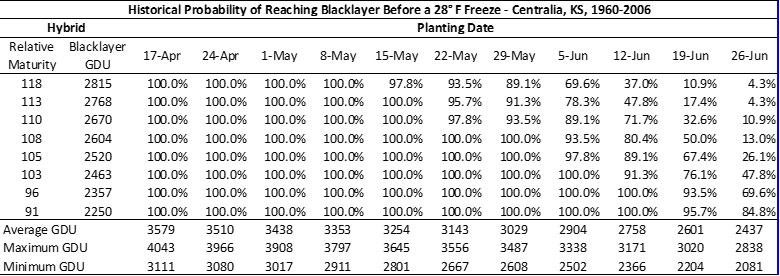
Local data is important in evaluating these probabilities, as relatively short distances can result in large changes in the probability of success for a given hybrid x planting date combination.
It is important to note that these tables likely represent the “worst-case” scenario for probabilities of success. Data from the eastern Corn Belt and some preliminary data in Kansas suggest that when a hybrid is planted later than its optimal planting date, it takes fewer GDU’s to reach physiological maturity. Data from the Corn Belt suggest that GDU requirements for maturity are reduced by 6.8 GDUs for each day after May 1 that planting occurs. Unfortunately, we have not been able to find data from the Great Plains to either confirm that rate or suggest another rate.
It’s reasonable to believe that corn hybrids here will also reduce their GDU requirement with later planting. To get a full view of the possibilities, we recommend you look at the probabilities for the maturity of the hybrid you are considering, and also for a hybrid that is 3-6 days shorter. This will likely give you a realistic range of potential outcomes. For example, if you are considering the probabilities for a 108-day/2604 GDU hybrid, you should consider the range of likely scenarios to be between the values listed for that hybrid and those listed for a 105 or 103-day hybrid. So, for a 108-day/2604 GDU hybrid planted June 19 at Manhattan, the range of probabilities would be 79-93% (green circled probabilities in Table 2).
Table 2. Historical probability of reaching black layer before a 28-degree F freeze for Manhattan, KS, 1890-2020. Data compiled and prepared by Lucas Haag, K-State Extension.
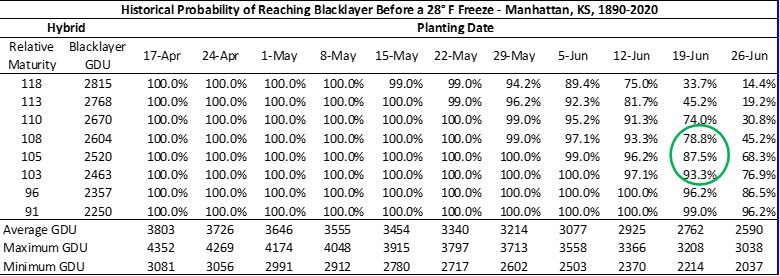
Additional probability tables for other locations are included below.
Table 3. Historical probability of reaching black layer before a 28-degree F freeze for Belleville, KS, 1948-2016. Data compiled and prepared by Lucas Haag, K-State Extension.
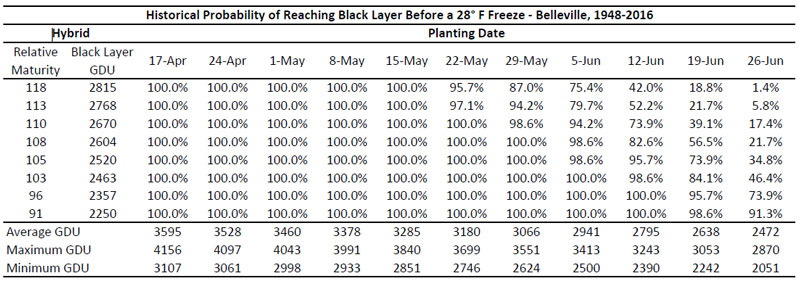
Table 4. Historical probability of reaching black layer before a 28-degree F freeze for Concordia, KS, 1948-2016. Data compiled and prepared by Lucas Haag, K-State Extension.
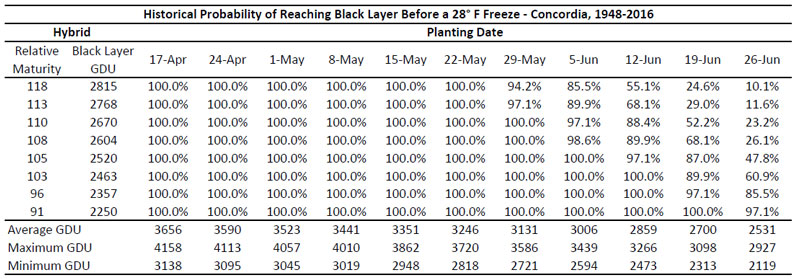
Table 5. Historical probability of reaching black layer before a 28-degree F freeze for Lawrence, KS, 1890-2020. Data compiled and prepared by Lucas Haag, K-State Extension.
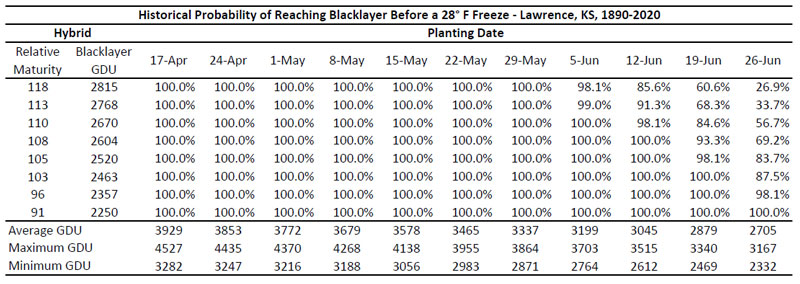
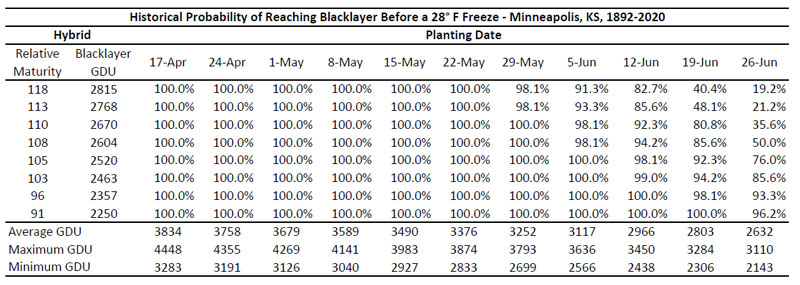
Table 6. Historical probability of reaching black layer before a 28-degree F freeze for Minneapolis, KS, 1892-2020. Data compiled and prepared by Lucas Haag, K-State Extension.
Insurance Implications
The final planting date for corn in the majority of Kansas was May 15 in southeast, May 25, through central, northeast, and east-central, and June 5 for western Kansas (Figure 3). After the final planting date, there is a “late planting period” that extends for 20 days after the final planting date. Producers give up 1% of their insurance guarantee for each day past the final plant date during this window. Any corn planted after the 20-day window is uninsurable.
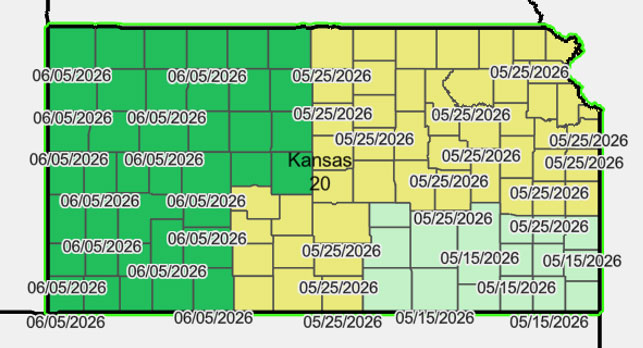
Figure 1. 2026 Final planting date for non-irrigated corn in Kansas.
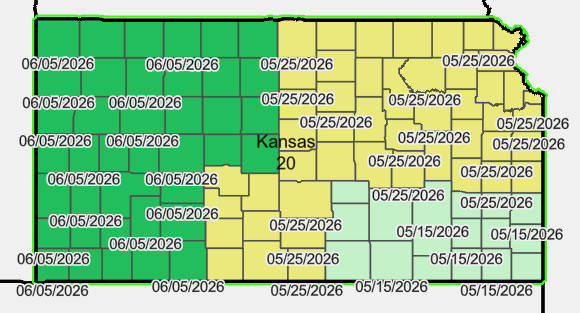
Figure 2. Final planting date for irrigated corn in Kansas.
Lucas Haag, Agronomist-in-Charge, Tribune
lhaag@ksu.edu
Tina Sullivan, Northeast Area Agronomist
tsullivan@ksu.edu