Low Levels of Tar Spot Confirmed in Kansas for the 2026 Corn Season
Tar spot of corn, a disease caused by the fungus Phyllachora maydis, was confirmed in Republic and Brown Counties, Kansas, on June 17, 2026. (Figure 1). These are the first documented reports of Tar Spot in Kansas for this growing season.
Now is the time to intensify scouting efforts. If you wait until there is significant disease pressure in the upper canopy, a fungicide application may be too late. The early disease onset we’re observing this year raises concerns about yield loss. Generally, early observations of tar spot have corresponded with high yield loss. Fields scouted this week were in the V6-V10 growth stages, which increases the risk of disease spread and development. The recent rains and lower temperatures likely helped to promote tar spot development.
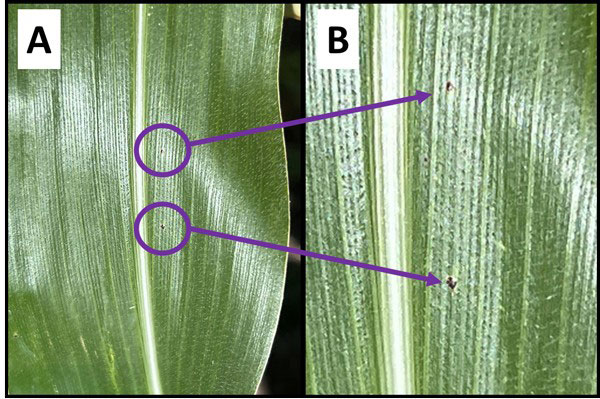
Figure 1. Example of tar spot of corn (A) and a close-up on the tar spot lesions (B). Photo courtesy of Rodrigo Onofre, K-State Extension
Frequently Asked Questions about Tar Spot
How do I scout for Tar Spot?
Tar spot develops as small, black, raised spots (circular or oval) that develop on infected plants and may appear on one or both sides of the leaves, leaf sheaths, and husks. Spots may be found on healthy (green) and dying (brown) tissue. Tar spot can be easily confused with insect poop, which can appear as black spots on the surface of the leaf.
If you would like assistance in confirming tar spot, you can contact Dr. Rodrigo Onofre at 785-477-0171, your local county extension office, or the K-State Plant Disease Diagnostic Laboratory at https://www.plantpath.k-state.edu/extension/plant-disease-diagnostic-lab/.
Is there a history of Tar Spot in this field or neighboring fields?
Tar spot overwinters in infested corn residue on the soil surface, providing a source of inoculum for the subsequent growing season. Spores can be dispersed by wind and rain splash and move to nearby fields if conditions are favorable.
What counties and when was Tar Spot reported in Kansas during the 2025 corn season?
During the 2025 corn season, Tar spot was confirmed in Doniphan (6/11/2025), Brown (6/17/2025), Jefferson (6/25/2025), Atchison (7/2/2025), Jackson (7/15/2025), Republic (7/7/2025), Marshall (7/9/2025), Washington (7/25/2025), Lincoln (10/10/2025), and Smith (10/16/2025) counties. Overall, during the 2025 season, Tar Spot severity was low. However, some growers in the northeast part of Kansas reported severe yield impact.
What growth stage is the field in?
Research has shown that making an application just after first detection and at or after VT is effective if lesions are detected early. If you wait until there is significant disease in the upper canopy, then a fungicide application may be too late. A guide to determining corn growth stages is available at https://bookstore.ksre.ksu.edu/pubs/MF3305.pdf.
How does moisture influence disease development?
The recent rains and lower temperatures likely helped to promote tar spot development. Additionally, irrigated corn may be particularly at high risk of yield or silage loss. Forecasted rainfall and high humidity will favor the development and spread of tar spot.
Should I apply a fungicide?
Fungicides are an effective tool for controlling tar spot when applied at the right time. Research has shown that the best return on investment from a fungicide application on corn occurs when fungal diseases are active in the corn canopy. A well-timed, informed fungicide application will be important to reduce disease severity when needed. We recommend holding off until the disease is active in your field and corn is at least the V10 growth stage. Scouting will be especially important if wet weather continues.
Several fungicides are highly effective at controlling tar spot when applied from VT to R3. I would recommend picking a product with multiple modes of action. The National Corn Disease Working Group has compiled efficacy ratings for fungicides labeled for tar spot control, available on the Crop Protection Network website at https://cropprotectionnetwork.org/publications/fungicide-efficacy-for-control-of-corn-diseases.
If there is high disease pressure early in the season, a second application may be warranted. Fields should be scouted 14-21 days after the first application to determine whether tar spot has become active again. Fungicides will not provide benefits after R5. Always consult fungicide labels for any use restrictions prior to application.
Where has tar spot been reported in the 2026 season?
In cooperation with K-State Plant Pathology Department, the Kansas Corn Commission has developed an online Corn Disease Resource Center (https://kscorn.com/corn-disease/) to help corn growers identify what diseases to watch for in their geographic area. Tar Spot has now been confirmed in two counties in Kansas (Brown and Republic; Figure 2).
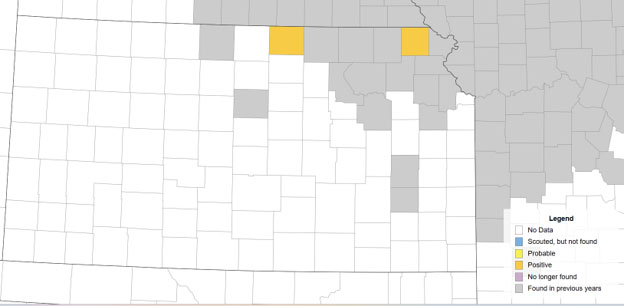
Figure 2. Tar Spot of Corn (Phyllachora maydis) in Kansas in 2026. Source: https://kscorn.com/corndisease/
Please help us track tar spot!
If you suspect a field has tar spot, contact Rodrigo Onofre directly at 785-477-0171 and/or submit a sample to the K-State Plant Disease Diagnostic Lab at https://www.plantpath.k-state.edu/extension/diagnostic-lab/documents/2021_PP_DiseaseLabChecksheet.pdf.pdf. This will help us monitor the situation in the state.
Rodrigo Onofre, Row Crop Plant Pathologist
onofre@ksu.edu