Fungicide Considerations and Field Scouting for Corn Diseases in Kansas
We are entering the time window in Kansas when corn producers should be scouting fields and assessing the need for a foliar fungicide application. In cooperation with the K-State Plant Pathology Department, the Kansas Corn Commission has launched an online Corn Disease Resource Center (https://kscorn.com/corndisease/) to help corn growers identify what diseases to watch for in their geographic area. Now is the time to be out scouting for the following fungal diseases of corn:
- Southern Rust (Figure 1, left)
- Common Rust (Figure 1, right)
- Gray Leaf Spot (Figure 2)
- Tar Spot (Figure 3)
Southern Rust
Southern rust is typically first reported in Kansas in mid-July. Pustules appear on the upper leaf surface, unlike common rust, which can be found on either side of the leaf (Figure 1). The pustules are scattered on the leaf surface, and spores appear orange and rub off on fingers (and clothes!). Severe infections can be seen on the leaf sheaths.
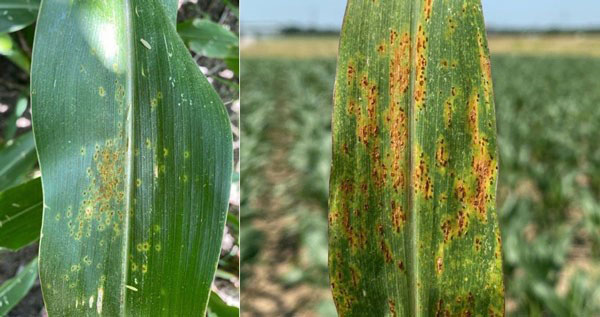
Figure 1. Typical symptoms of southern rust (left) and common rust (right). Photo courtesy of Rodrigo Borba Onofre, Department of Plant Pathology, K-State Extension.
Gray Leaf Spot
Begin scouting for gray leaf spot in corn about two weeks before expected tassel emergence. Gray leaf spot is characterized by rectangular lesions that are 1-2 inches long and cover the entire area between the leaf veins (Figure 2). Early lesions are small, necrotic spots with yellow halos that gradually expand to full-sized lesions. Lesions are usually tan in color but may turn gray during foggy or rainy conditions. The key diagnostic feature is that the lesions are usually very rectangular in shape.
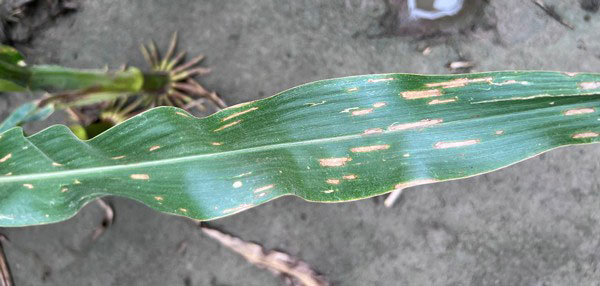
Figure 2. Gray leaf spot lesions are rectangular in shape and delimited by leaf veins. Photo courtesy of Rodrigo Onofre, Department of Plant Pathology, K-State Extension.
Tar Spot
Tar spot has been confirmed in Brown and Republic counties as of June 18, 2026. Tar spot lesions are black, raised, and round to elliptical in shape (Figure 3). Susceptible corn hybrids may be at particularly high risk for yield or silage loss.
More information on tar spot is available in a separate eUpdate article in this issue.
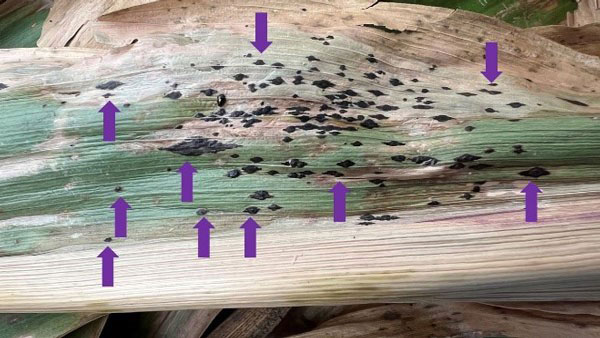
Figure 3. Tar spot of corn. Purple arrows are indicating a few of the tar spot lesions. Photo courtesy of Rodrigo Onofre, K-State Extension.
For confirmation of tar spot, please submit samples to the K-State Plant Pathology Diagnostic Clinic at https://www.plantpath.k-state.edu/extension/plant-disease-diagnostic-lab/
Factors that influence corn yield response to fungicide applications
- Research clearly demonstrates that the single best time to apply a fungicide to corn for gray leaf spot control is from VT to R1.
- First applications for tar spot disease management should be between V10 to VT growth stages, and, if needed, a second fungicide application should be between R1 to R3 growth stages. A single application at V6 – V8 will not hold up against late-season pressure.
- A VT to R3 growth stage fungicide application may also provide suppression of southern rust.
- Some fungicides that are good to excellent for gray leaf spot are also very good for tar spot and southern rust control. Summaries of multi-year university research about fungicide efficacy can be found here: https://cropprotectionnetwork.s3.amazonaws.com/CPN2011_FungicideEfficacyControlCornDiseases_04_2022-1650470887.pdf
Disease risk factors to consider before a fungicide application
Susceptibility level of the corn hybrid. Seed companies typically provide information on the susceptibility of their hybrids to tar spot, gray leaf spot, and southern rust. In general, hybrids that are more susceptible to fungal foliar diseases will have a greater response to a foliar fungicide (if disease pressure is high enough).
Previous crop. Because tar spot and gray leaf spot survive in corn residue, the risk of disease increases when corn is planted back into a field that was in corn the previous year. Fields with a history of gray leaf spot and tar spot should be closely scouted. Southern rust, on the other hand, blows in from the south each year. It is important to watch regional updates about southern rust pressure in the state.
Weather. Rainy and/or humid weather is generally most favorable for gray leaf spot. In growing seasons, when these conditions prevail, the risk for disease development increases. Southern rust is favored by warm days and nights (> 80 degrees) and high humidity. Tar spot is favored by mild temperatures (60F to 73F), high relative humidity (>75%), and a prolonged leaf wetness period (>7h).
Field history. Some field locations may have a history of high foliar disease severity. Fields in river bottoms or low areas, or surrounded by trees, may be more prone to having gray leaf spot.
If no disease is present or pressure is low, I recommend holding off on the VT-R1 application, as efficacy will begin to wane in three to four weeks, just as late-season pressure may develop. Data suggest that if disease pressure develops later, an R2 application can be economical and provide protection later into the grain fill period. This later application could also protect against any late-season southern rust pressure.
Distinguishing between gray leaf spot and bacterial streak
Bacterial streak, identified as a new corn disease in the U.S. in 2016, is now active in most of western Kansas. While the yield loss potential of this disease remains unknown, we do know it can be misidentified as gray leaf spot, leading to unwarranted fungicide applications. Fungicides will not have any effect on bacterial streak. Remember that gray leaf spot typically has very sharp edges defined by the leaf veins, whereas bacterial streak will have a wavy edge that can cross the leaf vein (Figure 4). Also, when backlit, gray leaf spot lesions appear opaque, while bacterial streak lesions are more translucent (Figure 4).
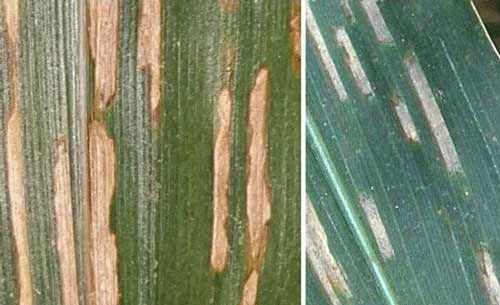
Figure 4. Comparison of sharp-edged gray leaf spot lesions (right) with wavy-edged bacterial streak lesions (left). Photo courtesy of the University of Nebraska.
Take-Home Message
The most effective fungicide program starts with good scouting. Knowing which diseases are present and which are not can help avoid unnecessary applications and protect yield potential. Scout fields carefully, identify diseases accurately, and consider disease pressure before investing in a fungicide application.
Rodrigo Onofre, Plant Pathology Row Crop Specialist
onofre@ksu.edu