Considerations for Storm-Damaged Wheat
Kansas is no stranger to the wind, but the wheat crop has taken a beating in many counties across the state due to heavy rains, high winds, and hail. Wheat harvest has been slow despite the fast-maturing crop, with 5% harvested, similar to 2025. Some fields have lodged wheat (Figure 1), while others have been unfortunate enough to be underwater from streams leaving their banks. In terms of lodging, extreme storm winds and torrential rains are the culprits behind the damage, rather than root/crown diseases, insect damage, or excess N applications, though these could all exacerbate the issue. Some varieties have been standing better than others due to straw strength. See the 2025 Kansas Wheat Variety Guide for variety-specific ratings: https://bookstore.ksre.ksu.edu/item/kansas-wheat-variety-guide-2025_MF991.
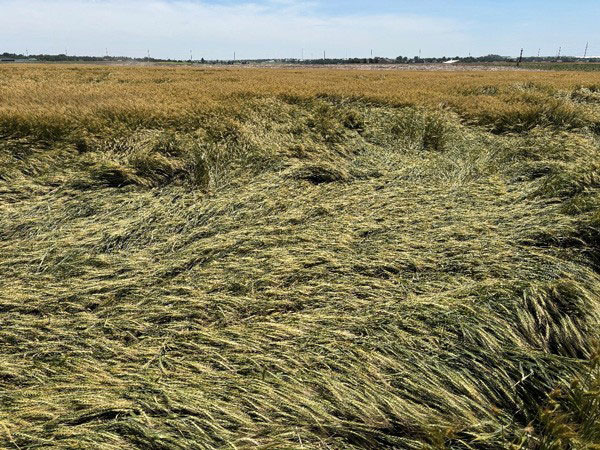
Figure 1. Wheat lodged following torrential storms near Garden City in 2025. Photo courtesy of Logan Simon, K-State Extension.
Harvest concerns
Wheat harvest 2026 is likely to be slow for some, as they work to harvest the downed crop as efficiently as possible. Lodged wheat lying at least partially on the ground will trap humidity, preventing the grain and chaff from drying as quickly as usual. Giving the wheat time to dry down during the best windows will limit the amount of wet chaff going through the combine. In these situations, driving combines slower through the field and potentially perpendicular to the downed wheat could help pick.
Lodged wheat trapping humidity not only slows harvest with the soil and chaff not drying out, it can also lead to diminished grain quality, especially test weight. Additionally, grain and chaff molds may be a challenge. In fields that have been infected with scab (Fusarium head blight), high humidity and delayed harvest could also exacerbate mycotoxin accumulation. Producers should also be mindful of potential pre-harvest sprouting with excessive moisture around the mature heads.
From a machinery standpoint, harvesting lodged wheat can be quite challenging. Due to the trapped moisture discussed previously in the article, the straw will likely remain tougher later into the day, thus reducing hours available for efficient harvesting. If the lodging is in one predominant direction, it may be possible to harvest perpendicular or counter to the direction that the plants are lodged. Crop lifter attachments are available for conventional platform, flex, and flex-draper style headers. These lifters can be fixed or spring-loaded. Lifter attachments with an adjustable drop height can be useful as they can be adjusted downward for the nose of the lifter to more easily get underneath lodged plants and lift them up and over the cutterbar so that the stems can be cut by the sickles. Harvesting lodged wheat generally means a larger-than-normal amount of straw passing through the combine, which will result in decreased capacity to maintain acceptable levels of harvest loss. Combine kill-stop checks are always a useful tool to evaluate machine performance in non-standard operating conditions.
Stripper headers are a useful tool for harvesting lodged wheat. Operators will want to pay attention to the proper setting of the skid plates to prevent the stripping rotor from encountering the soil. Additionally, the crop deflector hood will need to be run in a higher-than-normal position. This allows the rotor to lift the entire plant while still maintaining an adequate area to strip the grain. Operators should expect to use higher-than-normal stripping rotor speeds, especially if the stems retain moisture. While combines equipped with stripper headers are generally set for harvesting conditions where almost no straw enters the machine, when harvesting down wheat, it’s likely that more material other than grain will be going through the combine than normally occurs with stripper header harvest. Operators will need to pay attention to chaffer, sieve, and fan settings for these conditions.
If the crop is ready, do not delay harvest, as delay will only exacerbate grain quality issues and potentially expose the crop to additional storms.
Post-harvest concerns with volunteer wheat
Because harvesting lodged wheat can be challenging, producers may see greater than average volunteer wheat this summer. If volunteer wheat goes uncontrolled, it can cause serious problems for nearby wheat fields in the fall. As a reminder, volunteer wheat harbors the wheat curl mite. The wheat curl mite is responsible for transmitting the wheat streak mosaic complex of viruses (wheat streak mosaic, High Plains wheat mosaic virus, and Triticum mosaic).
The wheat streak mosaic complex impacted many fields in central and western Kansas this year, though not as badly as in 2025 due to our volunteer wheat control. Even though we cannot eliminate all kernel losses, especially in areas of severe lodging, we should be mindful of volunteer wheat control after harvest.
Key points
- Lodging in wheat can be exacerbated by root/crown diseases, insect damage, or excess N applications, and variety-dependent straw strength.
- Wheat that is lodged and trapping humidity will slow harvest, with the soil and chaff not drying out, and potentially lead to test weight reduction, grain/chaff mold, mycotoxin accumulation, and pre-harvest sprouting.
- If the crop is ready, do not delay harvest, as delay will only exacerbate grain quality issues and potentially expose the crop to additional storms.
- Even though we cannot eliminate all kernel losses during harvest, especially in areas of severe lodging, we must be mindful of volunteer wheat control after harvest.
Logan Simon, Southwest Area Agronomist
lsimon@ksu.edu
Tina Sullivan, Northeast Area Agronomist
tsullivan@ksu.edu
Lucas Haag, Northwest Area Agronomist
lhaag@ksu.edu
Kelsey Andersen Onofre, Extension Wheat Pathologist
andersenk@ksu.edu