Spray Drones: Benefits and Management Considerations
Planting season in Kansas is almost over, with most of the soybeans, corn, cotton, and sorghum already planted. During the growing season, farmers must make multiple decisions related to crop protection, such as weed, disease, and pest control. Spray drones are an emerging technology for applying crop protection products. They overcome labor shortages, lower equipment costs, and reduce environmental impact.
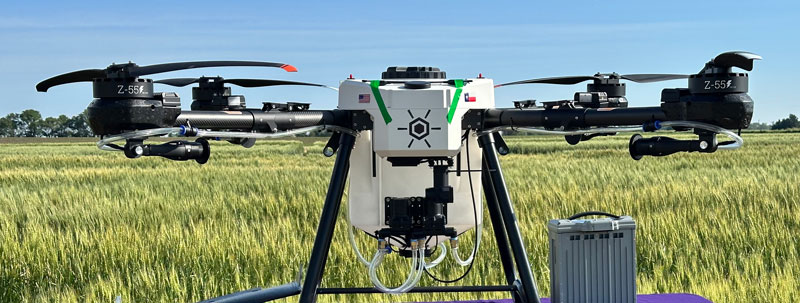
Figure 1. Multirotor spray drones are used for spraying and seeding. Photo by Deepak Joshi, K-State Extension.
Advantages of spray drones
Field accessibility: Spray drones can be used to apply pesticides or fertilizers in difficult terrain where the ground rigs can struggle. This is the main reason spray drones are very popular for weed management in pastures and rangelands, which are often characterized by steep slopes, terraces, irregular boundaries, waterways, and trees.
No crop damage to tall canopy crops: Ground rigs can damage tall-canopy crops when spraying at later growth stages. While a spray drone can be used even in tall-canopy crop conditions, as it does not have to meet the ground.
Wet field conditions after rain: After a rainfall event, ground rigs can be difficult to drive into the wet fields.
Targeted product application: Using a drone, a more precise spray is possible by integrating the prescription map. It allows targeting the specific problematic area of the field.
Timely application: Because the spray drone requires minimal preparation, it can be used or deployed right away when needed, especially during a disease or insect outbreak.
Though spray drones offer significant opportunities in Kansas agriculture, a few factors need to be considered.
Factors for Effective Drone Spraying
Weather Conditions: Weather is the most critical factor affecting drone spray performance.
- Wind speed: High-speed wind easily drifts the spray, resulting in off-target application and ultimately wasting the chemical and money. In general, wind speeds of 3-7 mph are suitable for most pesticide applications, including herbicides, fungicides, and insecticides, but the effect of wind on spray will also depend on the spray droplet and nozzle type used. Larger droplets are generally less prone to drift than smaller droplets under the same wind conditions. Temperature: High temperatures can cause rapid evaporation of spray droplets. In general, temperatures between 60 and 85°F (15–29°C) are favorable for most of the pesticide applications.
Droplet Size: Finding the optimum droplet is important. Using fine droplets can achieve better coverage; however, it may increase the risk of drift. Coarse droplets reduce drift but do not provide large-area coverage. Therefore, balance is critical. Usually, for herbicide application, drift control is the main priority, whereas for the fungicide application, coverage is the priority. The droplet size should be adjusted based on the application type.
Flight Parameters (Figure 2):
- Spray Flight Height: Spraying at too high a height results in a too long distance for the spray droplet to travel from the nozzle to the crop, and there is a high chance of drift and off-target application. Similarly, too low a spray height may create excessive turbulence from the drone's propeller downwash, resulting in an uneven distribution of spray droplets. While a general flight height of 8-12 ft above the canopy is recommended for spray drones, slightly higher heights are typically used for herbicide applications to maintain swath uniformity, whereas lower heights are preferred for fungicide applications to improve canopy penetration and deposition. But again, spray flight height will also be affected by canopy height, canopy density, crop type, and other factors.
- Flight Speed: The drone's speed depends on the objective and what you are spraying. For example, for early-season weed control when canopy penetration is not the main concern, and weeds are sparsely covered by the canopy, moderate speed can perform well. In contrast, when spraying fungicide, the speed should be slightly lower because the canopy is thicker, and droplet deposition and canopy penetration are more important for controlling disease. So, a slower speed can result in better deposition and canopy penetration.
- Swatch Width: This is how wide the drone can spray in a single pass, which is influenced by various factors such as drone models, flight height, nozzle type, droplet size, etc. Different drone models exhibit distinct downwash force dynamics that determine spray distribution by pushing droplets downward and reducing lateral spread. Similarly, higher flight height results in a wider spread of spray droplets, producing a wider swath, but may increase drift, whereas lower height produces a narrower spray pattern, resulting in lower width but better penetration into the canopy.
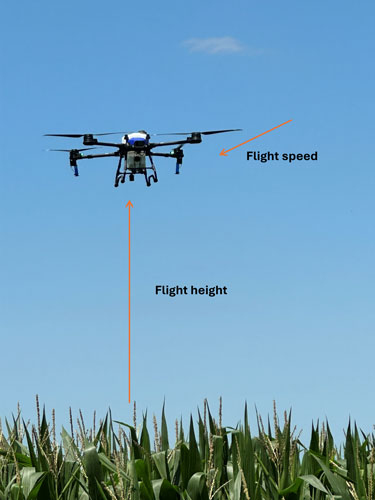
Figure 2. Spray drones are being used for fungicide applications. Appropriate height from the top of the canopy, as well as the speed, is important for optimum results. Photo by Deepak Joshi, K-State Extension.
Take-home message
Spray drones have significant potential for a range of operational activities. They allow greater accessibility in sloped fields, wet soil conditions, tall canopy crops, and at field edges. When using a spray drone, several factors must be considered, including wind speed, air temperature, droplet size, flight height, speed, and swath width. While spray drones have multiple benefits, they should not necessarily be considered as a replacement for conventional ground-spraying. Instead, both can work together to complement each other and support the Kansas growers for sustainable agricultural production. Moreover, for the safety and health of drone spraying, all FAA regulations are important, including insurance coverage for spray drones.
Deepak Joshi, Precision Ag Extension Specialist
drjoshi@ksu.edu
Jeremie Kouame, Weed Scientist, Hays Agricultural Research Center
Sarah Ganske, Extension Weed Management Specialist
Logan Simon, Southwest Area Agronomist