Pre-Harvest Weed Control in Wheat
Making an herbicide application that will not directly affect crop yield is a difficult decision. However, pre-harvest applications may be beneficial this year, especially in wheat fields with short, thin stands. . A pre-harvest herbicide application can address harvest difficulties, dockages, weed seed production, and soil water depletion. It is very difficult to estimate the value of pre-harvest weed treatments as it is influenced by the effects on harvest efficiency and dockage, and applications may not pay with lower weed densities unless harvest is delayed. If the weeds are about to set seed, a pre-harvest treatment can go a long way toward reducing weed problems in future years by preventing seed production.
Herbicides labeled for use as harvest aids in wheat are listed in Table 1. There are differences in how quickly they act to control the weeds, the interval requirement between application and grain harvest, and the efficacy on the weeds present in the field. All of them will require thorough spray coverage to be most effective.
Paraquat is sometimes mentioned as a possible herbicide for pre-harvest application, but it is NOT labeled for pre-harvest treatment in wheat. Application of paraquat to wheat is an illegal treatment and can result in quarantine and destruction of the harvested grain, along with severe fines.
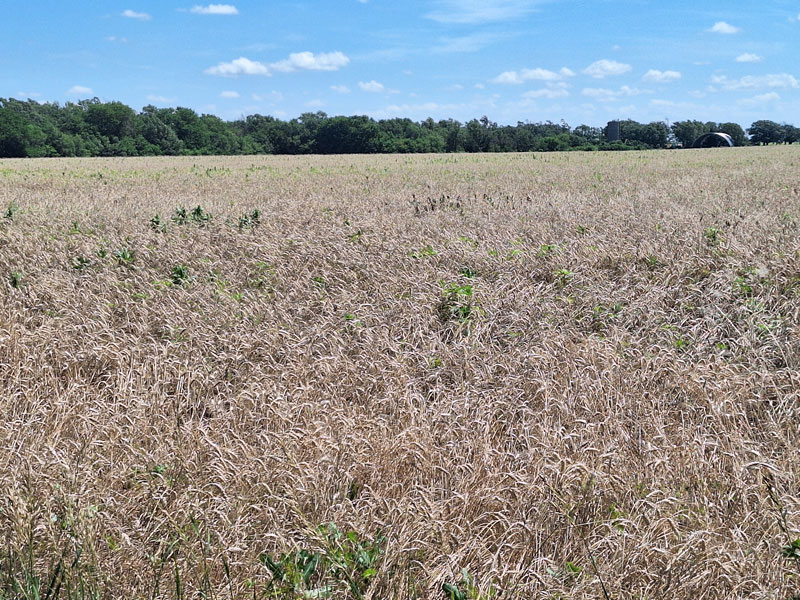
Figure 1. Weeds in wheat near harvest time. Photo by Sarah Ganske, K-State Extension.
Table 1. Herbicides for use as pre-harvest weed control options in wheat.
|
Herbicide |
Rate |
Weeds Controlled |
Application Timing |
PHI* (days) |
|
Metsulfuron (Ally, others)
|
0.1 oz + 0.25 to 0.5 % v/v nonionic surfactant |
Some broadleaf weeds |
Hard dough stage
|
10
|
|
2,4-D LVE |
1 pt of 4lb/gal product or 2/3 pt 6 lb/gal product |
Broadleaf weeds |
Hard dough stage |
14 |
|
Dicamba |
0.5 pt |
Broadleaf weeds |
Hard dough stage, and green color is gone from nodes |
7 |
|
Glyphosate |
1 qt of 3 lb ae/gal product, 22 fl oz of Roundup PowerMax, or 20 fl oz of Roundup PowerMax 3 |
Grasses and broadleaf weeds |
Hard dough stage (30% or less grain moisture).
|
7 |
|
Carfentrazone (Aim, others) |
1 to 2 fl oz + 1% v/v crop oil concentrate |
Pigweeds, kochia, lambsquarters, Russian thistle, wild buckwheat, velvetleaf |
Not specified, but hard dough (30% or less grain moisture) is recommended |
7 |
|
Saflufenacil (Sharpen) |
1 to 2 fl oz + 1% v/v methylated seed oil + 1 to 2% w/v AMS or 1.25-2.5% v/v UAN |
Broadleaf weeds
|
Hard dough stage (30% or less grain moisture).
|
3 |
|
Flumioxazin |
(Valor, others) 1.5 to 2 fl oz + Use 1 qt/A MSO
|
Broadleaf weeds |
After wheat reaches the hard dough stage and 30% or less grain moisture |
10 |
*PHI = Pre-harvest interval, or days required between application and harvest.
The use of trade names is for clarity to readers and does not imply endorsement of a particular product, nor does exclusion imply non-approval. Always consult the herbicide label for the most current use requirements.
For more information, see the 2026 Chemical Weed Control for Field Crops, Pastures, Rangeland, and Noncropland, K-State publication SRP-1194 at https://bookstore.ksre.ksu.edu/item/2026-chemical-weed-control-for-field-crops-pastures-rangeland-and-noncropland_SRP1194.
Sarah Ganske, Weed Management Extension Specialist
slancaster@ksu.edu
Patrick Geier, Weed Scientist, Southwest Research & Extension Center – Garden City
pgeier@ksu.edu
Jeremie Kouame, Weed Scientist, Agricultural Research Center - Hays
jkouame@ksu.edu
Jeanne Falk Jones, Northwest Area Agronomist
jfalkjones@ksu.edu