Postemergence Control of Palmer Amaranth in Grain Sorghum
When the aggressive nature of Palmer amaranth is combined with the limited post-emergence herbicide options in grain sorghum, problems often arise, even with an adequate pre-emergence herbicide program (Figure 1). This article covers post-emergence herbicide options for Palmer amaranth control in grain sorghum. Combinations of the herbicides listed here will generally improve control, and all of the options are most effective when applied to small (under 4 inches tall) weeds.
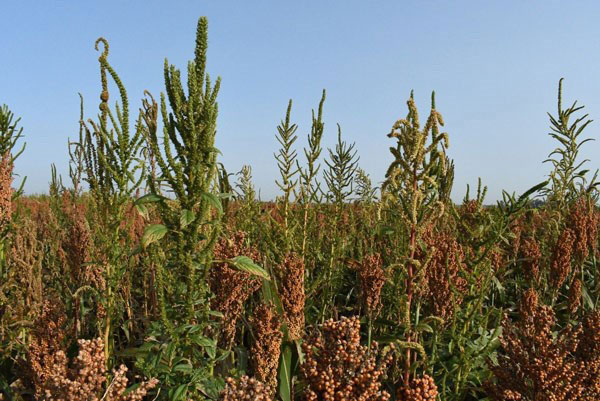
Figure 1. Palmer amaranth in a grain sorghum field that escaped treatment earlier in the growing season. Photo by Sarah Ganske, K-State Extension.
Atrazine can control sensitive Palmer amaranth populations and can be combined with many herbicides to enhance effectiveness. It is important to check the labels of potential tank-mix partners to ensure compatibility. Recommended rates range from 0.25 to 2.0 pounds of atrazine (0.5 to 4 pints of Atrazine 4L or other products). Atrazine should be applied with crop oil or surfactant to control emerged weeds. Atrazine can be applied to grain sorghum between 3-leaf and 12 inches, or between 6 to 12 inches in western Kansas. Be sure to observe rate limits for your area.
Aim (carfentrazone) is a Group 14 herbicide that can be applied to grain sorghum between the 4-inch and boot stages. It is less effective than some of the other herbicides in this article and requires good coverage for maximum effectiveness. Aim can be tank-mixed with atrazine, 2,4-D, dicamba, bromoxynil, and Huskie. Aim is likely to burn grain sorghum leaves, especially if applied in hot, humid weather or with crop oil. Leaf burn will also be greater if Aim is applied with bromoxynil.
2,4-D can be effective herbicide for controlling susceptible Palmer amaranth populations. However, crop response is expected, especially when applied in hot, humid conditions. Crop responses can include rolled leaves, lodging, and brittle stems. Grain sorghum is most tolerant of 2,4-D applications when it is 5 to 10 inches tall. Drop nozzles should be used when applying 2,4-D to grain sorghum greater than 8 inches. To reduce crop response, apply lower rates (2/3 pint) with atrazine, Aim, bromoxynil, or Huskie. Using crop oil in tank mixes with 2,4-D will increase crop injury.
Dicamba, at the rates used in grain sorghum (0.5 pint), may be less effective on Palmer amaranth than 2,4-D. It can be applied to grain sorghum between 2 and 15 inches. Drop nozzles should be used if the grain sorghum is 8 inches or taller to avoid damaging seed heads. Crop response, including rolled leaves and lodging, should be expected, especially if applied in hot, humid conditions. Dicamba can be tank-mixed with Aim, atrazine, and bromoxynil.
Bromoxynil can be applied from the 3-leaf stage through the boot stage. Crop response will be less with bromoxynil than with other herbicides, but bromoxynil alone will not control Palmer amaranth larger than 4-leaf. Bromoxynil is a contact herbicide that is not translocated in the plant. Therefore, adequate spray coverage is needed for maximum effectiveness.
Huskie (pyrasulfutole+bromoxynil) is most effective when mixed with atrazine (up to 1 pound). When used alone, it can be applied between 3-leaf and 30 inches and should be applied with HSOC (high surfactant oil concentrate) or AMS + NIS. Huskie will cause leaf burn (Figure 2), which can be greater in fields where mesotrione was applied pre-emergence. Huskie plus atrazine may be tank-mixed with phenoxy broadleaf herbicides such as 2,4-D or dicamba.
Imiflex (imazamox) can only be applied to igrowth grain sorghum and only in fields that were not sprayed preemergence with Imiflex. Imiflex is an ALS-inhibiting herbicide, and ALS-resistance is assumed to be widespread in Kansas. However, there is limited evidence that Imiflex may still contribute to the suppression of ALS-resistant pigweeds. Postemergence applications of Imiflex should inlcude COC, MSO, or HSOC and a nitrogen fertilizer. For susceptible Palmer amaranth plants, herbicide applications should target plants that are 3 inches or less in height.
Other herbicide-resistant sorghum technologies, that specifically target grasses, are also on the market. These technologies include Inzen sorghum from Corteva, with the herbicide partner Zest WDG, and DoubleTeam sorghum from Warner Seeds, with the herbicide partner First Act.
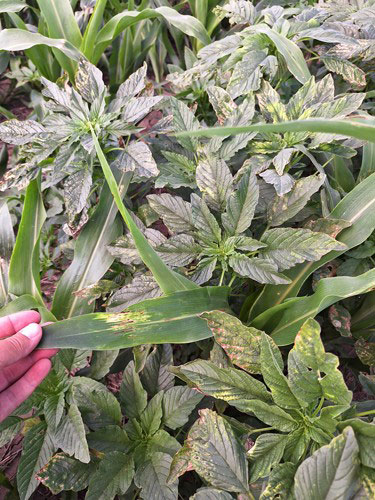
Figure 2. An example of leaf burn caused by a post-emergence application of Huskie. Note that the large Palmer amaranth plants were not controlled by this tank-mix of Huskie and atrazine. Photo by Sarah Ganske, K-State Extension.
Additional information can be found in the 2026 Chemical Weed Control for Field Crops, Pastures, Rangeland, and Noncropland, https://bookstore.ksre.ksu.edu/pubs/SRP1194.pdf
The use of trade names is for clarity to readers and does not imply endorsement of a particular product, nor does exclusion imply non-approval. Always consult the herbicide label for the most current use requirements.
Sarah Ganske, Weed Science Extension Specialist
slancaster@ksu.edu
Jeremie Kouame, Weed Scientist, Agricultural Research Center – Hays
jkouame@ksu.edu
Jeanne Falk Jones, Multi-County Agronomist
jfalkjones@ksu.edu
Patrick Geier, Weed Scientist, Southwest Research & Extension Center
pgeier@ksu.edu