Assessing Storm Damage in Corn: Defoliation, Root Lodging, and Green Snap
Severe storms with high winds and hail this week caused significant injury to crops, specifically corn. In some cases, we’ve seen significant leaf loss (defoliation), leaning, and stalk breakage (Figure 1). The degree of crop injury strongly depends on the crop’s developmental stage.
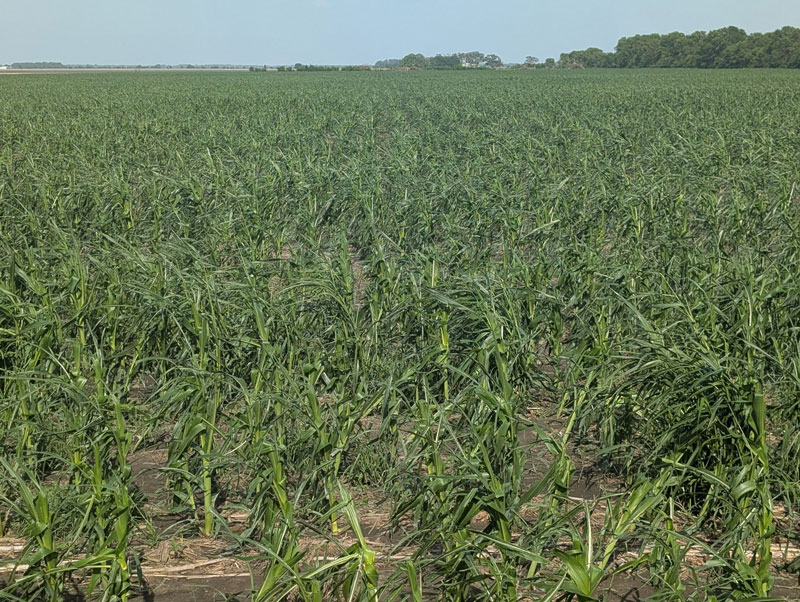
Figure 1. Hail-damaged corn near Salina, KS, after a hail event in June 2026. Photo by Jay Wisbey, K-State Extension.
If the corn had fewer than five leaves before the hail, the growing point is likely still below ground, thus sustained limited damage. This is good because young corn has a great capacity to recover from early-season hail damage. The growing point of a corn plant is the top of the stem, which contains cells actively dividing and elongating that will ultimately become the tassel. Even in cases of complete defoliation, the plant should grow out of it if the growing point was still below ground.
If the growing point was above ground, damage could be severe. The best course of action is to wait a few days before making any decisions about the future of the crop. If the main stem starts to grow again with new leaves emergence, then the plant is likely to near fully recover. Corn tillers will start growing outward from the base of the damaged plant, and even though they look okay now, they will not be productive during tasseling and ear-forming. This plant should not be counted for stand counts when evaluating whether to replant.
When corn leans over or is flattened without stalk breakage, we refer to it as “root lodging”. When stalks are broken, we usually refer to it as “green snap”.
Root lodging (Figure 2): This typically occurs when strong winds pull the roots on one side partway out of the soil, and most often occurs when the soil is saturated and soft. If root lodging occurs early, plants usually recover or stand back up at least partly. This will usually appear as a response and results in the characteristic gooseneck bend in the lower stalk with new brace roots providing above-ground support.
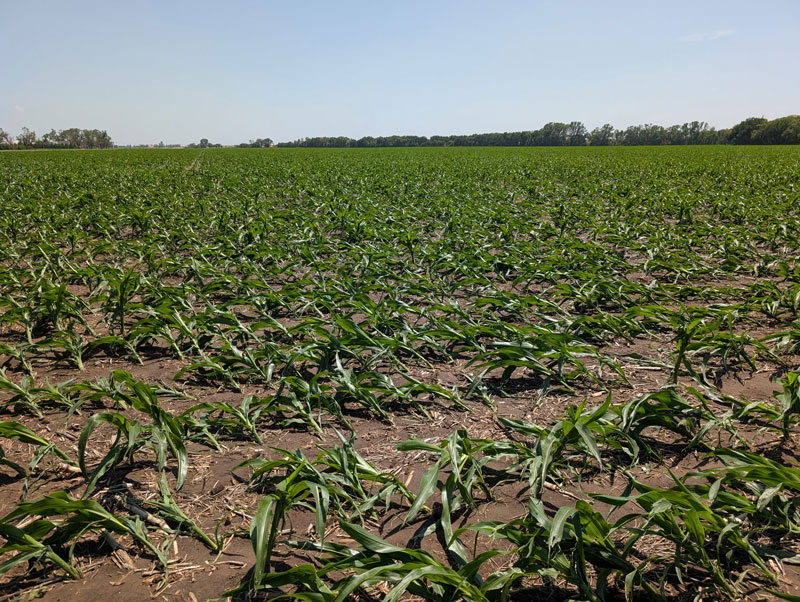
Figure 2. Corn leaning over due to high winds and exhibiting root lodging near Salina, KS, in June 2026. These plants should be able to recover from the damage. Pictures provided by Jay Wisbey, K-State Extension.
Green snap (Figure 3): This typically occurs when high winds cause stalks to break or snap as corn is rapidly growing (V8 to tassel) in the two- or three-week period from late vegetative until silking. In this case, the stalks have enough height to catch more wind and are also typically more brittle and susceptible to breakage during this period.
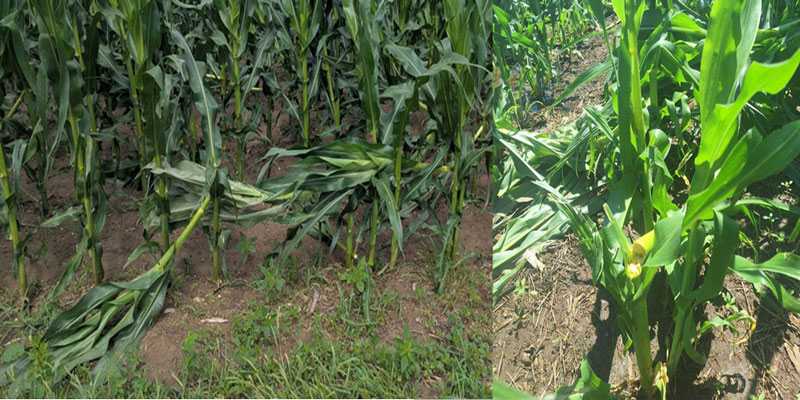
Figure 3. High wind during V8 to tassel can result in green snap. These photos were taken in south central Kansas around mid-June 2025. Photos courtesy of Tina Sullivan and Sarah Lancaster, K-State Extension.
Factors influencing root lodging and green snap
Many factors can affect the severity of root lodging and green snap. Anything that contributes to rapid, vigorous growth may make corn more susceptible to this problem. Often, our best management practices for corn (i.e., high N fertilizer rates, rotation after soybeans, higher plant density promoting early competition with faster elongation and thinner stalks) can contribute to the severity of damage. No hybrid is immune to these issues, but there is a varying level of susceptibility similar to disease ratings. Timing also has a huge impact on the severity of damage, with much less damage in younger corn or in fields that have tasseled and flowered. Fields with younger, shorter corn are more likely to see root lodging than green snap.
What are the implications?
When root lodging occurs early, there may be little or no impact on yield. However, when more developed corn is leaned over, some yield decrease should be expected due to partial loss of root activity and reduced light interception. Lodging during pollination may severely interfere with fertilization and significantly reduce kernel set. While corn may recover from early root lodging, though with a characteristic goose-necked stalk, it may be more susceptible to lodging at maturity.
In the case of green snap, recovery is minimal. However, the corn ear may develop normally if the stalk breaks above the primary ear node. Even with stand loss from green snap, the yield loss may not be proportional to the stand loss. When green snap occurs before tasseling, surviving plants could respond by increasing ear size, final kernel weight, or even by setting additional ears. With 10% or fewer broken stalks, it may be hard to detect a significant yield loss if stands were adequate before the storm.
Research conducted in Minnesota, Nebraska, and Iowa shows that yield loss due to green snap ranged from 0.5 to 1.0% for every 1% stand loss. Yield loss was least severe when stalks broke above the primary ear and greatest when stalks broke below the ear from V12 to the tassel. Research conducted by North Dakota State University further showed the response of corn yields to green snap at V12, V15, and V18 (Table 1).
Table 1. Corn yield reduction (%) from three levels of green snap occurrence at three growth stages. Data courtesy of North Dakota State University Extension.
|
Green snap occurrence (%) |
Growth stage when damage occurred |
||
|
V12 |
V15 |
V18 |
|
|
–––––––––––––––––––––– Yield reduction –––––––––––––––––––––– |
|||
|
25 |
11% |
10% |
14% |
|
50 |
14% |
23% |
30% |
|
75 |
27% |
37% |
48% |
Real-world scenario
Following a severe storm with hail and high winds the night before, you might go check your corn the following day. The best thing you can do now is nothing (unless the crop is completely damaged). Don’t make any decisions immediately. Wait a few days, then come back to check for signs of growth. Small plants need a few days to grow, so that you can get an accurate stand count for the field.
An accurate estimate of plant survival should be done in the coming days to more precisely determine the true degree of stand reductions. Young corn has a great capacity to recover from early-season hail damage. Scout your fields and check the final plant count for potential problems associated with these weather events, which may include increased susceptibility to diseases.
Stand losses may reduce canopy cover and the crop's capacity to suppress weeds. It is important to consider what herbicides have been applied, especially residual products, and consider the need for follow-up applications to control weeds in the absence of a crop canopy.
If stand losses are very severe, there may still be an opportunity to harvest the worst areas for forage. At this point in the season, it is not too late to terminate stands to plant sunflowers, soybeans, grain sorghum, or forage sorghum. However, these options may be limited by the herbicide program used on the damaged corn crop.
Some helpful resources from the University of Nebraska for evaluating corn and soybeans after a hail event are included below.
Corn: https://extensionpubs.unl.edu/publication/ec126/2011/pdf/view/ec126-2011.pdf
Soybeans: https://extensionpubs.unl.edu/publication/ec128/2011/pdf/view/ec128-2011.pdf
Logan Simon, Southwest Area Agronomist
lsimon@ksu.edu
Tina Sullivan, Northeast Area Agronomist
tsullivan@ksu.edu
Jeanne Falk Jones, Northwest Area Agronomist
jfalkjones@ksu.edu
Lucas Haag, Agronomist-In-Charge, Tribune
lhaag@ksu.edu