Corn Leafhopper Update for Kansas - June 11, 2026
As of June 2026, the corn leafhopper has been confirmed in Texas and Oklahoma. To date, neither corn leafhopper (CLH) nor corn stunt spiroplasma (CSS) has been detected in Kansas. However, now is the time to intensify our scouting efforts. Early detection of corn leafhoppers is a vital component of corn stunt management.
2026 Kansas Corn Disease Network
For the 2026 growing season, 35 corn leaf hopper trapping sites across the state are being monitored for corn leaf hoppers since April 15, 2026 (Figure 1). Through a collaborative effort among K-State Plant Pathology, Agronomy, and Entomology departments, the Kansas Corn Commission, Kansas Independent Crop Consultants, K-State Research & Extension Ag Agents, and Corteva, monitoring is ongoing and will continue for 40 weeks. This will help us understand our real-time risk during the growing season. The leafhoppers trapped will be tested to see whether they carry the pathogens that cause corn stunt disease. Any detections will be added to a map that tracks corn leafhopper detections in Kansas and other states (kscorn.com/corn-disease).
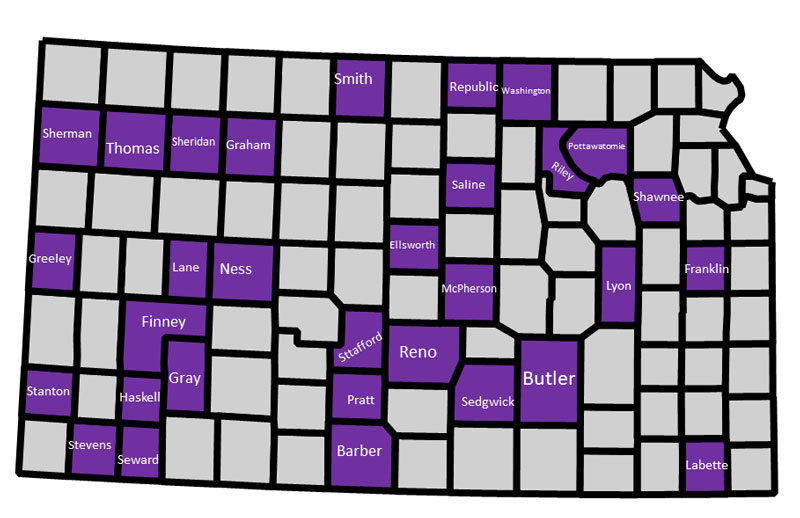
Figure 1. In-season K-Trap monitoring counties. Counties that are purple have at least one trap for CLH that is being monitored weekly during the 2026 Corn Season.
Corn Leafhopper Identification
The corn leafhopper is relatively simple to identify under magnification (Figures 1A and 1B). Corn leafhoppers are light tan to yellowish-white in color and approximately 1/8” long. Two distinct dark spots between the eyes are very characteristic of this species and lack facial marks. Nymphs lack wings and can vary in color. However, some leafhopper species can be mistaken for corn leafhoppers. These look-alike species, such as aster leafhoppers (Figure 1C and 1D), are not important pests of corn and do not transmit corn stunt pathogens.
Like most leafhoppers, all corn leafhopper stages move quickly when disturbed and hide in shaded areas of corn plants. All stages can be sampled using a sweep net; a video showing how to sample for corn leafhoppers in mature corn canopies can be found here: https://youtu.be/QgLuWWSwHWU.
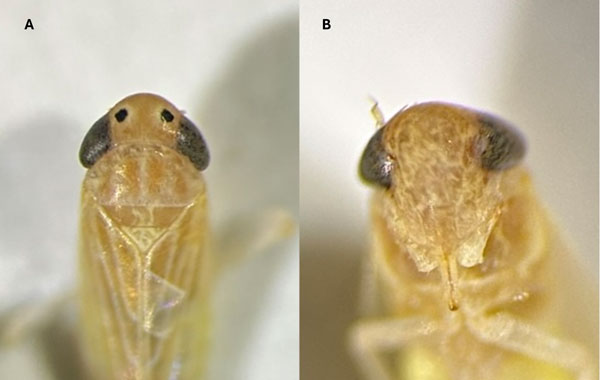
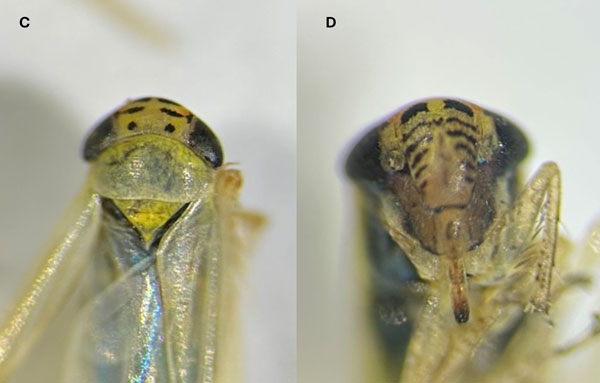
Figure 2. Images of leafhopper: A) Above view of the Corn Leafhopper showing the two black spots surrounded by light/white “halos” and B) Underside view of the Corn Leafhopper showing no markings on the face. C) Above view of the Aster Leafhopper showing the two black spots, no light/white “halos” are present, and D) Underside view of the Aster Leafhopper showing facial marks. Photos courtesy of Rodrigo Onofre, K-State Extension.
Corn Leafhopper Management
Insecticide applications are an option. However, trials conducted in 2025 in Oklahoma and Texas found broad spectrum insecticides were largely ineffective against corn leafhoppers. Up to 14 days of nymph suppression was observed with applications of indoxacarb, flupyradifurone, thiamethoxam, and lambda-cyhalothrin. However, insecticides are not a bulletproof option for preventing corn stunt disease, as multiple waves of adult CLH may occur throughout the season. Also, spraying for CLH may increase the chances of spider mite infestations and negatively impact beneficial arthropods. In addition, corn stunt disease incidence will not be reduced by insecticide or fungicide applications. If symptomatic corn plants are observed in the field, the plants have already been infected. Remember, the label is the law.
Corn leafhopper 2025 Overview
In the 2025 growing season, a weekly sticky trapping network was deployed throughout the state. There were 31 trap locations across 29 counties in a growing corn crop. The first detection of CLH was on July 14th, 2025, in Cherokee County, with populations spiking in September and tapering off as corn was harvested. Corn stunt spiroplasma detections remained low throughout the season, and it was first detected in Saline County on July 28, 2025. During the 2025 corn season, corn leafhopper and corn stunt spiroplasma were reported in 31 and 25 counties, respectively, in Kansas.
Following corn harvest, a winter sticky trapping network was deployed throughout the state to monitor the overwinter potential of corn leafhopper in Kansas. A total of 15 trap locations were placed across 11 counties in the state (Figure 3). Traps were placed in alfalfa, rye, triticale, winter wheat, and corn stalks. Since December 8, 2025, no corn leafhoppers have been trapped in Kansas.
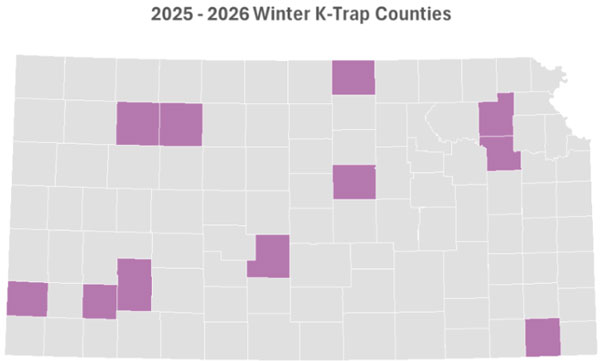
Figure 3. 2025-2026 Corn Leafhopper winter monitoring network.
FAQs for Leafhopper and Corn Stunt
- Learn the best way to scout your fields for corn leafhopper: https://www.youtube.com/shorts/_n7RZq0ougY
- Does corn stunt carry over in corn residue?
https://www.youtube.com/shorts/5rUZdi4CG3Q - Purple corn leaves – Is it corn stunt?
https://www.youtube.com/shorts/Jxkicq8DQfA - What other problems look like corn stunt?
https://www.youtube.com/shorts/dtjD8Wpip6A - How are sticky traps used to track corn leafhoppers?
https://www.youtube.com/shorts/DqLKsUI2xcs - Leafhopper project: What, Who, and Why?
https://www.youtube.com/shorts/XPEnmN05Nfc
For more information, please visit https://kscorn.com/corndisease/
Please help us track! K-State Offers FREE TESTING for Corn Leafhopper Identification and Corn Stunt Disease
Kansas corn farmers have new tools to guard against corn leafhoppers and corn stunt disease. The Kansas Corn Commission is supporting the work of K-State Plant Pathologist Rodrigo Onofre to track leafhoppers and corn stunt disease in Kansas, helping growers manage this risk. In addition to the creation of a statewide system to track leafhopper infestations, K-State Plant Pathology is offering FREE TESTING to identify corn leaf hoppers (CLH Confirmation and Pathogen Presence) and plant tissue testing for corn stunt disease, thanks to support from the Kansas Corn Commission.
Collection and shipping instructions can be found below.
- Collect and ship samples on or before Wednesday to avoid weekend storage
- Collect symptomatic fresh leaf tissue.
- Use a sweep net to collect insects. Empty net into gallon plastic bags.
- Label and use plastic bags; Do not use paper bags, and do not add water.
- Fill out the submission form. Please make sure to add a “2026 FREE CORN STUNT TESTING” note to the submission form.
- Ship samples ASAP overnight via UPS or FedEx if possible.
K-State Plant Diagnostic Lab
4032 Throckmorton PSC
1712 Clafin Road
Manhattan, KS 66506
As the 2026 growing season progresses, the Kansas Corn Disease Network remains committed to providing timely, science-based information to help growers protect yield potential and make informed management decisions. The network is actively monitoring tar spot, southern rust, corn leafhopper, and corn stunt diseases
Rodrigo Onofre, Row Crop Plant Pathologist
onofre@ksu.edu
Anthony Zukoff, Entomology Extension Associate
azukoff@ksu.edu
Tina Sullivan, Northeast Area Agronomist
tsullivan@ksu.edu