Controlling Weeds After Wheat Harvest
The 2026 wheat harvest is underway, which means it is time to consider weed control in wheat stubble. When soil moisture conditions are favorable, emerged weeds with retarded growth due to crop canopy closure will grow rapidly once crop competition is removed. In addition, weeds that have emerged through the wheat canopy will be damaged during harvest and will quickly begin regrowth. Delaying control can result in lost soil moisture that could be used for crop production, as well as increased weed seed production, which will cause difficulties in the future.
When thinking about weed control in wheat stubble, there are two priorities: controlling already-emerged weeds and preventing later flushes. Making applications before weeds exceed 4 to 6 inches is necessary for good control of already emerged weeds (Figure 1). Residual herbicides are necessary to reduce the number of herbicide applications required to control multiple flushes of weeds.
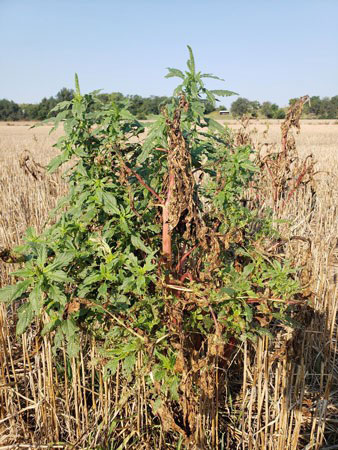
Figure 1. This large Palmer amaranth is regrowing after being sprayed with paraquat. Photo by Sarah Ganske, K-State Extension.
Despite a growing number of herbicide-resistant weeds, glyphosate plus 2,4-D LVE and/or dicamba continue to be important for weed control in wheat stubble. However, these herbicides alone are not likely to provide adequate control of pigweeds or kochia, especially when applied in the hot, dry conditions that are common after wheat harvest. The following paragraphs list some herbicide options commonly used to control weeds after wheat harvest.
Paraquat (Gramoxone, others) is a Group 22 herbicide that can work well in place of glyphosate for nonselective control of emerged pigweed and kochia. Treatments that included paraquat (Gramoxone) resulted in the greatest control of large Palmer amaranth in wheat stubble in research that was conducted in Hays during 2019 and 2020. Paraquat is a contact herbicide, so spray coverage is critical. Spray volumes of 20 gallons/acre or higher are preferred, especially on larger weeds or denser stands. If sprayed at less than 20 GPA, flat fan nozzles are required to achieve smaller droplet sizes. Paraquat needs to be applied with a non-ionic surfactant or oil concentrate to enhance the surface coverage of the plant foliage. Also, remember there is a requirement for handlers and applicators to complete training every three years to use paraquat. Syngenta has announced that it will discontinue production of paraquat (Gramoxone) on June 30 of this year, and sales will be stopped at the end of the year. However, generic paraquat formulations may still be available.
If planning to plant corn or sorghum next spring, a tank mix of paraquat with atrazine (Group 5) will enhance the control of emerged weeds and provide some residual weed control. Atrazine labels have recently changed such that the only noncrop uses of atrazine permitted are for wheat stubble in wheat-fallow-wheat, wheat-corn-fallow, and wheat-sorghum-fallow rotations. In these rotations, it is still important to be aware of the total amount of atrazine you are applying to each field in a given year and stay below the maximum rate allowed for your field. Metribuzin is another Group 5 herbicide that can be used instead of atrazine to enhance control and provide some residual activity. There are three benefits of using metribuzin instead of atrazine.
- First, there are more crop rotation options. Atrazine limits crop options to corn or sorghum in the next season, whereas metribuzin can be applied as a pre-emergence herbicide for soybeans or field peas.
- Second, post-emergence applications of metribuzin will have some activity on atrazine-resistant weed populations.
- Third, the residual weed control provided by metribuzin is likely not affected by enhanced degradation associated with extensive atrazine use.
One final note regarding paraquat. Limited research from Australia suggests that applying paraquat 2 weeks after a glyphosate application increases weed control. This is called a ‘double knock’ strategy. This information is included here not as a recommendation per se, but to encourage careful consideration of when to use contact herbicides in your fallow weed management system. If paraquat is sprayed before or with glyphosate, the rapid damage to leaf tissue can prevent glyphosate uptake and translocation. However, if a glyphosate application partially controls weeds, there will be sufficient leaf area 2 weeks after application for paraquat to be effective.
Saflufenacil (Sharpen), a Group 14 herbicide applied at 1 to 2 fluid ounces per acre, is an option for postemergence and short-term residual control of Palmer amaranth, kochia, and other broadleaf weeds. Sharpen should be applied with glyphosate for grass control and can be applied with other products labeled for use in wheat stubble, but do not apply Sharpen with Valor. Sharpen works best with the addition of methylated seed oil and ammonium sulfate. Good spray coverage is needed, so using 15 to 20 gallons/acre spray solution is important. Be sure to note crop rotation intervals for your situation, especially if using more than one fluid ounce per acre or applying to sandy or low organic matter soils. Tiafenacil (Reviton) is a Group 14 very similar to Sharpen in terms of weed control and adjuvant use.
Flumioxazin (Valor, others) is a Group 14 herbicide that can be added to burndown treatments at rates of one to four fluid ounces per acre for activity on emerged broadleaf weeds and some residual activity on broadleaf and grass weeds. Flumioxazin can be mixed with glyphosate or clethodim (Select Max) for enhanced grass control. It can also be mixed with 2,4-D, atrazine, metribuzin, or paraquat.
- Wheat can be planted 30 days after two fluid ounces per acre, or 60 days after three fluid ounces per acre if at least one inch of rain occurs between application and planting.
- Soybeans can be planted immediately after an application of three fluid ounces per acre.
- Corn, sorghum, cotton, sunflowers, or soybeans can be planted in the spring following the application of four fluid ounces per acre.
Residual weed control with flumioxazin will depend on rainfall (0.25 inch) for activation, just as with pre-plant treatment in soybeans.
Another group 14 herbicide that can be considered is sulfentrazone (Spartan, others). Sulfentrazone can be applied to stubble and will control Palmer amaranth and kochia as well as other broadleaf weeds and some grasses. However, sulfentrazone can limit crop rotation options. Specifically, if rates greater than 8.0 fl oz of a 4L formulation are used, the rotation to sorghum is 18 months, while it is 10 months for lower rates.
Of the Group 14 herbicides discussed, flumioxazin and sulfentrazone provide the greatest residual activity; however, saflufenacil provides greater postemergence kochia control than flumioxazin.
Take Home Message
- Apply as soon as possible after harvest. Early weed control protects soil moisture and reduces seed production.
- Target smaller, actively growing weeds for the best results.
- Residual herbicides are essential for managing later flushes of weeds in wheat stubble.
- Match herbicide choices with next year's crop plans to avoid rotation restrictions.
For more detailed information, see the “2026 Chemical Weed Control for Field Crops, Pastures, and Noncropland” guide available online at https://www.bookstore.ksre.ksu.edu/pubs/CHEMWEEDGUIDE.pdf or check with your local K-State Research and Extension office for a paper copy.
The use of trade names is for clarity to readers and does not imply endorsement of a particular product, nor does exclusion imply non-approval. Always consult the herbicide label for the most current use requirements. Users should read and follow all label directions.
Sarah Ganske, Weed Science Extension Specialist
slancaster@ksu.edu
Jeanne Falk Jones, Northwest Area Agronomist
jfalkjones@ksu.edu
Jeremie Kouame, Weed Scientist – Agricultural Research Center, Hays
jkouame@ksu.edu
Patrick Geier, Weed Scientist – Southwest Research & Extension Center
pgeier@ksu.edu