Considerations for Replanting or Late Planting of Soybeans
As of May 31, 2026, approximately 75% of the soybeans have been planted with 57% emerged. This compares to being above average for both planted (65%) and emerged (45%). However, heavy rains may slow harvest for quickly progressing wheat in areas of the state or in extremely heavy pockets, causing stand losses that need to be considered for replanting (Figure 1). Cold snaps in April have also shown some sluggishness in soybeans that went in early for March’s warm temperatures.
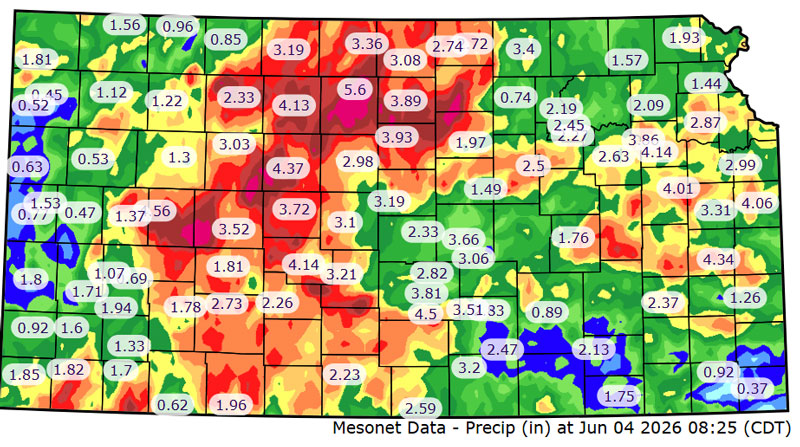
Figure 1. Seven-day precipitation totals across Kansas from May 29 to June 4, 2026. Map from the Kansas Mesonet.
Planting Progress Overview
Kansas farmers have been planting soybeans slightly earlier in recent years, by about one-third of a day each year (Figure 2). Statewide, the “50% planting date” mark has ranged from the end of May (for the most recent decade) to the first of June (in the 1980s). The earliest date at which half of all soybeans in the state were planted was May 12 in 2014, while the latest delay was June 28 in 1982.
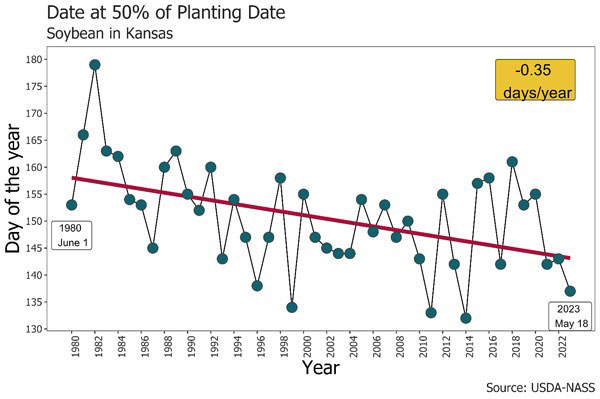
Figure 2. Trend in the date at which 50% of planting progress was achieved for soybean from 1980 to 2023 in Kansas (the last four decades of soybean progress in Kansas). Source: USDA-NASS.
Considerations for Replanting or Late Planting
The decision to replant can be difficult. Before replanting late, producers should consider plant population, distribution, and growth stage. Soybean emergence could be delayed or compromised by excessive rainfall in recent weeks (Figure 1). Replanting soybeans should be reserved only for exceptional cases of reduced plant population and stand uniformity. Assessments should be done a week or so after the initial damage to assess the overall condition of plants and potential issues related to lack of uniformity, which could be a problem when stands are severely reduced. Generally, if there are fewer than 50,000 to 60,000 healthy plants per acre, replanting may be warranted. However, this number may vary across the state with differences in expected yield. Producers must also consider weed management, seed and variety availability, the availability of insurance, and the actual cost to replant.
When replanting or planting late, producers should consider a few key management practices.
Planting Date and Maturity Group
From mid-April to mid-July, we may expect maximum soybean yield in Kansas to be reduced by about 0.3 bu/a for each day of delay past mid-April, from yield levels of about 80-90 bu/a to ~50 bu/a.
When considering soybean maturity group, it is important to remember that soybeans flower in response to a combination of temperature and day length, so shifting to an earlier-maturing variety when replanting or planting late will result in very short plants with pods that are close to the ground. Planting a variety with the same or perhaps even slightly later maturity rating (compared to soybeans planted at a typical planting date) will allow the plant to develop a larger canopy before flowering.
Seeding Rate and Row Spacing
Increasing the seeding rate of late-planted soybeans by 10-20% compared to the optimal seeding rate allows for compensation in the shortened growing window. Under normal conditions, the same soybean cultivar planted early in the planting window will develop nearly 50% more productive nodes than when planted in late June: 19-25 nodes when planted early vs. 13-16 nodes when planted late. Information on late-planted soybeans across multiple row spacing suggests that narrow rows (e.g., 7” or 15” vs. 30”) can hasten canopy closure, increasing season-long light interception, weed suppression, and potentially improving biomass and final yield. The likelihood of a positive yield response to narrow rows increases as the yield environment lowers, for example, with delayed planting.
Key Points
- Replanting is recommended only for exceptionally reduced populations and uniformity.
- If there are <50,000 to 60,000 healthy plants/acre, you may consider replanting.
- Plant a variety with the same or perhaps even a slightly later maturity rating.
- Increase the seeding rate of late-planted soybeans by 10-20%.
- Narrow row spacing may increase yield potential with late planting.
Tina Sullivan, Northeast Area Agronomist
tsullivan@ksu.edu
Logan Simon, Southwest Area Agronomist
lsimon@ksu.edu