Peak Western Corn Rootworm Egg Hatch Underway in Kansas
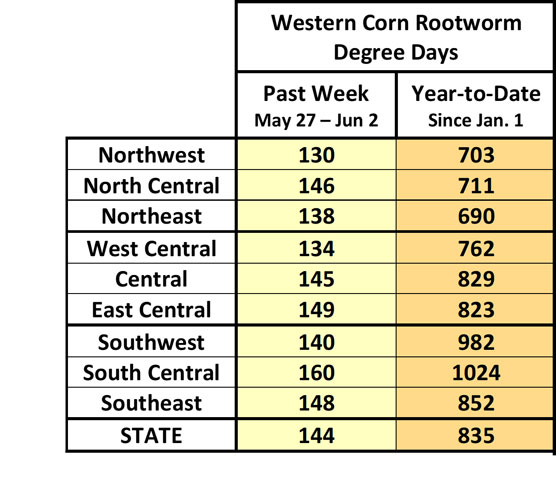
As of the end of May, accumulated degree days for western corn rootworm indicate that eggs are hatching statewide. In the southern and central portions of the state, peak egg hatching is underway in most locations, and it is not far behind in the northern regions (Table 1).
Table 1. 2026 western corn rootworm degree day accumulation for the final week of May, as well as total yearly accumulation for all regions of the state. Calculations based on data from the Kansas Mesonet provided by Matthew Sittel.
Calculating Corn Rootworm Degree Days
As with all degree-day models, the base temperature, or developmental threshold, will be important for predicting rootworm hatch and emergence. Western Corn Rootworm eggs are laid in summer and overwinter in the soil. The following spring, a threshold soil temperature of 52°F or higher will trigger eggs to develop. This base temperature and the daily 10-cm high and low soil temperatures are used to monitor egg hatch using the formula below. It is important to note that degree day calculations for egg hatch should begin on January 1 of the current year.
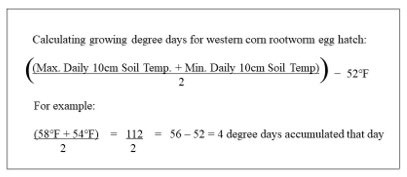
Eggs should begin hatching after approximately 380 degree days have accumulated. Peak egg hatch occurs between 684 and 767 accumulated degree days. Examining corn roots for damage 10 to 14 days following peak hatch is recommended since feeding damage will be fresh and easier to detect.
Why is it important to scout for root damage?
Western corn rootworm resistance to Bt corn continues to be an issue in continuous corn in the United States. Field-evolved resistance was first detected in 2009, and, to date, resistance to every commercially available Bt trait package has been detected in corn-producing areas of the country. However, resistance is not uniform across all corn-growing regions, so be sure to check local conditions when making planting decisions. Given this, evaluating corn roots for rootworm damage during the growing season is highly recommended. Doing so lets you know how well your rootworm management practices are working and provides a way to detect the presence of potential resistance to the Bt hybrid planted.
Details on evaluating corn root damage can be found in the KSRE publication MF845, Corn Rootworm Management in Kansas Field Corn. In short, several plants should be dug up throughout the field, and their roots should be thoroughly washed before subsequent evaluation using the Iowa State University 1-3 Node Injury Scale. Digging roots will need to be timed after peak damage from rootworm larvae occurs, but before roots begin to regrow, typically late June to early July. Corn rootworm resistance to a Bt protein should be considered if the node injury rating is 1.0 in a field with at least 2 consecutive years of use of the same single corn rootworm Bt toxin or if the node injury rating is greater than 0.5 in a field with at least 2 consecutive years of use of the same pyramided corn rootworm Bt toxins.
Take Home Message
It is important to remember that the best management tool for western corn rootworm is rotation. In continuous corn production, this includes rotating Bt traits annually to help slow the evolution of resistance. Rotation to a non-Bt hybrid combined with soil-applied insecticides would be another option for continuous corn. Both practices will help prolong the efficacy of currently available Bt traits.
Anthony Zukoff, Extension Entomology – Garden City
azukoff@ksu.edu
Matthew Sittel, Assistant State Climatologist
msittel@ksu.edu