Using Remote Sensing to Monitor Wheat Under Weather Variability in Kansas
Kansas has experienced increased weather variability, including tornadoes, freezing temperatures, sudden drought, high winds, and hailstorms. These conditions have impacted in-season crop growth and development, especially in winter wheat, which is in the mid- to late season right now. Such uncertainties and frequent fluctuations can negatively affect wheat by damaging leaf tissue, limiting photosynthetic activity, and increasing the risk of lodging and defoliation. Moreover, in many cases, such effects on wheat are not uniform across the field due to differences in soil properties, topography, residue cover, and crop vigor. As a result, some areas of the field may recover successfully, while others may continue to decline throughout the season.
Therefore, regular in-season assessment of wheat growth is important to identify damaged areas, assess damage severity, and detect delayed growth and lodging caused by strong winds, freezing temperatures, and drought. Based on these assessments, wheat growers can make better management decisions regarding in-season fertilizer and fungicide applications, crop insurance documentation, damage recovery, and yield loss assessment.
How Does Remote Sensing Work?
One approach to such monitoring could be the use of remote sensing technology, which is more scalable and enables faster, less labor-intensive field assessments. Remote sensing is the collection of information about crop growth using sensor technology mounted on platforms such as satellites and drones. Sensors measure the reflectance of different wavelength light from crops, which is strongly influenced by crop health conditions that are often not visible to the human eye. Based on wavelength, reflected light is divided into different regions of the electromagnetic spectrum:
- Visible light: Blue, green, and red bands are easily detected by the human eye.
- Red-edge and near-infrared (NIR) wavelengths are beyond the range of normal human vision and can only be detected with specialized sensors mounted on drones or satellites.
Healthy plants typically show higher NIR reflectance and distinct red-edge reflectance patterns compared to stressed or damaged plants, due to differences in chlorophyll concentration, internal leaf structure, and canopy condition. These differences in reflectance allow us to assess crop vigor, growth, freeze injury, drought stress, hail damage, and overall spatial variability within fields. Using this information, remote sensing can support timely, site-specific management decisions during the wheat-growing season.
Remote sensing for in-season wheat growth monitoring
A study was conducted to assess the applicability of remote sensing for in-season environmental stress, such as drought, in wheat growth in a 149-acre field in Ellsworth County, KS. High-resolution satellite imagery was collected from PlanetScope at five different times during the growth stages from March 25 to May 3, 2026, as this season has been a drought year and has experienced frequent freezing events. The spatial resolution (pixel size) of the imagery was 118 inches/pixel, and it provides 8 different light reflectance information.
The Normalized Difference Red Edge (NDRE) index was used to assess crop vigor, chlorophyll content, and stress.
- NDRE values range from 0 to 1
- Higher values = healthier plants
- Lower values = stress or reduced vigor
The temporal NDRE maps show spatial and seasonal variability in wheat canopy vigor during the 2026 growing season. The highest mean NDRE value was observed on April 6 (0.65), followed by April 15 (0.63), indicating relatively healthy and vigorous crop growth during this period. Lower mean NDRE values were observed on March 25 (0.61), April 24 (0.55), and May 3 (0.56), suggesting reduced canopy vigor, possible stress, or advancing crop maturity (Figure 1). Areas with consistently lower NDRE values may indicate stress-prone zones associated with freezing injury, moisture stress, nutrient variability, or soil and topographic differences. These maps highlight the usefulness of remote sensing for monitoring in-season wheat conditions and identifying areas requiring further scouting or management attention.
Moreover, the overall change in the NDRE was calculated during the period from March 25 to May 3. The overall mean NDRE change was -0.05, indicating a general decline in canopy vigor across the field during this period (Figure 2). More such changes were distinct in the different regions of the field. For example, areas shown in red represent larger reductions in NDRE values, suggesting greater decreases in chlorophyll content or crop vigor, potentially associated with freeze injury or moisture stress. In contrast, green areas indicate relatively smaller changes or more stable crop conditions over time.
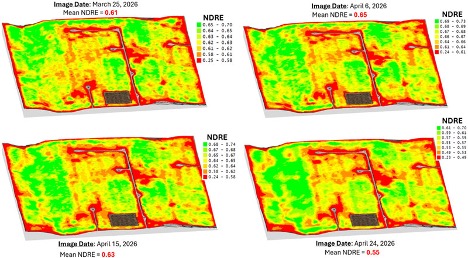
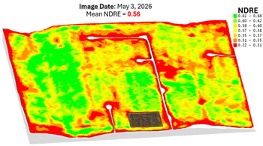
Figure 1. Temporal NDRE maps from satellite imagery showing spatial variability in wheat canopy vigor during the 2026 growing season. Green areas represent higher NDRE values and healthier crop growth, while yellow to red areas indicate lower canopy vigor or potential stress conditions. Map images from Deepak Joshi, K-State Extension.
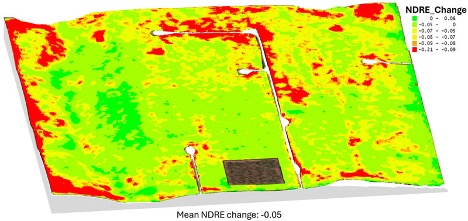
Figure 2. Map showing the NDRE change between March 25 and May 3, 2026. Negative NDRE changes indicate reductions in wheat canopy vigor over time. Red areas represent larger declines in NDRE values, while green areas indicate relatively smaller changes or more stable crop conditions. The overall mean NDRE change across the field was -0.05. Map image from Deepak Joshi, K-State Extension.
Conclusion
In this article, we demonstrate how remote sensing-based NDRE imagery can be used to monitor in-season wheat growth variability and assess crop response to environmental stress conditions across the growing season in Kansas. Based on such an assessment, growers can make multiple in-season decisions related to wheat production.
Deepak Joshi, Precision Agriculture Extension Specialist
drjoshi@ksu.edu
Logan Simon, Southwest Area Agronomist
Romulo Lollato, Wheat & Forage Specialist
Craig Dinkel, Midway District Agent & Interim District Director