Double Crop Options After Wheat
Double-cropping after wheat harvest can be a high-risk venture for grain crops. The remaining growing season is relatively short. Hot and/or dry conditions in July and August may cause problems with germination, emergence, seed set, or grain fill. Some regions of the state currently have ample soil moisture that will aid in establishing a successful crop after wheat harvest. The most common double crop grain options are soybean, sorghum, and sunflower. Other possibilities include summer annual forages and specialized crops such as proso millet, short-season summer corn, or cover crops.
Be Aware of Herbicide Carryover Potential
One major planting consideration after wheat is the potential for herbicide carryover. Many herbicides applied to wheat are Group 2 herbicides in the sulfonylurea family with the potential to remain in the soil after harvest. If a herbicide such as chlorsulfuron (Glean, Finesse, others) or metsulfuron (Ally) has been used, the most tolerant double crop will be sulfonylurea-resistant soybean varieties (STS, SR, Bolt) or other crops. When choosing herbicide-resistant varieties, be sure to match the resistance trait to the specific herbicide (not just the herbicide group) you used. This is especially true for double-crop sunflowers. There are Clearfield sunflowers that allow Beyond herbicide applications, and ExpressSun sunflowers that allow an application of Express herbicide. While both of these herbicides are Group 2 (ALS-inhibiting herbicides), the Clearfield trait and ExpressSun are not interchangeable, and plant damage can result from other Group 2 herbicides.
Less information is available regarding the herbicide carryover potential of wheat herbicides to cover crops. There is little or no mention of rotational restrictions for specific cover crops on the labels of most herbicides. However, this does not mean there are no restrictions. Generally, there will be a statement that indicates “no other crops” should be planted for a specified amount of time, or that a bioassay must be conducted prior to planting the crop.
Controlling Emerged Weeds
Burndown of summer annual weeds present at planting is essential for successful double-cropping. Assuming glyphosate-resistant kochia and pigweeds are present, combinations of glyphosate with products such as saflufenacil (Sharpen) or tiafenacil (Reviton), or alternative treatments such as paraquat may be required. Sprayer set up to ensure adequate spray coverage and herbicide deposition is critical for the application of these contact herbicides. Dicamba or 2,4-D may also be considered if the soybean varieties with appropriate herbicide resistance traits are planted. Be aware that large weeds that have been mechanically injured during harvest may require more than one post-emergence herbicide application. In addition, residual herbicides for the double crop should be applied at this time.
One thing to consider is that weed control costs cannot really be counted against the double crop, since that cost should occur whether or not a crop is present. In fact, having a competitive crop on the field may reduce herbicide costs compared to leaving the field fallow.
Management, production costs, and yield outlooks for double crop options are discussed below.
Soybeans
Soybeans are likely the most commonly used crop for double cropping, especially in central and eastern Kansas (Figure 1). 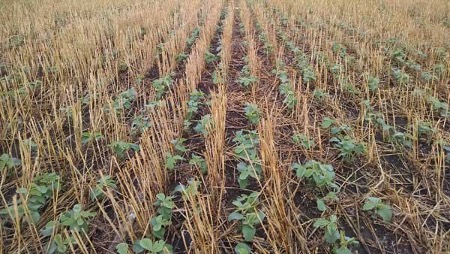
Figure 1. Soybeans planted as a double crop following wheat at the Ashland Bottoms Research Farm in Manhattan. Photo by Kraig Roozeboom, K-State Research and Extension.
Variety selection for double cropping is important. Soybeans flower in response to a combination of temperature and day length. Double-crop planting an earlier-maturing variety often results in very short plants with pods close to the ground, with limited harvestability. Planting a variety with the same or slightly later maturity rating (compared to soybeans planted at a typical planting date) will allow the plant to develop more vegetative growth before flowering. Planting a late-maturing variety too late increases the risk that the beans may not mature before frost, especially if long periods of drought slow growth. The goal is to maximize the length of the growing season of the crop, so prompt planting after wheat harvest is critical. The earlier you plant, the higher the crop's yield potential if moisture is not a limiting factor.
Seeding rates and row spacing. Seeding rate can be slightly increased if soybeans are planted too late in order to increase canopy development. Narrow row spacing (15 inches or less) has often resulted in a yield advantage over 30-inch rows in late plantings. Soybeans planted in narrow rows will canopy over more quickly than in wide rows, which is important when the length of the growing season is shortened. Narrow rows also offer the benefits of increasing early-season light capture, suppressing weeds, and reducing erosion. On the other hand, the advantage of planting in wide rows is that the bottom pods are usually slightly higher off the soil surface, which aids harvest. The other consideration is planting equipment. Often, no-till planters handle wheat residue better and place seeds more precisely than drills, although the difference has narrowed in recent years.
Fertilizer considerations. Adding some nitrogen (N) to double-crop soybeans may be beneficial if the previous wheat yield was high and the soil N was depleted. A soil test for N levels before wheat harvest is recommended. Use no more than 30 lbs/acre of N. It would be ideal to knife-in the fertilizer. If that is not possible, banding it on the soil surface would be acceptable. Do not apply N in the furrow with soybean seed, as severe stand loss can occur.
Weed control. Pre-emergence residual herbicides should be applied before or at planting time. Herbicides that could be used include a Group 15 herbicide such as acetochlor (Warrant, others), dimethenamid (Outlook, others), pyroxasulfone (Zidua), or S-metolachlor (Dual Magnum). Keep in mind that S-metolachlor tends to require more rainfall for activation than the other Group 15 herbicides. A second herbicide, such as metribuzin (Sencor, others), flumioxazin (Valor, others), or sulfentrazone (Spartan, others) should also be included for residual weed control. A postemergence application may be necessary to control weeds that were not controlled by the burndown application. In Enlist varieties, applications can include Enlist One (2,4-D choline) combined with glufosinate (Liberty, others) and/or glyphosate (Roundup, others). In XtendFlex varieties, XtendiMax (dicamba) can be combined with glyphosate but not with glufosinate.
What are typical yield expectations for double-crop soybeans? It varies considerably depending on moisture and temperature, but yields are usually several bushels less than full-season soybeans. A long-term average of 20 bushels per acre is often mentioned when discussing double-crop soybeans in central and northeast Kansas. Rainfall amount and distribution can cause a wide variation in yields from year to year. Double-crop soybean yields typically are much better as you move farther southeast in Kansas, often ranging from 20 to 40 bushels per acre.
A K-State publication explores the potential yield of double-crop soybeans relative to full-season yield (Figure 2) and the most limiting factors affecting the yields for double-crop soybeans. The link to this article is: https://bookstore.ksre.ksu.edu/pubs/MF3461.pdf
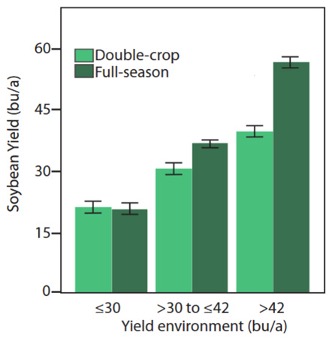
Figure 2. Double-crop compared to full-season soybean yields. Yield environments were divided into three ranges: ≤30 bu/a, >30 to ≤42 bu/a, and >42 bu/a.
Grain Sorghum
Grain sorghum is another double-crop option. Unlike soybeans, sorghum hybrids for double cropping should be earlier-maturing hybrids. Sorghum development is primarily driven by accumulated heat units, and the double-crop growing season is too short to allow medium-late or late hybrids to mature before the first frost in most of Kansas.
Seeding rates and row spacing. Late-planted sorghum likely will not tiller as much as early plantings and can benefit from slightly higher seeding rates than would be used for sorghum planted at an earlier date. Narrow row spacing is advised, especially if the outlook for rainfall is good.
Fertilizer considerations. A key component in estimating N application rates is yield potential. This will largely determine the N needs. It is also important to consider potential residual N from the wheat crop. This can be particularly important when wheat yields are lower than expected. In that situation, additional available N may be present in the soil. Assess the amount of profile N by taking soil samples at a depth of 24 inches and submitting them for analysis at a soil testing laboratory.
Double-crop sorghum planted into average or greater-than-average amounts of wheat residue can result in a challenging amount of residue to deal with when planting next year’s crop. Nitrogen fertilizer can be tied up by wheat residue, so use application methods to minimize tie-up, such as knifing into the soil below the residue.
Weed control. Weed control can be important in double-crop sorghum. Warm-season annual grasses, such as crabgrass, can reduce yields of double-crop sorghum. Using a chloroacetamide -and atrazine pre-emergence product such as Bicep II Magnum or FulTime NXT may be key to successful double-crop sorghum production. Including mesotrione will likely improve control of Palmer amaranth but may cause some crop injury. Herbicide-resistant grain sorghum varieties will allow the use of imazamox (Imiflex in igrowth sorghums) or quizalofop (FirstAct in DoubleTeam grain sorghum) that can control summer annual grasses.
Yield expectations. No-till studies at Hesston documented 4-year average double crop sorghum yields of 75 bushels per acre compared to about 90 bushels per acre for full-season sorghum. A different 10-year study that did not have double crop planting but did compare early- and late-planting dates averaged 73 bushels per acre for May planting vs. 68 bushels per acre for June planting.
Sunflowers
Sunflowers can be a successful double-crop option anywhere in the state, provided there is enough moisture at planting time to establish a stand. Sunflowers need more moisture than any other crop to germinate and emerge due to their large seeds. Therefore, stand establishment is important. Planting immediately after wheat harvest in a limited-irrigation field can be a good fit to support stand establishment.
Seeding rates and hybrid selection. When double-cropping sunflowers, producers should use slightly lower seeding rates to reflect the lower yield expectations compared to full-season sunflowers. It is also necessary to use shorter-season hybrids, so they bloom and mature before frost.
Weed control. First, it is important to check the herbicide applications on the wheat. The rotation restriction to sunflowers after several commonly used wheat herbicides is 22-24 months.
Weed control can be an issue with double-crop sunflowers since herbicide options are limited, especially post-emergence. Thus, controlling weeds prior to sunflower planting and using residual herbicides is critical. Sulfentrazone (Spartan) is a commonly used residual herbicide, but pre-plant restrictions for herbicides like pyroxasulfone (Zidua) can complicate plans. Planting Clearfield or ExpressSun sunflowers will provide additional post-emergence herbicide options, but ALS-resistant kochia and pigweeds still won’t be controlled. Imazamox (Beyond in Clearfield sunflower) has activity on small annual grasses as well as many broadleaf weeds, if they are not ALS-resistant.
Summer annual forages
With mid-July plantings and where herbicide carryover is not a concern, summer annual sorghum-type forages are also a good double-crop option. A study planted July 21, 2008, near Holton, when summer rainfall was very favorable, provided yields of 2.5 to 3 tons dry matter/acre for hybrid pearl millet and sudangrass at the low end to 4 to 5 tons dry matter/acre for forage sorghum, BMR forage sorghum, photoperiod sensitive forage sorghum, and sorghum x sudangrass hybrids. Earlier plantings may produce even more tonnage, as long as there is adequate August rainfall.
One challenge with late-planted summer annual forages is getting them to dry down when harvest is delayed until mid- to late-September. Wrapping bales or bagging to make silage are good ways to deal with the higher moisture forage this late in the year.
Corn
Is double-crop corn a viable option? Corn is typically not recommended for late June or July plantings because yields are usually substantially lower than when planted earlier.
Typically, mid-July planted corn struggles during pollination and seldom receives sufficient heat units to fill grain before frost. Very short-season corn hybrids (80 to 95 RM) have the greatest chance of maturing before frost in double crop plantings, but generally have less yield potential when compared to hybrids of 100 RM or more used for full-season plantings. Short-season hybrids often set the ear fairly close to the ground, increasing the harvest difficulty. Glyphosate-resistant hybrids will make weed control easier with double-crop corn, but problems remain present with late-emerging summer weeds such as pigweeds, velvetleaf, and large crabgrass. Keep in mind, corn is very susceptible to carryover of most residual ALS herbicides used in wheat.
Considerations for altering seeding rates and variety/hybrid maturity for the crops discussed above are summarized in Table 1.
Table 1. Seeding rate and variety/hybrid relative maturity considerations for double crops compared to full-season.
|
Crop |
Seeding rate |
Relative maturity |
|
‒‒‒‒‒‒‒‒ Difference between double crop and full-season ‒‒‒‒‒‒‒‒ |
||
|
Soybean |
Increase |
No change or longer |
|
Sorghum |
Increase |
Shorter |
|
Sunflower |
Decrease |
Shorter |
|
Corn |
No change |
Shorter |
Volunteer wheat control
One of the issues with double-cropping that is often overlooked by producers is the potential for volunteer wheat in the crop following wheat. If volunteer wheat emerges and goes uncontrolled, it can cause serious problems for nearby wheat fields in the fall as a host for the wheat streak mosaic complex of viruses [wheat streak mosaic (WSMV), High Plains disease (HPD), and triticum mosaic (TriMV)] that are transmitted by the wheat curl mite (WCM).
Volunteer wheat can generally be controlled fairly well with glyphosate (Roundup, others) or Group 1 herbicides such as quizalofop (Assure II, others) or clethodim (Select Max, others), but control is reduced during times of drought stress. Atrazine can provide control of volunteer wheat in double-crop corn or sorghum, but control can be erratic depending on rainfall patterns.
For more detailed information about herbicides, see the “2026 Chemical Weed Control for Field Crops, Pastures, and Noncropland” guide available online at https://www.bookstore.ksre.ksu.edu/pubs/CHEMWEEDGUIDE.pdf or check with your local K-State Research and Extension office for a paper copy.
The use of trade names is for clarity to readers and does not imply endorsement of a particular product, nor does exclusion imply non-approval. Always consult the herbicide label for the most current use requirements.
Sarah Ganske, Weed Management Specialist
slancaster@ksu.edu
John Holman, Cropping Systems Agronomist
jholman@ksu.edu
Logan Simon, Southwest Area Agronomist
lsimon@ksu.edu
Tina Sullivan, Northeast Area Agronomist
tsullivan@ksu.edu
Jeanne Falk Jones, Northwest Area Agronomist
jfalkjones@ksu.edu