Controlling Volunteers in a Soybean/Cotton Crop Rotation
Volunteer plants of one crop growing in another can be considered weeds because they can reduce the yield, quality, and harvest efficiency of the current crop (Figure 1). In the cotton-producing regions of Kansas, cotton frequently follows soybeans in no-till or reduced-till cropping systems. Volunteer soybeans can reduce the value of cotton if not controlled before harvest (Figure 1). One way to control volunteer plants in this situation would be to rotate herbicide-resistance traits from year to year. However, there may be instances where this rotation is not desirable.
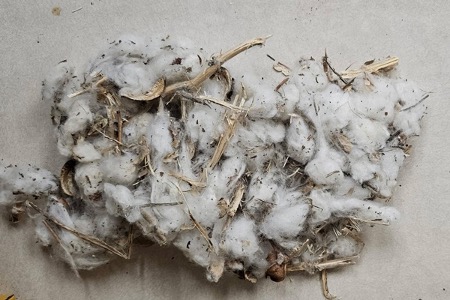
Figure 1. Plant material in harvested cotton with volunteer soybeans can severely impede the ginning process and penalize loan values. Photo courtesy of Rex Friesen, Southern Kansas Cotton Growers.
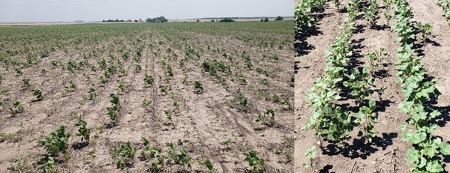
Figure 2. Volunteer soybeans in seedling cotton. Photo courtesy of Rex Friesen, Southern Kansas Cotton Growers.
Volunteer soybean in cotton
If Enlist cotton is planted, Enlist One or Enlist Duo will control volunteer soybeans that are not Enlist soybean varieties. Similarly, in XtendFlex cotton, Stryax or Engenia will control volunteer soybeans that are not dicamba-tolerant. However, there are very few options for controlling volunteer soybeans with the same herbicide-tolerance traits as cotton. Research from North Carolina suggests trifloxysulfuron (Envoke) controls volunteer soybeans. However, Envoke applications to stripper varieties of cotton should be post-directed, not broadcast. In addition, sulfonylurea-tolerant soybeans (STS, Bolt) must be planted in the following spring.
Volunteer cotton in soybean
Like the previous scenario, volunteer XtendFlex cotton can be controlled in Enlist Soybeans with Enlist One or Enlist Duo, and volunteer Enlist cotton can be controlled with Stryax or Engenia in XtendFlex cotton. Research from North Carolina evaluated preemergence and postemergence control of volunteer cotton in soybeans. Preemergence application herbicides that include metribuzin before planting and postemergence applications of flumiclorac (Resource) when volunteer cotton is at the 2 to 3 leaf stage were effective.
Other management options
If an applicator is willing to use hooded or post-directed application equipment, the following contact herbicides can be used to control either volunteer cotton or soybeans, regardless of which of the currently available herbicide-resistance traits are present. Contact herbicides include: carfentrazone (Aim, others), linuron (Lorox, others), or paraquat (Gramoxone, others). In addition, hooded applications of flumioxazin (Valor, others) may be used in cotton.
If volunteers are a significant concern due to harvest conditions the previous year, the best alternative may be to rotate to corn or grain sorghum, which would provide more herbicide options for broadleaf control.
More information about weed management in soybean and cotton can be found in the “2026 Chemical Weed Control for Field Crops, Pastures, and Noncropland” guide at https://www.bookstore.ksre.ksu.edu/pubs/CHEMWEEDGUIDE.pdf or check with your local K-State Research and Extension office for a paper copy.
The use of trade names is for clarity to readers and does not imply endorsement of a particular product, nor does exclusion imply non-approval. Always consult the herbicide label for the most current use requirements.
Sarah Ganske, Extension Weed Science Specialist
slancaster@ksu.edu
Logan Simon, Southwest Area Agronomist, Garden City